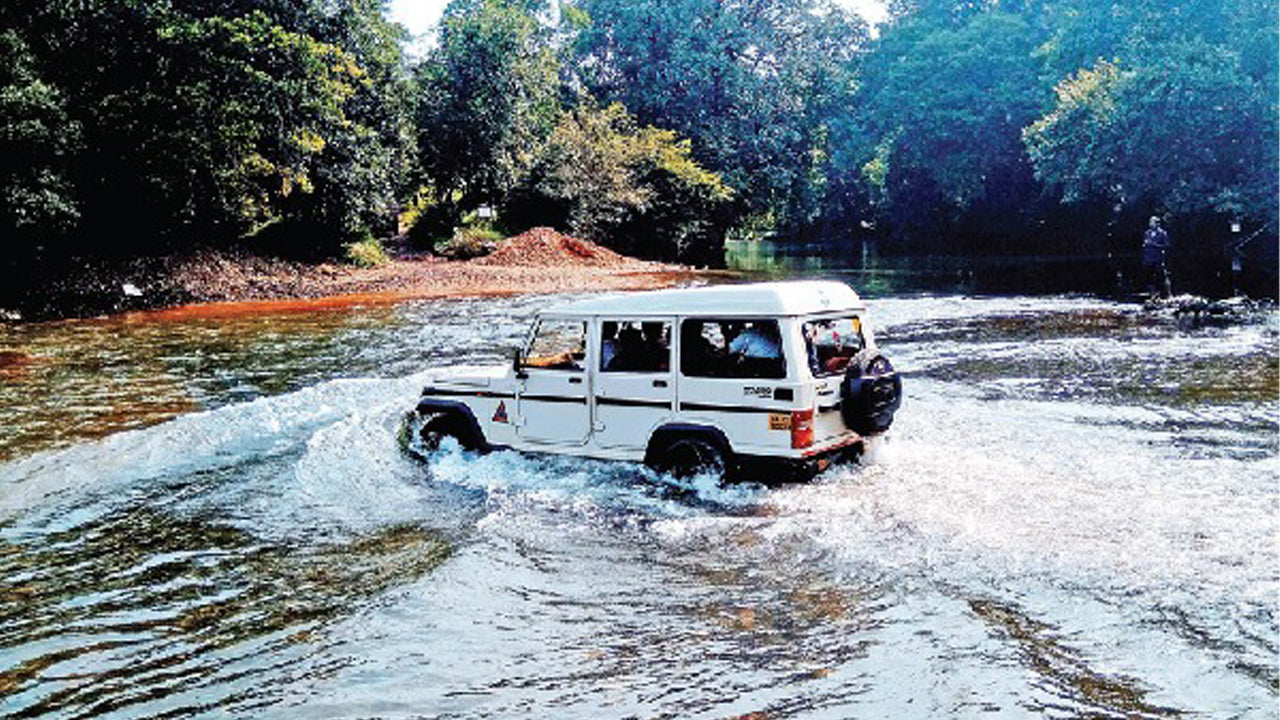
Kolapathana Falls — also written as Kolapathana Ella — is a multi-step waterfall tucked into the highlands above Mandaram Nuwara village in Sri Lanka's Nuwara Eliya District. Fed by a stream originating inside the Pidurutalagala Forest Reserve, the falls descend roughly 50 metres through dense montane vegetation before reaching a rocky base that pools naturally downstream. Because the surrounding forest limits direct sunlight and mist clings to the valley for much of the day, the site has a quiet, almost otherworldly character that sets it apart from better-known cascades in the hill country.
Where exactly is Kolapathana Falls?
The falls lie on the outskirts of Mandaram Nuwara, a small agricultural village that sits at the foot of Pidurutalagala — Sri Lanka's highest mountain. The village sits well above sea level, and its nickname, roughly translated as "the town beneath a rainy sky," reflects the near-constant cloud cover that rolls in from the surrounding peaks. The local economy centres on vegetable cultivation and Ceylon tea cultivation, giving the landscape an orderly patchwork of gardens and small estates.
The nearest significant town is Nuwara Eliya, roughly 10–15 kilometres away depending on the route. Most visitors approach Mandaram Nuwara by road from Nuwara Eliya, either by private vehicle or a local bus that runs infrequently; confirm departure times locally before you travel.
How do I get to Kolapathana Falls on foot?
From the centre of Mandaram Nuwara village, the trail to the falls is approximately 800 metres — a straightforward walk that takes around 20–30 minutes at a comfortable pace. The path climbs gradually through vegetable plots and patches of secondary forest before opening onto the viewpoint above the upper cascade. Trail markers are minimal, so asking a local resident at the village for directions is advisable before you set off.
Footwear with grip is important: the path can be slippery after rain, and the final approach to the falls involves some uneven, root-crossed ground. Light rain gear is worth carrying given the village's reputation for frequent afternoon showers.
What can I see and do at Kolapathana Falls?
The falls themselves are the main draw — a series of steps that accelerate over exposed rock faces before pooling below. Because the stream originates inside a protected forest reserve, the water is notably clear and the surrounding vegetation is largely undisturbed. Bird activity is high along the trail, particularly early in the morning when species typical of cloud forest habitat are easiest to spot.
Swimming directly beneath the upper falls is not permitted: the waterfall serves as a drinking-water source for the Mandaram Nuwara community, and this restriction is enforced out of practical necessity rather than bureaucratic caution. Visitors who want to cool off should continue downstream to the Purahangala Natural Pool, a designated bathing area that offers a pleasant alternative without affecting the village water supply.
- Photography: the mist and dappled light make early-morning visits ideal for photography.
- Birdwatching: the trail corridor is productive for endemic hill-country species.
- Swimming: permitted only at the Purahangala Natural Pool downstream.
- Picnicking: flat ground near the lower pools is suitable, but carry out all litter.
When is the best time to visit Kolapathana Falls?
The falls are most impressive during and immediately after the inter-monsoon and southwest monsoon periods (typically May to August), when stream levels are highest and all steps of the cascade run at full volume. The Nuwara Eliya District receives rainfall during both the southwest and northeast monsoon seasons, so water flow is rarely negligible even in the drier months — though peak flow produces the most photogenic results.
Morning visits are generally clearer; afternoon cloud tends to settle heavily by midday. The period from December through March is popular with domestic tourists escaping the heat of the lowlands, so the trail sees more foot traffic during these months.
How does Kolapathana Falls compare with other waterfalls nearby?
The Nuwara Eliya region is one of the most waterfall-dense parts of Sri Lanka. Hakgedi Ella is another lesser-visited cascade in the broader hill-country area worth combining if you are spending multiple days in the highlands. Further afield, Horton Plains National Park — about an hour's drive — anchors World's End and Baker's Falls within a single protected landscape. The advantage of Kolapathana is precisely its relative obscurity: visitor numbers are low, the setting feels genuinely local, and the short hike from the village is accessible to most travellers without technical hiking experience.
What should I know before visiting?
There are no formal entry fees, ticketing, or visitor facilities at the falls at the time of writing. Equally, there is no on-site cafe or shop, so carry water and snacks from Mandaram Nuwara or Nuwara Eliya. Mobile network coverage can be patchy in the valley.
- Do not bathe under the main falls — it supplies drinking water to the village.
- Take all waste back with you; the area has no managed rubbish collection.
- Ask the local community before exploring beyond the marked trail.
- Check weather forecasts before you go: heavy rain can make the path hazardous and briefly raise the stream to unsafe levels.
Reaching Mandaram Nuwara comfortably is straightforward with a private driver who knows the Nuwara Eliya highlands. Lakpura's private driver network can arrange door-to-door transfers from Nuwara Eliya, Kandy, or further afield, allowing you to set your own schedule rather than relying on infrequent local buses.
Is Kolapathana Falls worth a full-day trip?
For most visitors the falls themselves occupy half a day at most, including the drive from Nuwara Eliya, the hike, time at the pool, and the return journey. The smarter approach is to pair the visit with other attractions in the Nuwara Eliya area: the tea estates of the hill country, the botanical gardens in Hakgala, or a walk through the town's colonial-era architecture. If you are travelling south from Nuwara Eliya toward Ella, the route passes through spectacular highland scenery and several other points of interest, making Kolapathana a logical morning stop before continuing your journey.
Nearby places
12 places within about 25 km, nearest first.
- Bambarakele Rajamaha viharaya2 km
- Damro Labookellie Estate2 km
- Shanthipura2 km
- Victoria Park Nuwara Eliya3 km
- Nuwara Eliya Post Office3 km
- The Grand Hotel, Nuwara Eliya3 km
- Ceylon Tea Regions3 km
- Pekoe Trail3 km
- Udu malaya/ weda hitina maligawa3 km
- Udu malaya/ weda hitina maligawa3 km
- Labookellie Estate4 km
- Ramboda Town4 km
Related reading
6 pages on closely related subjects.