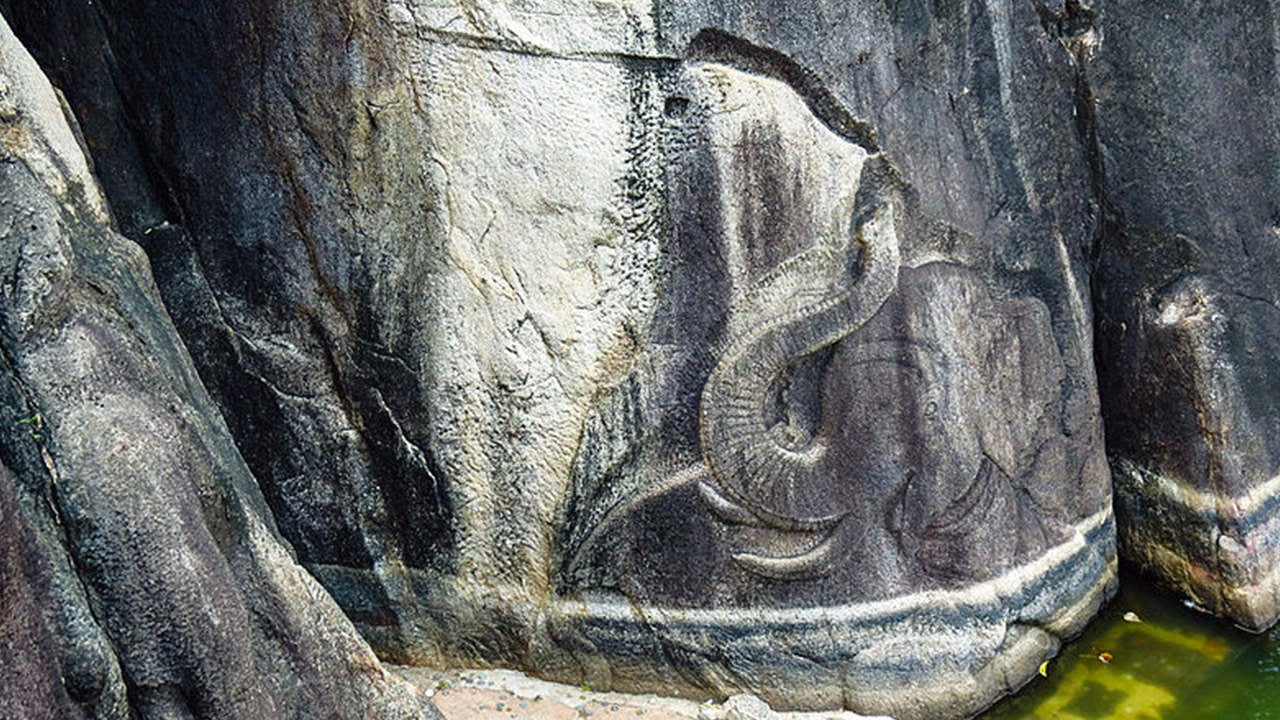


Carved into the granite face of Isurumuniya Rock in Anuradhapura, the Elephant Pond Carving is one of the most quietly compelling sculptural works to survive from Sri Lanka's ancient past. Dating to the 7th century A.D. during the Anuradhapura Period, it depicts four elephants at play in water — a scene rendered with a naturalism and artistic confidence that sets it apart from purely ceremonial temple art.
What does the Elephant Pond Carving show?
The carving portrays four elephants bathing in a pond, their bodies submerged to varying depths, trunks raised or dipping toward the water. The composition has an easy, unhurried quality — less a formal religious statement than a careful observation of animal life. The elephants are shown in low relief, using the technique known in Sanskrit as Ardha Unnata, which sits between fully flat and fully three-dimensional sculpture.
The figures are worked in granite, the same hard stone used for much of Isurumuniya's sculptural programme, and the carving has survived the centuries in recognisable condition. Surrounding rock surfaces and natural pool formations at the site complement the aquatic theme of the relief itself.
How does this carving connect to ancient India?
Art historians note a strong stylistic parallel between the elephant figures here and those found at Mamallapuram (Mahabalipuram) in Tamil Nadu, India — a coastal site celebrated for its open-air rock-cut sculptures produced under Pallava patronage. The Isurumuniya carving is attributed to the Pallava tradition, reflecting a period when artistic ideas moved fluidly across the Palk Strait between the Indian subcontinent and Sri Lanka.
This cross-cultural connection makes the Elephant Pond Carving significant beyond its immediate visual appeal. It is evidence of a living artistic dialogue between two civilisations at a moment when both were producing some of their most accomplished stone work. The Pallava style — characterised by fluid animal forms, rhythmic composition, and sensitive use of natural rock surfaces — is clearly present here, yet the Anuradhapura craftsmen adapted it to local materials and a local sensibility.
Where exactly is the carving located?
The relief is situated at Isurumuniya — more precisely, the Isurumuniya Vihara complex on the southern edge of the Tissa Wewa reservoir in Anuradhapura. The rock itself rises from a natural pool, and the carvings are found on its lower surfaces, accessible from the temple grounds. The site also houses the celebrated Isurumuniya Lovers carving and several other sculptural panels, making it one of the richest small-scale collections of ancient Sri Lankan stone art.
Anuradhapura is the first of Sri Lanka's ancient capitals and a UNESCO World Heritage Site. The Isurumuniya complex sits within the sacred city's protected zone and is actively maintained as a functioning Buddhist temple as well as an archaeological monument.
What are the key facts about this carving?
| Detail | Information |
|---|---|
| Location | Isurumuniya Rock, Anuradhapura |
| Period | Anuradhapura Period |
| Century | 7th century A.D. |
| Artistic tradition | Pallava |
| Medium | Granite |
| Technique | Low relief (Ardha Unnata) |
| Subject | Four elephants bathing |
| Stylistic parallel | Mamallapuram, Tamil Nadu, India |
Why is the Pallava tradition significant in Sri Lankan art?
The Pallava dynasty, centred in southern India between roughly the 4th and 9th centuries A.D., produced a sculptural style that proved remarkably influential across maritime South and Southeast Asia. Their artists excelled at carving directly into living rock, using natural formations as both canvas and subject. The technique brought a sense of emergence and weight to figures that purely constructed sculpture rarely achieves.
At Isurumuniya, the choice to carve elephants — animals that held deep symbolic weight in both Buddhist and broader South Asian traditions — in this naturalistic mode suggests a sculptor fluent in Pallava conventions but working within a Sri Lankan Buddhist context. Elephants appear across Anuradhapura's artistic output in mosaic, fresco, and stone, but the pond carving is distinctive for prioritising behaviour over symbolism: these animals are simply bathing, and the artist found that worth recording.
How does the Elephant Pond Carving compare to other Isurumuniya sculptures?
Isurumuniya's most famous work is the Isurumuniya Lovers, a carving of a seated couple that has attracted extensive scholarly debate about its identity — possibilities range from a prince and his consort to Parjanya (the Vedic rain god) and the earth goddess. The Elephant Pond Carving is less discussed in popular literature but is equally accomplished technically, and its Pallava connections make it the site's most internationally comparative work.
Other panels at the site include a figure of a man seated on a horse, often read as royal imagery, and a carved head rising from foliage. Together, these works suggest Isurumuniya was a site of creative ambition rather than purely devotional function — a place where craftsmen experimented with style, subject, and the possibilities of the granite they were given.
What should visitors know before going?
Isurumuniya Vihara is an active Buddhist temple, so modest dress is required — shoulders and knees should be covered, and shoes removed before entering the main shrine areas. The carvings are partially exposed to the elements, so early-morning visits in the cooler months (roughly December to March) are generally more comfortable. Photography is typically permitted in the outdoor areas; check with temple staff regarding the small museum inside the complex, which houses some of the most important carvings in a climate-controlled setting.
Visitors with an interest in Sri Lanka's relationship with elephants in a living context may also find value in a visit to the Elephant Transit Home in Udawalawe, where orphaned wild elephants are rehabilitated for release — a very different, but complementary, encounter with the animal that inspired this ancient carving.