
The Dambulla Cave Temple — widely called the Golden Temple of Dambulla — is the largest and best-preserved cave-temple complex in Sri Lanka, and one of the most rewarding heritage sites in the country. Recognised as a UNESCO World Heritage Site in 1991, the complex sits atop a granite massif that rises roughly 160 metres above the surrounding plains, making it visible from a considerable distance across the Cultural Triangle.
What is the Dambulla Golden Temple?
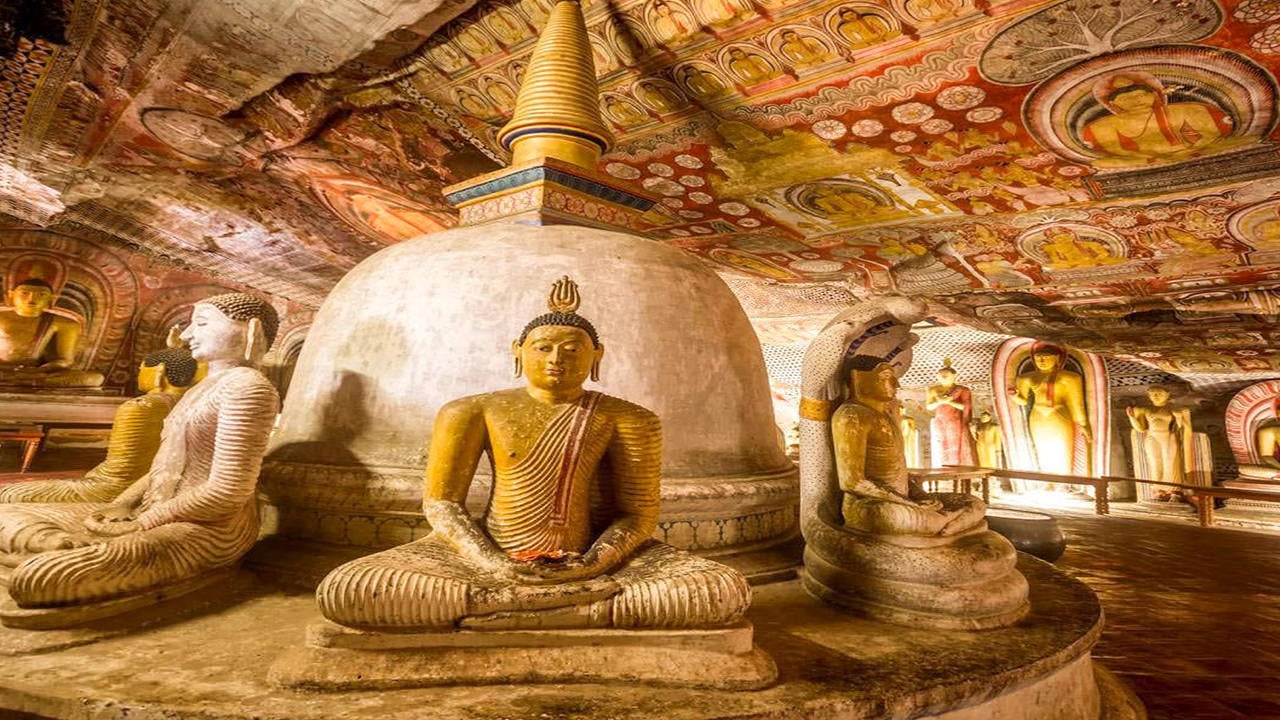
Spread across five caves carved into a single vast overhanging rock, the temple shelters 153 Buddha statues, three statues of Sri Lankan kings, and four images of Hindu deities including Vishnu and Ganesha. The painted ceilings follow the natural contours of the rock with almost no flat surface left undecorated — the murals together cover around 2,100 square metres, forming one of the most extensive continuous fresco schemes in Asia. Subjects include the temptation of the Buddha by the demon Mara, his first sermon at Sarnath, and scenes from the Jataka tales.
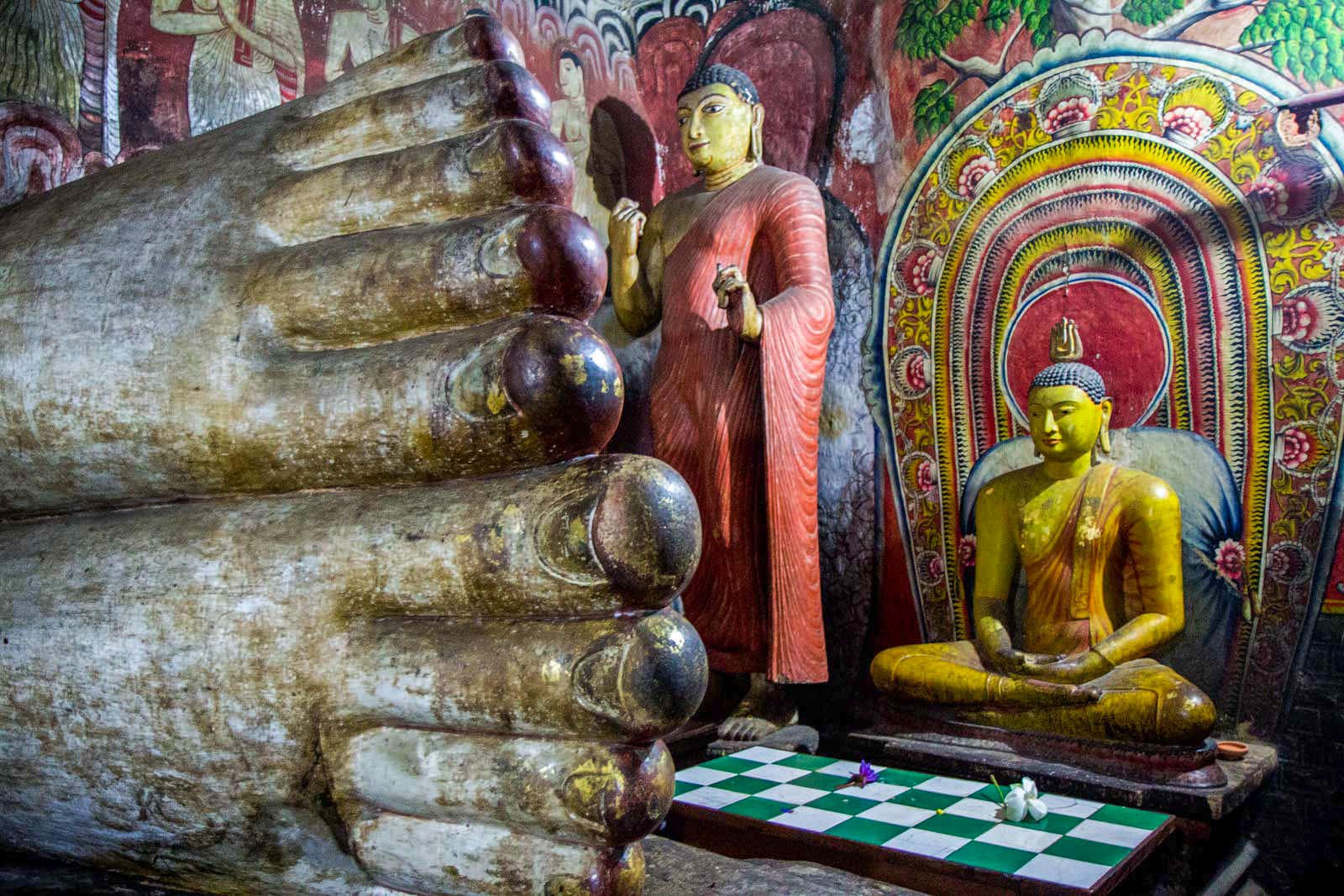
Although the five caves are visited sequentially, each has its own character and patron history. Cave II (Maharaja Viharaya) is the largest and most elaborately decorated, roughly 52 metres wide, and holds 56 Buddha statues beneath the complex's finest painted ceiling. Cave I (Devaraja Viharaya) is dominated by a single monolithic reclining figure believed to be among the oldest in the complex.
How old is the Dambulla Cave Temple?
The rock shelters were inhabited by prehistoric Sri Lankans long before the arrival of Buddhism. Excavations at the nearby site of Ibbankatuwa have uncovered burial grounds with human remains estimated to be around 2,700 years old, suggesting continuous human use of this landscape for millennia.
The cave complex was formally converted into a Buddhist temple in the first century BCE by King Valagamba (also known as Vattagamani Abhaya) of Anuradhapura. Exiled from his capital for roughly 15 years following an invasion from South India, the king took refuge in these caves. On reclaiming Anuradhapura, he returned and consecrated the caves as a place of worship in gratitude. Subsequent monarchs continued to embellish the complex: King Nissanka Malla of Polonnaruwa gilded the caves and added around 70 Buddha statues in 1190 CE. During the 18th century the Kandyan kings oversaw a major restoration and repainting programme. In 1938 arched colonnades and gabled entrances were added to the cave facades, giving the complex its distinctive whitewashed exterior. A drip ledge carved along the full width of the overhanging rock keeps the interiors remarkably dry even during heavy monsoon rains.
What are the five caves at Dambulla?
- Cave I – Devaraja Viharaya (Temple of the Lord of Gods): The earliest cave, dominated by a 14-metre reclining Buddha and an image of the god Vishnu in a separate chamber.
- Cave II – Maharaja Viharaya (Temple of the Great Kings): The largest cave, with statues of King Valagamba and King Nissanka Malla, an intricately painted ceiling, and a stone water cistern fed by natural seepage — the water is said to have never dried up.
- Cave III – Maha Alut Viharaya (New Great Temple): Commissioned by a Kandyan king in the 18th century and notable for a beautifully painted ceiling and a large seated Buddha.
- Cave IV – Pachima Viharaya (Western Temple): A smaller cave with a dagoba (stupa) at its centre; local tradition holds that the dagoba once contained jewellery belonging to Queen Somawathie.
- Cave V – Devana Alut Viharaya (Second New Temple): The most recently added cave, originally used as a storehouse and later converted into a temple; it contains a reclining Buddha and images of local deities.
Where is Dambulla and how do I get there?
Dambulla lies in the North Central Province, approximately 148 km north-east of Colombo, 72 km north of Kandy, and 43 km north of Matale. The most convenient way to reach the temple from Colombo or Kandy is by private car or chauffeur-guided transfer, which also allows you to combine Dambulla with nearby sites such as the Sigiriya Rock Fortress in a single day.
Public buses run regularly between Colombo, Kandy, and Dambulla town, with the cave temple entrance located about 1.5 km from the main bus stand. The climb from the car park to the cave entrances takes around 20 minutes on foot via a broad stone stairway. Shoes must be removed before entering the caves, so wearing sandals makes the visit more practical.
When is the best time to visit Dambulla?
The cave temple is open year-round. The interior caves are naturally sheltered, so rain rarely disrupts a visit. For comfortable climbing conditions, the cooler and drier months from November through April are generally preferable. Early morning visits (the complex typically opens around 7 am) allow you to experience the caves before large tour groups arrive and while the light on the painted ceilings is at its most vivid.
Dambulla falls within the dry zone, so it receives less rainfall than the hill country or the south-west coast. January through April tends to offer the most reliable weather in this part of Sri Lanka.
What should I know before visiting?
- Dress modestly — shoulders and knees should be covered. Sarongs are available for hire at the entrance.
- Remove shoes and hats before entering each cave. Shoe storage is available at the cave entrance level.
- Photography is permitted inside the caves, but flash photography directed at murals is discouraged to protect the pigments.
- A ticket office is located at the base of the rock. Foreign visitor entrance fees are charged; confirm the current rate at the ticket counter or through your tour operator.
- Monkeys inhabit the stairway and summit area. Keep bags closed and avoid eye contact or offering food.
- Guided tours are available and add significant context — the iconography is dense and a knowledgeable tour guide can explain the narrative sequences painted across the ceilings.
What else is near the Dambulla Cave Temple?
Dambulla sits at the heart of Sri Lanka's Cultural Triangle, making it an ideal base for exploring several major World Heritage Sites. Sigiriya, the ancient rock citadel, is around 20 km to the north-east. The medieval city of Polonnaruwa lies roughly 65 km to the north-east, while Anuradhapura — Sri Lanka's first ancient capital — is around 65 km to the north-west. The Minneriya National Park, famous for its seasonal elephant gatherings, is within an hour's drive. The Habarana area nearby also offers elephant-back rides and village cycle tours.
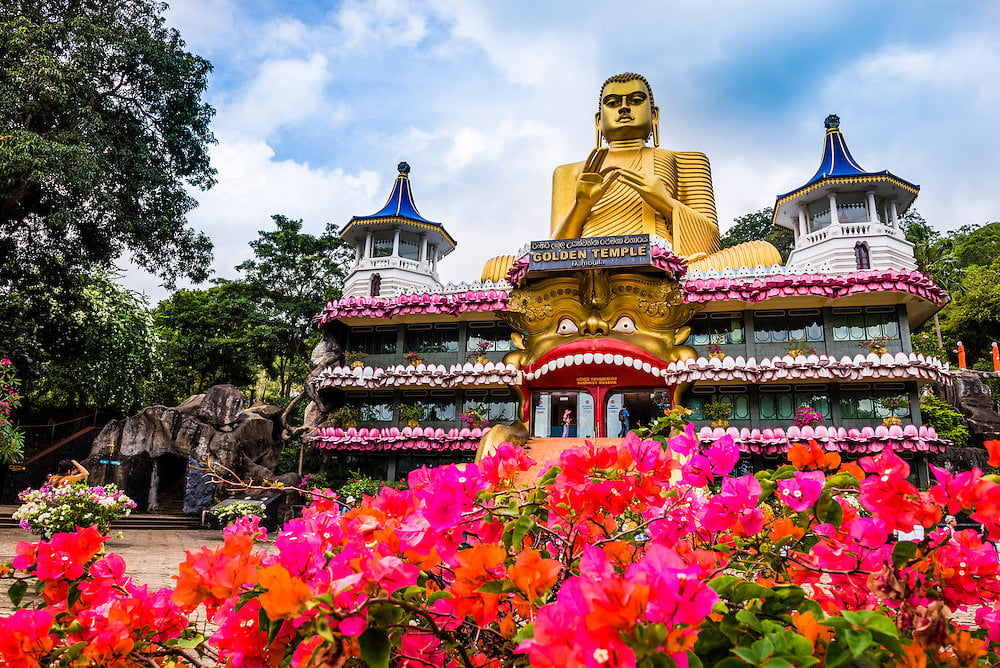
Below the rock, the Golden Temple complex includes a large golden-coloured seated Buddha statue visible from the main road and a newer temple building with a small museum that provides historical context for the site's conservation history.
Conservation and living heritage
The Dambulla cave monastery remains an active place of worship today — monks still reside in the complex, and daily offerings and religious ceremonies take place inside the caves. Conservation work since the 1960s has focused on cleaning the murals and applying protective coatings, with ongoing efforts since the 1980s concentrating on structural integrity and preventing moisture ingress. The coexistence of active religious practice and heritage tourism makes Dambulla one of the most culturally alive sites in Sri Lanka, rather than simply a monument.


