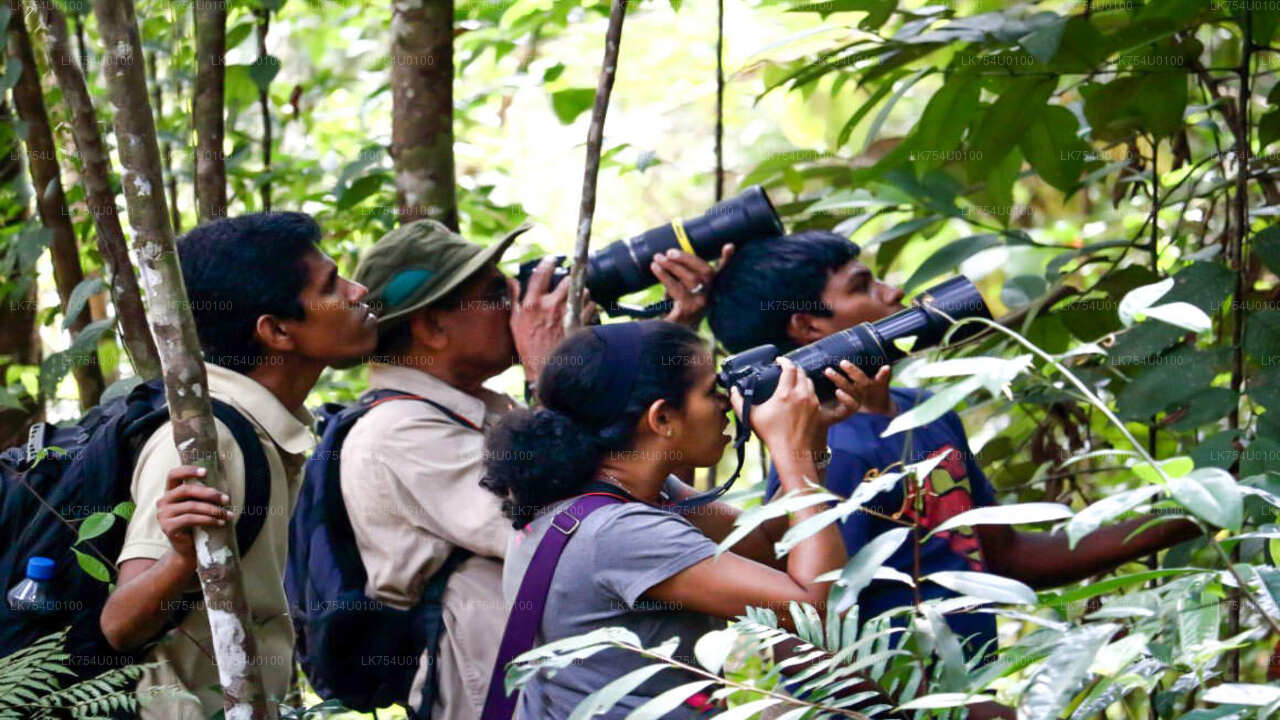
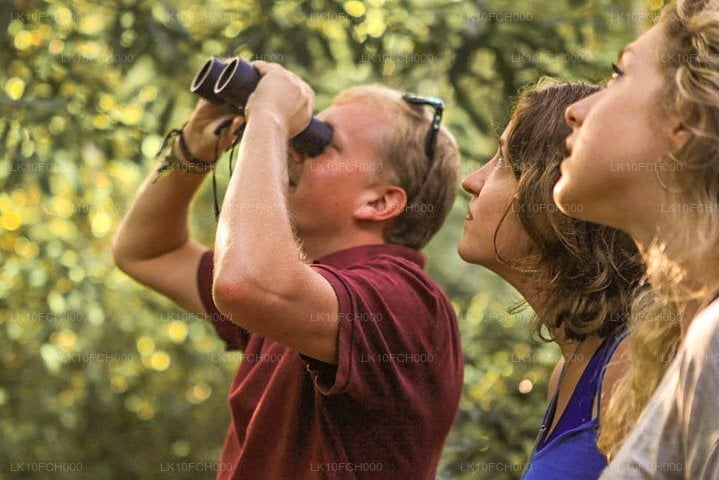
Sinharaja Forest Reserve is Sri Lanka's last substantial tract of lowland tropical rainforest — a UNESCO World Heritage Site and an International Biosphere Reserve. For birdwatchers, it represents something rarer still: a living stronghold for species that exist nowhere else on earth. Of the 26 birds endemic to Sri Lanka, around 20 have been recorded within Sinharaja's boundaries, making it arguably the single most productive birdwatching site the island offers.
What bird species can I see at Sinharaja?
The forest holds an impressive roster of endemics alongside widespread South Asian species. What follows are the birds most consistently encountered on guided walks.
- Sri Lanka Blue Magpie — Perhaps the most photographed bird in the forest. This corvid moves noisily through the mid-storey in small, raucous flocks and is frequently the anchor species in mixed feeding parties.
- Sri Lanka Junglefowl — The national bird, seen scratching through leaf litter at the forest edge, especially in early morning. Males display intensely coloured plumage and a call that carries far through the trees.
- Red-faced Malkoha — A cuckoo family member with a crimson facial patch and long graduated tail. Patient and quiet observers tend to find it perched motionless in dense undergrowth.
- Green-billed Coucal — This large, ground-frequenting endemic is often heard before it is seen: a deep, resonant call echoes upward from the valley floors.
- Sri Lanka Scaly Thrush — An elusive, scarce bird that forages on the forest floor. Its mottled plumage blends almost perfectly with decomposing leaf litter.
- Yellow-fronted Barbet — Small and conspicuously marked, this endemic barbet announces itself with repetitive calls from fruiting trees and forest-edge vegetation.
- Malabar Trogon — Not endemic but spectacular. Males show deep crimson underparts and a finely barred back; they sit quietly for extended periods, making them rewarding to observe once located.
- Spot-winged Thrush — A near-endemic that forages on the ground along shaded trails, often allowing surprisingly close approach.
- Sri Lanka Spurfowl — Heard far more often than seen, this endemic galliform produces a harsh, repetitive call that is one of the defining sounds of the Sinharaja dawn.
- Legge's Flowerpecker — Tiny and fast-moving, this endemic frequents the canopy of fruiting trees and is easy to overlook without a guide pointing out its high-pitched calls.
Beyond endemics, Sinharaja supports a wide range of other species: Crested Serpent Eagle, Oriental Dwarf Kingfisher, and multiple species of bulbul, drongo, and babbler are all regularly recorded. The Sinharaja Forest Reserve as a whole has been documented to hold over 160 bird species in total.
When is the best time to visit Sinharaja for birdwatching?
Timing matters, both within the day and across the year.
Time of day: Activity peaks in the two hours after dawn. Mixed-species feeding flocks — a hallmark of Sinharaja — form in the early morning and move through the forest in a loose, extended wave. Arriving at the forest entrance by 6:00–6:30 a.m. gives you the best chance of following one of these flocks for an extended period. A second, shorter burst of activity typically occurs in the late afternoon.
Season: The months from December through March correspond to the drier inter-monsoon and northeast monsoon period in this part of Sri Lanka. Rain is lighter and more predictable, trails are less slippery, and visibility through the canopy tends to be better. That said, Sinharaja receives rainfall year-round — the forest is always wet to some degree — so a waterproof layer is advisable on any visit. The southwest monsoon (May to September) brings heavier, more sustained rainfall to the area, which can suppress bird activity and make trails difficult.
How do I get to Sinharaja from Colombo?
Sinharaja is located in the Sabaragamuwa and Southern provinces, roughly 150 km southeast of Colombo. The most common access point for birdwatchers is the Kudawa entrance near Weddagala, reachable via Ratnapura. A second entrance at Deniyaya in the south offers access to a different section of the forest and is often used by those staying in that area. Both routes involve mountainous roads during the final stretch; a private vehicle with an experienced driver is strongly recommended. Typical driving time from Colombo is around four hours, depending on traffic.
Do I need a guide for birdwatching in Sinharaja?
A local field guide is not legally mandatory but is effectively essential. The forest interior is dense and trails are not always well marked. More importantly, experienced local naturalists know the territories of resident species, can identify birds by call alone, and are skilled at locating mixed feeding flocks — the encounters that define a Sinharaja visit. Several guides based near the Kudawa and Deniyaya entrances have decades of field experience and maintain detailed personal records of sightings, which they use to plan routes on a given day.
Guides also help manage the leech situation: Sinharaja's floor is home to a significant leech population, particularly after rain. A good guide will advise on footwear and preventive measures before you set off.
What practical preparations should birdwatchers make?
- Binoculars: A mid-range 8×42 or 10×42 pair is ideal. The canopy is often 30–40 metres overhead and mixed flocks move fast.
- Field guide: A Photographic Guide to the Birds of Sri Lanka by Deepal Warakagoda et al. is the standard reference used by visiting birders.
- Clothing: Neutral, muted colours (olive, grey, brown). Long sleeves and trousers for leech and insect protection. Waterproof footwear with good ankle support.
- Leech socks or gaiters: Available locally near the park entrances; advisable for anyone without experience in tropical forests.
- Rain gear: A light packable poncho or rain jacket — afternoon showers can arrive without much warning.
- Patience: Sinharaja rewards those who are willing to stop and wait. The biggest mistake is walking too fast.
Where should I stay for a multi-day birdwatching visit?
A single day trip from Colombo allows for one early-morning session, which is rewarding but limiting. Serious birders typically spend two to three nights near the forest to cover different trail sections and catch multiple dawn sessions. Accommodation options range from simple guesthouses near the Kudawa entrance to more comfortable ecolodge-style properties near Deniyaya. Staying close to the forest also removes the need for a long pre-dawn drive, so you arrive rested and on time for the best hours.
For those interested in a broader wildlife itinerary, Horton Plains National Park — a highland grassland and cloud-forest reserve to the northeast — offers a complementary set of montane and near-endemic species and pairs naturally with a Sinharaja visit.
Is Sinharaja suitable for beginner birdwatchers?
Yes, with the right expectations. A guided morning walk with an experienced local naturalist is accessible to anyone with a general interest in wildlife, regardless of prior birding experience. The guides are accustomed to working with mixed groups and will pace the walk accordingly. That said, the forest floor can be uneven, paths are sometimes steep, and humidity is high; a reasonable level of fitness makes the experience more enjoyable. Visitors with deeper ornithological knowledge will get additional value from a longer stay and the chance to discuss species identification in more detail with their guide.
Nearby places
11 places within about 25 km, nearest first.
- Sinharaja Forest Reserveunder 1 km
- Sinharaja Rain Forestunder 1 km
- Sinhagala3 km
- Gongala4 km
- Gal Oruwa Ella Falls4 km
- Pathan Oya Ella4 km
- Kekuna Ella6 km
- Lumbini Tea Estate7 km
- Rakwana8 km
- Suriyakanda City14 km
- Goraka Ella Falls14 km