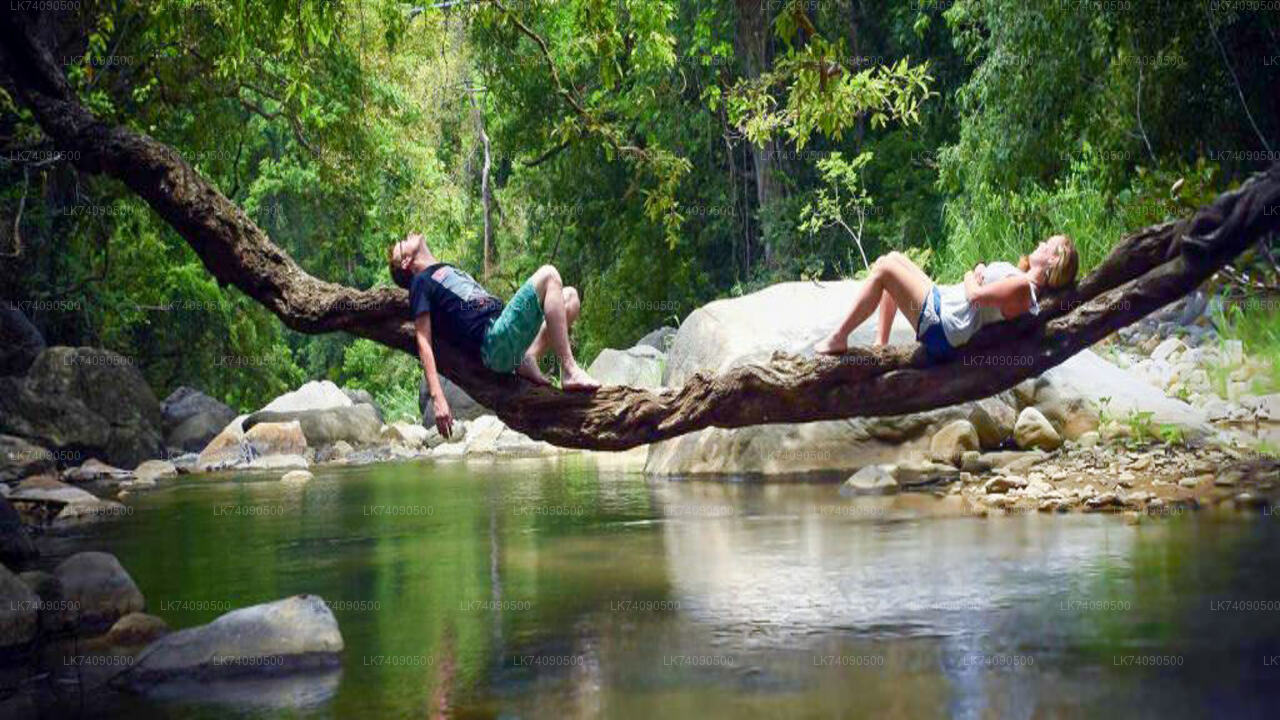
Goraka Ella Falls sits quietly in the lowland rainforest near Nivithigala, in the Ratnapura District of Sri Lanka's Sabaragamuwa Province. Fed by the Kuru Ganga — a tributary of the Kalu Ganga — the waterfall spills over a rocky ledge into a shaded pool below, trailing a fine mist that keeps the surrounding vegetation vivid and cool. For travellers prepared to venture off the main tourist circuit, it offers genuine solitude and an unmediated encounter with Sri Lanka's wet-zone forest.
What makes Goraka Ella Falls worth visiting?
Unlike the well-signposted falls that draw large weekend crowds, Goraka Ella remains largely untrafficked. The approach threads through a working landscape of rubber plantations and small-holdings before the forest closes in and the sound of the river grows louder. Arriving at the falls feels like a discovery rather than a scheduled stop on an itinerary.
The waterfall itself is modest in height but consistent in flow throughout most of the year, with the strongest cascade typically arriving during and just after the south-west monsoon (May to August). The pool at the base is shallow enough to wade in on calmer days, and the flat rocks nearby provide natural spots to rest and observe the birdlife that congregates around moving water.
What wildlife and plants can be seen around Goraka Ella?
The forest surrounding the falls forms part of the broader wet-zone lowland ecosystem that connects to the Sinharaja Forest Reserve, Sri Lanka's UNESCO-listed rainforest. While Goraka Ella's immediate surroundings are not primary forest, the secondary growth supports a meaningful range of species. Birdwatchers regularly note kingfishers, white-throated kingfishers, and several endemic species of bulbul. Purple-faced langurs are occasionally spotted in the canopy, and the undergrowth harbours land monitors and a variety of frogs.
The plant life is typical of Sri Lanka's wet lowlands: wild ginger, begonias, mosses carpeting the spray zone, and towering jak trees providing a dense canopy. Rubber trees — their bark scored in diagonal lines — frame much of the access trail, a reminder that this landscape has been shaped by both nature and agriculture.
When is the best time to visit Goraka Ella Falls?
The falls are accessible year-round, but flow and atmosphere vary significantly by season. The south-west monsoon (May to August) brings the heaviest rainfall to Ratnapura District, swelling the Kuru Ganga and producing the most dramatic cascade. However, trails can become slippery and river crossings unpredictable during peak monsoon weeks.
- December to March: Dry, pleasant conditions; lower water volume but easy walking.
- April to May: Transitional period; occasional showers freshen the forest without making paths dangerous.
- June to August: Peak flow; the falls are at their most impressive, but come prepared for rain.
- September to November: Inter-monsoon showers keep the forest green; a comfortable middle ground.
Early morning visits are consistently rewarding. Mist lingers in the valley, the light filters softly through the canopy, and the birdlife is most active in the first two hours after dawn.
How do I get to Goraka Ella Falls from Colombo or Ratnapura?
Ratnapura town is the nearest significant hub, roughly 100 km from Colombo along the A4 highway — a journey of around two and a half to three hours by car depending on traffic through the Sabaragamuwa lowlands. From Ratnapura, the road south towards Nivithigala covers approximately 25–30 km; the village is reachable by private car or local bus.
The final section of the route to the falls involves a narrower track, and local guidance is strongly recommended for first-time visitors. Hiring a tuk-tuk from Nivithigala with a driver who knows the area is a practical option and supports the local economy. A four-wheel-drive vehicle is advisable during or immediately after heavy rain.
| Starting point | Distance (approx.) | Estimated travel time |
|---|---|---|
| Colombo | ~130 km | 3–3.5 hours by car |
| Ratnapura | ~30 km | 45–60 minutes by car |
| Nivithigala | ~5–8 km | 20–30 minutes by tuk-tuk or foot |
What should I bring and how should I prepare?
Because the site has no formal visitor infrastructure — no ticket booth, refreshment stall, or maintained path — independent preparation matters more here than at managed attractions.
- Wear sturdy grip shoes or trail sandals; the rocks near the falls are consistently wet.
- Carry enough drinking water for the full round trip, as no facilities exist on site.
- A light rain jacket is useful at any time of year in Ratnapura District.
- Bring a small first-aid kit and insect repellent.
- Respect the surrounding farmland — ask permission before crossing private land and leave no litter.
Photography is rewarding in the spray zone, but protect camera equipment from moisture. A polarising filter significantly improves results in the mist-heavy light around the plunge pool.
Is Goraka Ella Falls suitable for a combined day trip?
Yes, and the Ratnapura District rewards itinerary planning. The Hakgedi Ella Waterfall is another lesser-known cascade within the broader region that pairs naturally with a visit to Goraka Ella for travellers specifically interested in Sri Lanka's hidden waterfalls. The Sinharaja Forest Reserve, roughly an hour south of Ratnapura, is a logical second destination for nature-focused visitors who want to extend time in the wet zone.
For those based in Colombo, combining Goraka Ella with a gem-market visit in Ratnapura — the country's sapphire and ruby trading centre — rounds out a full day without back-tracking significantly. The district's working gemstone pits are an unexpected addition to an eco-tourism day.
What is the conservation status of the area around the falls?
Goraka Ella is not within a gazetted national park or strict nature reserve, which is one reason it remains informal and undeveloped. The surrounding land is a mixture of private agricultural holdings and community forest. Local conservation interest has grown alongside general eco-tourism awareness in the region, and community groups in Nivithigala have periodically discussed formalising trail maintenance and litter management. Visitors who travel responsibly — carrying out waste, staying on established paths, and engaging local guides — directly contribute to the case for keeping the falls accessible in the long term.
Nearby places
8 places within about 25 km, nearest first.
- Budugala8 km
- Kalawana City9 km
- Katugas Ella Falls12 km
- Sinharaja Forest Reserve14 km
- Birdwatching at Sinharaja Rainforest14 km
- Gongala14 km
- Kirindi Ella14 km
- Sinharaja Rain Forest14 km