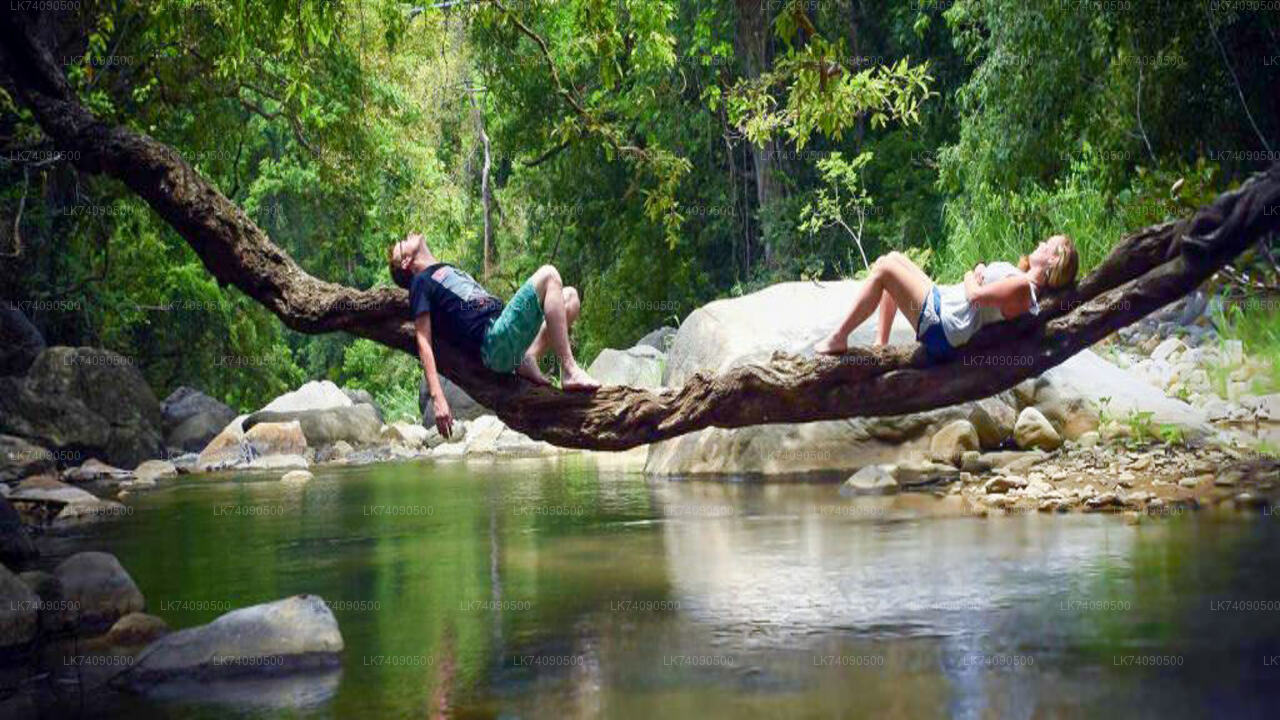
Katugas Ella Falls is one of Ratnapura District's quieter rewards — a 6-metre cascade tucked inside the dense forest of Kospelawinna that most travellers never find. The waterfall sits on the Katugas Ela stream, which draws its water from the monsoon-drenched southern slopes of Minuwangala mountain before eventually merging with the Kalu Ganga river below. Because it sits off the main tourist trail, the site stays calm even during Sri Lanka's busiest travel seasons.
What makes Katugas Ella Falls worth visiting?
The falls splits into two distinct stages. The lower section — roughly a metre in height — is the first thing you encounter, and many visitors mistake it for the whole waterfall and turn back. Persevere past that point and the terrain opens to the main drop: a clean, full-faced plunge of around 6 metres into a natural rock pool. The pool at the base is wide and calm enough for bathing, and smaller pools along the stream offer additional spots to cool off. The forest surrounding the falls belongs to the wet zone and shelters a dense understorey of ferns, mosses, and native tree species, giving the approach walk its own quiet character.
How do I reach Katugas Ella Falls?
The waterfall is located in the Kospelawinna area of Ratnapura District in Sabaragamuwa Province. Ratnapura town is the most practical base; from there, a vehicle with reasonable ground clearance is advisable for the final approach road. The last stretch to the falls involves a short but uneven trail on foot over rocks and roots. Sturdy footwear, a change of clothing if you plan to swim, and enough drinking water for the return walk are all worth packing. There are no formal facilities — no ticketing booth, no café, no signage at the trailhead — so asking locally for directions in Kospelawinna is strongly recommended.
When is the best time to visit Katugas Ella Falls?
The falls flows most powerfully after the south-west monsoon (May to September), when Minuwangala's slopes receive heavy rainfall and the Katugas Ela runs high. Visiting in the weeks immediately following heavy rain gives the most dramatic flow, but the trail can be slippery and the rocks at the base are submerged. The inter-monsoon months of October and March through April tend to offer a balance: reasonable water volume and more manageable trail conditions. During the dry months of January and February the flow diminishes noticeably, though the pools remain swimmable.
What should I know before trekking to the falls?
- The path to the upper falls requires scrambling over wet rocks — take your time and test each foothold.
- Leeches are common in the wet zone forest, particularly after rain. Wearing long socks and carrying salt or a leech repellent is sensible precaution.
- There is no mobile signal at the waterfall itself; download offline maps before leaving Ratnapura.
- The site has no entry fee and no ranger presence, so carry all rubbish out with you.
- Swimming in the main pool is generally safe, but avoid entering immediately after heavy rain when currents can be deceptively strong.
What else can I explore in the Ratnapura area?
Ratnapura District sits on the edge of Sri Lanka's wet zone and rewards travellers who look beyond the town's famous gem trade. The Sinharaja Forest Reserve, a UNESCO World Heritage Site, lies within reach to the south and represents one of the last significant areas of primary lowland rainforest in the country. Birdwatchers, botanists, and anyone interested in Sri Lanka's endemic species will find the region exceptionally productive. Combining a visit to Katugas Ella with a day in Sinharaja is one of the more satisfying itineraries available in Sabaragamuwa Province.
Is Katugas Ella Falls suitable for families and casual walkers?
The lower section of the falls is accessible to most reasonably fit walkers and makes a pleasant short excursion on its own. Reaching the upper, 6-metre drop requires more care — the rock scramble is short but demands confidence on uneven, potentially wet surfaces. It is not suitable for very young children or anyone with mobility difficulties. Teenagers and adults comfortable with light hiking will manage the full route without specialist equipment, provided the trail is dry.
How does Katugas Ella compare with other waterfalls in Sri Lanka?
At 6 metres, Katugas Ella is modest in height compared with Sri Lanka's tallest cascades, but its appeal lies in seclusion rather than scale. Unlike heavily visited falls such as Dunhinda or Diyaluma, you are unlikely to share the pools here with a crowd. The two-stage layout — where the upper falls is effectively hidden from the approach path — gives the site an exploratory quality that more accessible destinations rarely retain. For travellers who enjoy the process of finding a place as much as arriving at it, Katugas Ella delivers.
Nearby places
11 places within about 25 km, nearest first.
- Budugala4 km
- Hunuwella Estate4 km
- Pahangala4 km
- Sabaragamuwa Dance7 km
- Opata Estate7 km
- New Vithanakande7 km
- Martin's Simple Lodge8 km
- Sts. Peter and Paul Cathedral8 km
- Kalawana City8 km
- Goraka Ella Falls12 km
- Fahian Cave22 km