


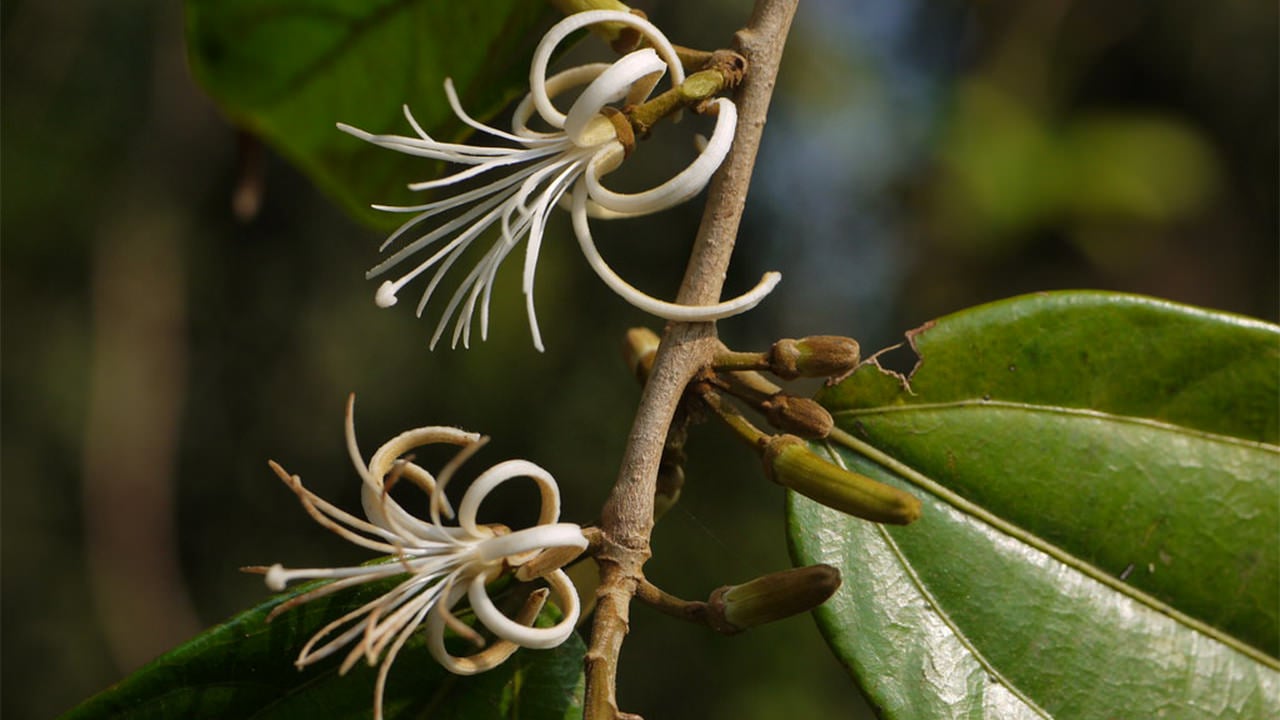


Alangium salviifolium, widely known as the sage-leaved alangium, is a small flowering tree with a long history of use in traditional medicine, woodcraft, and everyday rural life across South and Southeast Asia. In Sri Lanka it is part of the official catalogue of Ayurvedic medicinal plants, where it has been valued for centuries as a remedy for a range of ailments. The species goes by many regional names: Ankolam in Malayalam, Ankola in Kannada, Akola or Ankol in Hindi, and Alanji in Tamil.
What does Alangium salviifolium look like?
The sage-leaved alangium is a bushy, compact tree with a short trunk and a dense, spreading canopy. Its leaves are simple, alternate, and oblong-lanceolate — broadly similar in shape to those of the culinary sage, which gives the tree its common name. Stunted lateral branches taper to sharp points that resemble thorns, giving the tree a slightly formidable appearance up close.
Flowers are white and notably fragrant, emerging from green buds. The petals curl sharply backwards at maturity, exposing a cluster of stamens and a slender, protruding stigma — an arrangement that is easy to recognise in the field. Fruits are round, berry-like, and ripen to a deep red; the remnants of the calyx remain visible at the tip of each fruit as a distinctive pale collar.
Taxonomically the species is classified within the family Cornaceae, a placement that aligns it with dogwoods and related plants rather than the tropical families it superficially resembles.
Where is Alangium salviifolium found in Sri Lanka?
In Sri Lanka, A. salviifolium occurs naturally in the dry and intermediate zones, often in scrub forests, along roadsides, and on the margins of agricultural land. It is tolerant of poor, rocky soils and periodic drought, which makes it well suited to the dry lowland plains that cover much of the island's north, north-west, and south-east interior. Populations can also be encountered in similar habitats across peninsular India, where the tree is widespread in dry plains and low hill country.
Visitors exploring Wilpattu National Park in the north-west may notice the sage-leaved alangium among the scrub vegetation that characterises the park's wewa (tank) margins and open forest patches — an environment that closely mirrors the species' preferred habitat.
What are the traditional and Ayurvedic uses of Alangium salviifolium?
Ayurvedic practitioners in Sri Lanka and India have long drawn on almost every part of this tree. The roots and fruits are the most medicinally significant, and they have historically been prescribed for rheumatism and haemorrhoids. Root bark preparations are used externally to address skin disorders and are regarded in some traditions as an antidote for snakebite.
The root bark is also employed as an anthelmintic — a remedy used to expel parasitic flatworms (Platyhelminthes) and other internal parasites — and as an emetic and purgative when required. The plant is additionally applied externally in the management of animal bites, including those from rabbits, rats, and dogs. These applications place A. salviifolium alongside better-known Ayurvedic plants such as Pongamia pinnata in Sri Lanka's traditional pharmacopoeia.
Contemporary pharmacological research has begun investigating the bioactive compounds responsible for these traditional claims, particularly alkaloids isolated from the root bark, though clinical validation for most applications remains limited and patients should always consult a qualified Ayurvedic or medical practitioner before use.
How is Alangium salviifolium used in woodcraft and daily life?
Beyond medicine, the tree offers practical utility in several directions. Its wood is described as hard and close-grained, which allows a good finish and makes it suitable for ornamental carving, pestles, and rollers. It is also used as fuel wood in rural communities where alternatives are scarce.
- Furniture and musical instruments: The hardness of the timber is considered appropriate for small furniture pieces and certain musical instruments.
- Toothbrushes: In parts of India, thin twigs are traditionally used as chewing sticks for oral hygiene — a practice common to many South Asian tree species.
- Defensive use: In Kenya, where related species occur, the naturally sharpened stem ends have reportedly been used as spear shafts, illustrating the cross-cultural utility of plants with similar physical properties.
Is Alangium salviifolium related to other plants in the same region?
Sri Lanka hosts a rich diversity of woody plants with overlapping medicinal and economic uses. The sage-leaved alangium occupies a similar ecological niche to dry-zone species such as Acacia chundra, sharing the same scrubland habitats and a similar dual role as both a medicinal and a timber resource. Both species are documented in Sri Lanka's Ayurvedic plant catalogues, reflecting the island's extraordinary concentration of traditional botanical knowledge within a relatively small landmass.
Sri Lanka's dry-zone forests — threatened by agricultural expansion and climate variability — shelter many such specialist species. Conservation of these ecosystems is therefore inseparable from the preservation of the living pharmacopoeia they contain.
What is the conservation status of Alangium salviifolium?
The species is not currently considered globally threatened; its wide distribution across South and Southeast Asia and its tolerance of disturbed habitats give it a degree of resilience. Within Sri Lanka, however, dry-zone scrub forests face ongoing pressure from land clearance, and populations of slower-maturing timber-yielding trees can decline locally before broader assessments reflect the change. Sustainable harvesting of root bark — the most commercially exploited part — is an ongoing concern raised by practitioners of traditional medicine.
How does Alangium salviifolium fit into Sri Lanka's broader botanical heritage?
Sri Lanka's Ayurvedic tradition is among the oldest continuously practiced medical systems in Asia, codified in texts such as the Sarartha Sangrahaya and still actively taught and licensed today. The inclusion of A. salviifolium in the government-recognised catalogue of Ayurvedic medicinal plants reflects its continued relevance to that tradition rather than mere historical curiosity.
For travellers interested in the intersection of ecology and traditional knowledge, Sri Lanka offers immersive experiences — from guided walks in forest reserves to visits to Ayurvedic gardens — that bring plants like the sage-leaved alangium out of textbooks and into direct sensory experience. The Sinharaja Forest Reserve, although primarily a wet-zone rainforest, exemplifies the depth of Sri Lanka's botanical heritage and the country's commitment to protecting it.
