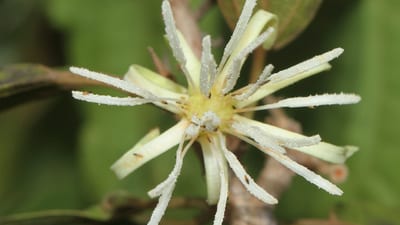
Calotropis gigantea, commonly known as the crown flower, is a large flowering shrub widespread across South and Southeast Asia. In Sri Lanka it grows naturally in dry lowland areas, roadsides, and disturbed scrubland, where it has been recognised for centuries both as a medicinal plant and as a culturally significant species. The plant is formally catalogued in the Ayurvedic medicinal plants of Sri Lanka — a designation that reflects its long-standing role in traditional healing practice on the island.
What does Calotropis gigantea look like?
The plant is a large, fast-growing shrub that can reach up to 4 m (around 13 ft) in height. Its stems are notably pale and exude a milky white latex when cut. Leaves are oval, light green, and have a slightly waxy texture. The most distinctive feature is its flowers: small clusters of five-pointed, waxy petals — either white or soft lavender — each carrying a central "crown" structure that gives the plant its common name. That crown encases the stamens and is what makes the blossom instantly recognisable.
The floral arrangement follows a valvate aestivation pattern, meaning the sepals and petals in each whorl meet edge-to-edge without overlapping. This botanical detail is often cited in South Asian plant taxonomy as a defining characteristic of the genus Calotropis.
Where does the crown flower grow in Sri Lanka?
Calotropis gigantea is distributed broadly across the dry and intermediate zones of Sri Lanka, favouring open, sunny conditions and tolerating poor, sandy soils. It is a common sight along roadsides in the North Central and North Western provinces and appears near coastal areas and scrub forests. The plant's drought tolerance and vigorous growth make it a pioneer species in disturbed habitats.
Visitors exploring dry-zone destinations such as Wilpattu National Park may encounter crown flower shrubs growing on the margins of tank bunds and forest edges, where the pale stems and lavender blooms stand out against the surrounding dry scrub.
What compounds are found in Calotropis gigantea?
The plant's latex is chemically complex. Documented constituents include:
- Cardiac glycosides — bioactive compounds that affect heart muscle function and are common in plants used in traditional medicine systems.
- Fatty acids — contributing to the plant's anti-inflammatory properties investigated in laboratory settings.
- Calcium oxalate — a mineral compound found in many plant latexes, which can cause skin irritation on direct contact.
- Calotropone — a compound isolated from the roots, specific to the genus.
Because the latex contains potent bioactive compounds, handling the plant with bare skin warrants caution. The milky sap is an irritant and should not be ingested.
How is Calotropis gigantea used in Ayurveda?
In Sri Lankan and South Asian Ayurvedic tradition, different parts of the plant are assigned different therapeutic roles. The root and leaf have historically been used in preparations for respiratory conditions including asthma and shortness of breath, as well as for bacterial infections, inflammation, and skin complaints such as boils. The bark has traditionally been applied in formulations associated with liver and spleen disorders.
A broader range of folk applications is documented across the plant's range. These include use of the latex against arthritis and as a traditional antidote for snakebite, and the plant has been applied historically in the treatment of fevers, nausea, vomiting, diarrhoea, and conditions such as elephantiasis. It is worth noting that most of these uses are rooted in folk medicine and ethnobotanical records; robust clinical trials confirming efficacy across these applications remain limited.
Sri Lanka's Ayurvedic tradition also includes compound formulations that draw on plants with similar profiles. The Yogaraja Guggulu formulation, for instance, illustrates how classical Ayurveda combines multiple botanical sources to address musculoskeletal and inflammatory conditions.
What does current research say about Calotropis gigantea?
Scientific interest in the crown flower has grown considerably in recent decades. Several lines of active research are worth understanding:
- Anti-cancer properties: Laboratory studies using dichloromethane (DCM) extracts of Calotropis gigantea have shown strong cytotoxic effects against non-small cell lung carcinoma (A549), colon carcinoma (HCT 116), and hepatocellular carcinoma (Hep G2) cell lines. These are preliminary in-vitro findings and clinical trials in humans are needed before any medical conclusions can be drawn.
- Calotropin as a contraceptive: Some studies have explored the compound calotropin — isolated from the plant's latex — for potential contraceptive applications. This research is still at an early stage.
- Antimicrobial and anti-inflammatory activity: Multiple studies report antimicrobial effects against a range of bacterial strains, which lends some scientific credence to traditional uses involving infection and inflammation.
Researchers and practitioners consistently note that while the plant's bioactive compounds show significant promise across several therapeutic areas, further peer-reviewed clinical research is required before any of these applications can be recommended as medical treatments.
What is the cultural significance of the crown flower in Sri Lanka?
Beyond its medicinal associations, Calotropis gigantea carries cultural weight in Sri Lanka and across the Indian subcontinent. The flowers are used as religious offerings in Hindu and Buddhist traditions, appearing in temple garlands and ceremonial contexts. In parts of South Asia, the flower is associated with particular deities, making it a plant with both spiritual and therapeutic dimensions.
In rural Sri Lanka, the plant is sometimes planted as a boundary marker and its lightweight wood and fibrous stem have been used in cottage crafts. The broad ecological role it plays — providing nectar to butterflies and supporting dryland fauna — makes it a small but notable part of Sri Lanka's dry-zone ecosystem.
Is the crown flower related to other important Sri Lankan plants?
Calotropis gigantea belongs to the family Apocynaceae, which connects it to a wide range of flowering plants valued in tropical medicine and horticulture. It shares its native range with other botanically significant species recorded in Sri Lanka's traditional pharmacopoeia. The Acacia chundra, for example, is another dry-zone shrub catalogued in Sri Lankan Ayurvedic medicine, and both species reflect the depth of the island's ethnobotanical heritage.
Sri Lanka's biodiversity — encompassing tropical forests, dry-zone scrublands, and coastal wetlands — supports a remarkable concentration of medicinal plants. Organisations engaged in traditional medicine continue to document and study this flora, and the crown flower remains one of the more actively researched species in that catalogue.
Should travellers expect to see Calotropis gigantea in Sri Lanka?
For travellers with an interest in plants, Sri Lanka's dry-zone regions offer easy and incidental encounters with the crown flower. It grows without cultivation along roadsides and village margins throughout the North Central Province and the dry coastal north and northwest. No specialist botanical tour is required — the plant's size, pale stems, and distinctive blooms make it easy to identify from a passing vehicle.
Those interested in a deeper engagement with Sri Lanka's traditional plant knowledge can enquire about Ayurvedic village tours and herbal garden visits, which a number of cultural and eco-tourism operators include in their itineraries.