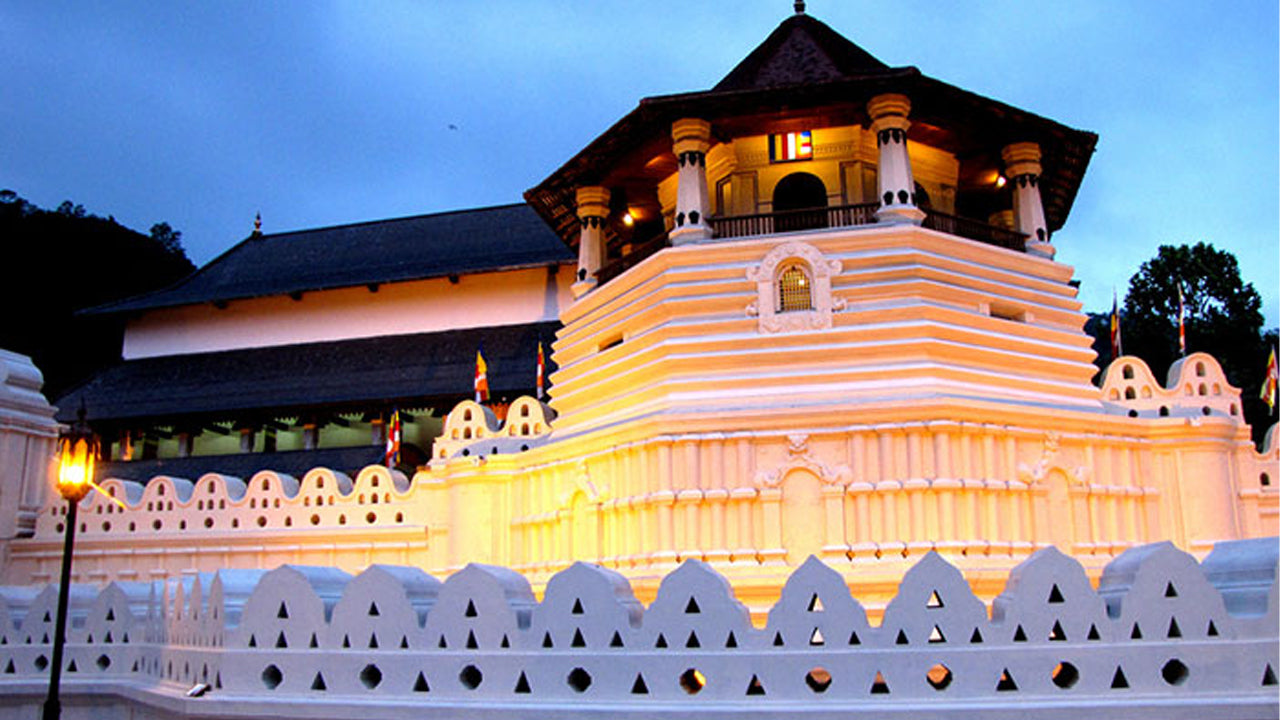
Sri Dalada Maligawa — the Temple of the Tooth Relic — stands at the heart of Kandy's royal lake complex as the most revered Buddhist shrine in Sri Lanka and one of the most significant in the world. For over three centuries, this walled palace complex has sheltered the left canine tooth of Lord Gautama Buddha, drawing pilgrims and travellers from across Asia and beyond. A visit here is not simply a cultural excursion; for many, it is an act of devotion that anchors the whole journey to the island.
What is the history of the Temple of the Tooth Relic?
The Sacred Tooth Relic was originally preserved in Kalinga, on the eastern coast of India. In the 4th century AD, King Guhasiva of Kalinga feared its safety during an invasion and entrusted it to his daughter, Princess Hemamala, and her husband, Prince Danta, to carry secretly to Sri Lanka — legend says the relic was concealed within a flower in the princess's hair. King Meghavanna of Anuradhapura received the relic and enshrined it in a purpose-built edifice, and from that moment the Tooth became a symbol of sovereign authority: whoever held it held the right to rule.
Over subsequent centuries the relic followed the movement of capital cities. The kingdoms of Polonnaruwa and Dambadeniya each built dedicated shrines beside their royal residences. During the Kotte Kingdom period the relic resided at Sri Jayawardenepura Kotte, before being transferred to Kandy when the Kandyan Kingdom rose to prominence. King Vimaladharmasuriya I constructed the first Kandyan shrine to house it — a two-storey wooden structure — in the late 16th century.
The present stone complex was largely built in the early 18th century by King Vira Parakrama Narendra Singha, with significant additions by the last Kandyan king, Sri Wickrama Rajasingha, who added the distinctive octagonal tower known as the Paththirippuwa. The temple sustained serious damage in a bomb attack in 1998 but was swiftly and meticulously restored. In 1988 the entire city of Kandy, including the temple precinct, was inscribed as a UNESCO World Heritage Site.
What is the legend behind the Sacred Tooth Relic?
Buddhist tradition holds that after the cremation of Lord Buddha, his remains were distributed among kings and realms to be venerated. His four canine teeth were regarded as the most precious of all relics. One was taken to the realm of the King of Gods, another to the kingdom of Gandhara, a third was enshrined by the Naga serpent kings in a golden chamber beneath the sea, and the fourth — the left canine — was entrusted to the King of Kalinga in eastern India. It is this fourth relic that eventually reached Sri Lanka and now rests within Sri Dalada Maligawa.
The relic has survived attempted destruction and deliberate concealment across seventeen centuries. During the Portuguese occupation in the early 17th century, it was hidden inland, and King Rajasingha II later returned it safely to Kandy. Each episode of danger followed by preservation has deepened the relic's sanctity in the eyes of devotees.
What can you see inside the temple complex?
The walled precinct contains several distinct structures, each with its own historical and spiritual significance:
- Main Shrine (Maligawa) — A two-storey building with a gilded roof and ornate silver doors. The ground floor houses an antechamber for offerings; the upper floor leads to the Handun Kunama, the inner sanctum where the Tooth Relic rests inside a series of nested golden caskets atop a throne.
- Paththirippuwa (The Octagon) — An elegant octagonal tower added by Sri Wickrama Rajasingha, once used as a royal audience hall and now home to an important collection of ola-leaf manuscripts.
- Handun Kunama — The fragrant sandalwood chamber within the upper shrine room, accessible to pilgrims during puja times.
- Golden Canopy — A gilded roof structure suspended above the inner relic chamber, gifted by successive rulers.
- Moat (Diya Sevana) — A wide water channel encircling the main shrine building, serving both as a defence feature and a reflective aesthetic element in Kandyan design.
- Temple Museum (New Palace) — Displays royal regalia, gifts received by the temple, and historic photographs of the complex.
- National Museum of Kandy — Housed in the adjacent old royal palace, with exhibits on Kandyan art and royal artefacts.
- International Buddhist Museum — Located in the former Queen's Palace building, presenting Buddhist traditions from countries across Asia.
- Kandy Lake and Queen's Bath — The ornamental lake constructed by Sri Wickrama Rajasingha borders the south side of the complex and is integral to the site's setting.
- Jayathilaka Mandapaya — A ceremonial pavilion on the lake's edge, used during royal processions.
What is Kandyan architecture and how does it shape the temple?
The temple is the finest surviving example of the Kandyan architectural style that flourished between roughly the 15th and 19th centuries. Characteristic features include steeply pitched tiled roofs with upswept eaves, whitewashed lime-plastered walls, large latticed windows designed to draw in air, and elaborate timber carvings painted in ochre, red, and gold. The moat and the layered arrangement of courtyards reflect a deliberate spatial hierarchy: the closer you move toward the relic chamber, the more sacred — and the more architecturally refined — the spaces become.
The gilded roof canopy added over the main shrine in the 20th century, funded by contributions from Buddhist countries, stands in deliberate contrast to the older whitewashed walls and signals the temple's living, evolving status as a place of active worship rather than a frozen monument.
When is the best time to visit the Temple of the Tooth?
The temple holds three daily puja (ritual offering) ceremonies — in the early morning, at midday, and in the early evening — during which the casket housing the relic is ceremonially opened to public view, accompanied by drumming, flute music, and the waving of oil lamps. Attending at least one puja adds a dimension to the visit that simply walking the shrine rooms cannot provide. Evening puja, held around 6:30 pm, tends to draw the largest congregations and the most atmospheric lighting.
The grandest time to experience Sri Dalada Maligawa is during the Esala Perahera Festival, held annually over ten nights in July or August. This is one of Asia's oldest and largest processions, featuring dozens of costumed elephants, Kandyan dancers, fire performers, and drummers circling the city streets around the temple. Accommodation in Kandy fills months in advance during Perahera season, so planning early is essential.
Outside festival periods, visiting on weekday mornings generally means lighter crowds. The temple receives very high footfall on Poya (full moon) days, which are public holidays in Sri Lanka and regarded as particularly auspicious for pilgrimage.
How do I get to the Temple of the Tooth from Colombo?
Kandy lies roughly 115 km from Colombo, typically around 3 hours by road depending on traffic. The most comfortable option is a private air-conditioned vehicle; the Lakpura Kandy City Tour combines transfer and guided access to the main sites. The scenic train from Colombo Fort to Kandy (approximately 2.5–3 hours) is a popular choice for independent travellers and one of Sri Lanka's most enjoyable rail journeys. Once in Kandy, the temple is a short walk from the city centre and the railway station.
What should visitors know before entering?
A few practical points help avoid surprises:
- Dress code is strictly enforced. Both men and women must cover shoulders and legs. Sarongs are available for hire at the entrance gate.
- Shoes must be removed before entering the shrine buildings. Socks are permitted and often advisable on hot days when the stone floors become warm.
- Foreign visitors pay an entrance fee at the gate; the amount is set by the Diyawadana Nilame, the lay custodian of the temple, and is subject to change. Purchasing tickets through a verified agent avoids queues.
- Photography is permitted in most areas of the outer complex. Flash photography inside the relic chamber is typically restricted out of respect for worshippers.
- Mobile phones should be switched to silent. The temple is an active place of worship, not a museum, and pilgrims are present at all hours.
Nearby places
16 places within about 25 km, nearest first.
- Aluth Sahal Mangallayaunder 1 km
- Esala Perahera Festivalunder 1 km
- Kandy Lakeunder 1 km
- Kandy Lake Clubunder 1 km
- Paththirippuwaunder 1 km
- Royal Palace Kandyunder 1 km
- The Nanumura Ceremonyunder 1 km
- International Buddhist Museumunder 1 km
- Jayatillake Mandapayaunder 1 km
- Raja Museumunder 1 km
- E.L. Senanayake Children Park Kandyunder 1 km
- Natha devalayaunder 1 km
- Randoli Peraheraunder 1 km
- Ulpangeunder 1 km
- Maha Vishnu Devalayaunder 1 km
- Malwatta Chapterunder 1 km
Related reading
1 pages on closely related subjects.