
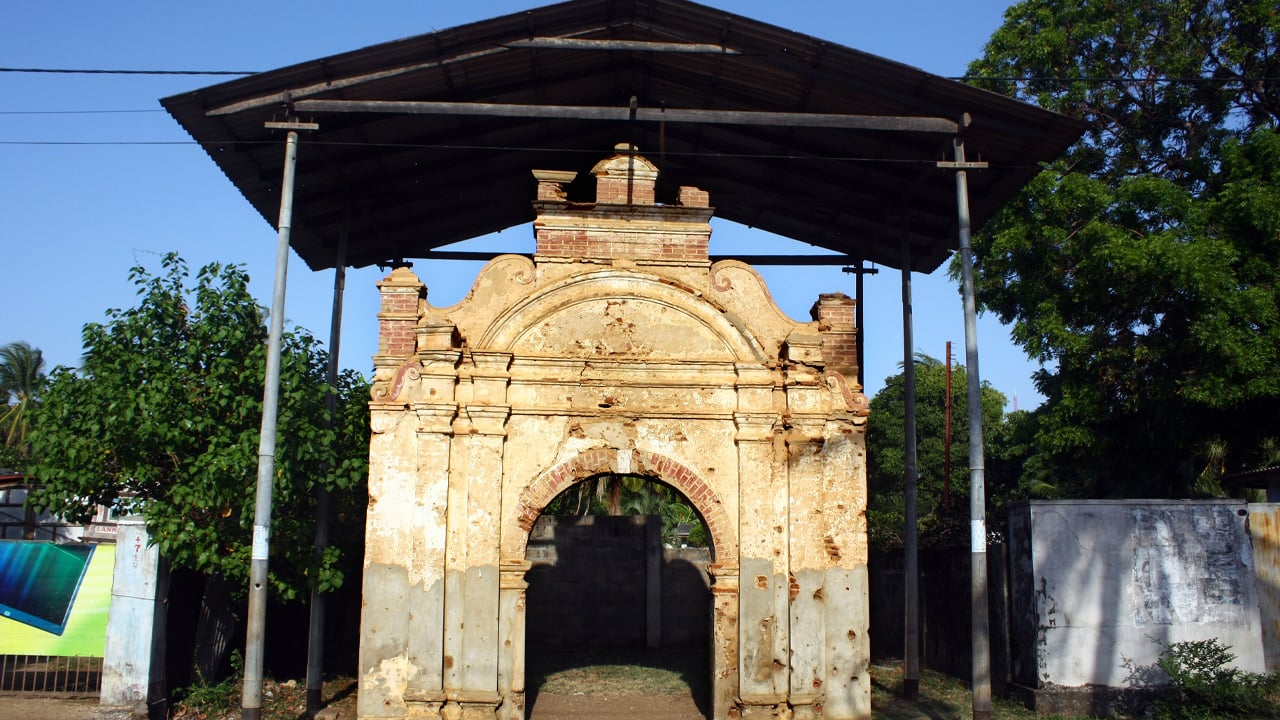
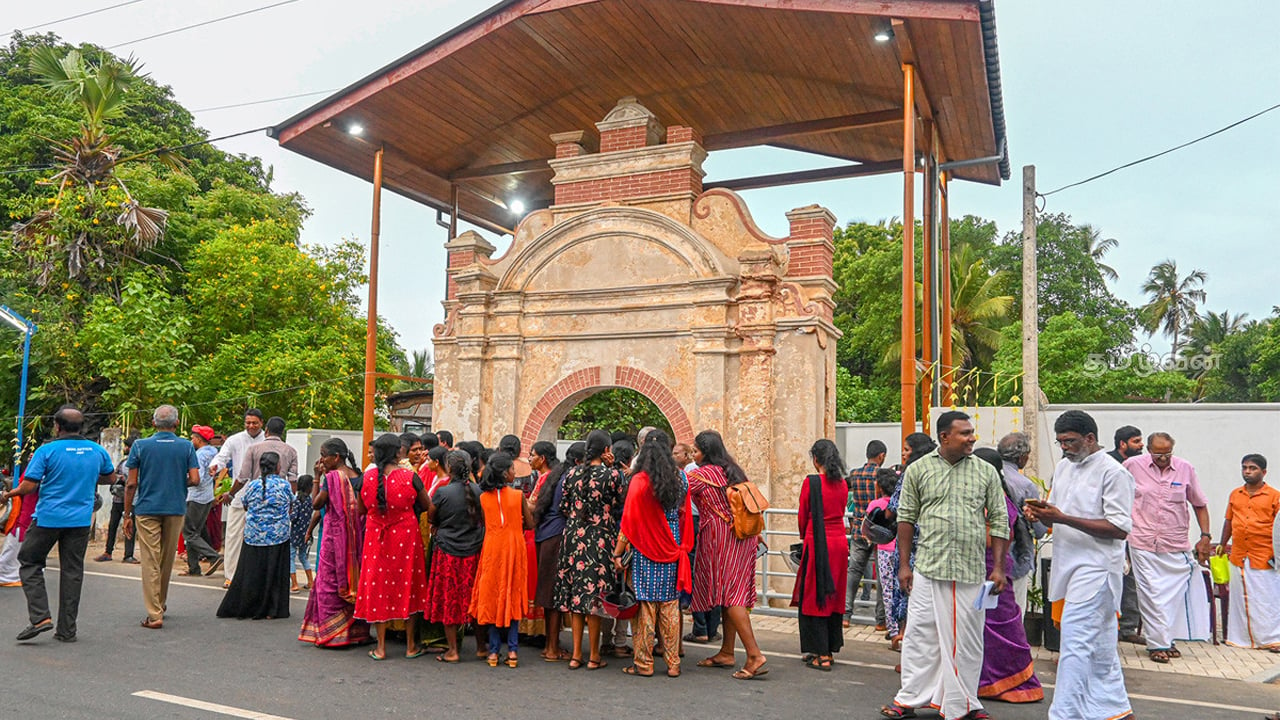
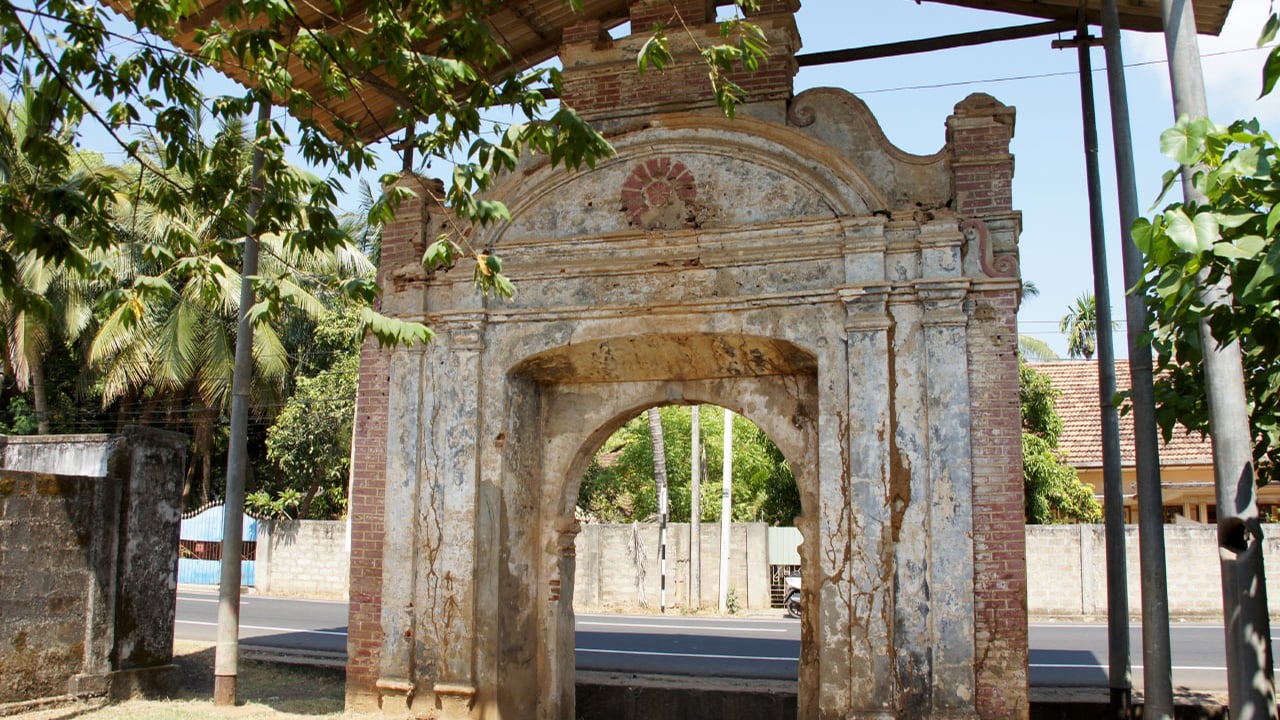
Sankili Thoppu — also rendered as Cankilian Thoppu or the Poothathamby Arch — is one of the few surviving physical traces of the Jaffna Kingdom, the medieval Tamil polity that once dominated the northern peninsula of Sri Lanka. Standing in the Nallur area of Jaffna, the arch is a quiet but weighty landmark: a brick-and-plaster gateway that once formed part of a royal palace facade, now protected as a scheduled archaeological monument.
What is the history of Sankili Thoppu?
The Jaffna Kingdom reached its political height between the 13th and 17th centuries, before Portuguese and later Dutch colonial forces dismantled much of its infrastructure. Sankili Thoppu is associated with King Cankili II, the last ruler of the independent Jaffna Kingdom, who was captured by the Portuguese in 1619. The arch is thought to have served as a ceremonial entrance to the royal compound, and a statue of King Cankili II installed nearby reinforces that historical connection.
The structure blends local Tamil architectural tradition with techniques that show some colonial-era influence — a combination visible in its semi-circular arched opening, brick construction, and plaster finishing. While the palace that once surrounded it has not survived, the archway itself endured, and was formally gazetted as an archaeologically protected monument in 2007 by the Central Cultural Fund of Sri Lanka.
What can visitors see at Sankili Thoppu?
The site is modest in scale but rich in atmosphere. The arch itself is the focal point: a single gateway of weathered brick and plaster, bearing inscriptions and decorative mouldings that reward close inspection. The proportions are dignified rather than monumental, giving it the character of a relic that has survived through persistence rather than grandeur.
- The archway structure — the semi-circular opening with surviving plaster details and carved elements.
- Inscriptions — faded but legible markings that provide clues to the site's original function and patronage.
- Statue of King Cankili II — a commemorative sculpture placed close to the arch, contextualising the site within its royal history.
- Surrounding streetscape — the arch sits within the living urban fabric of Nallur, giving it an organic rather than museum-like character.
How do I get to Sankili Thoppu from Jaffna city?
The site is located along the Jaffna–Point Pedro Road in the Nallur area, roughly 2 to 3 kilometres from Jaffna town centre. From Jaffna, the most straightforward approach is by tuk-tuk or hired vehicle. The road is well-maintained and the journey typically takes under 15 minutes from the centre of Jaffna. There is no dedicated car park, but roadside access is easy.
Sankili Thoppu is a short walk from the Nallur Kandaswamy Temple, one of the most important Hindu temples in Sri Lanka. Combining both sites in a single visit makes good practical sense and deepens the experience of Nallur's layered heritage.
When is the best time to visit Sankili Thoppu?
The site is open year-round and can be visited at any hour of the day. Jaffna's climate is governed by the northeast monsoon, which brings rain between October and January. Visiting between February and August gives drier, clearer conditions and easier access to the open-air site. Early mornings are particularly pleasant — cooler and less busy than midday.
If your visit coincides with the Nallur Festival (typically held in July or August at the adjacent Kandaswamy Temple), the surrounding streets become lively and crowded; the arch takes on a different character as a backdrop to active religious life rather than a quiet archaeological monument.
Is Sankili Thoppu suitable for a day trip from Jaffna?
Sankili Thoppu works best as part of a broader half-day or full-day itinerary covering Nallur and central Jaffna. The arch itself can be appreciated in 20 to 30 minutes, but the neighbourhood rewards slower exploration. The Nallur Kandaswamy Temple, Jaffna Public Library, Jaffna Fort, and the Dutch-era colonial quarter are all within a few kilometres and together give a coherent picture of the city's layered past.
For travellers arriving from the south, Jaffna is roughly 400 kilometres from Colombo. The A9 highway — reopened after the end of the civil conflict — makes the drive feasible, though many travellers prefer the overnight train service, which reduces travel fatigue.
What should I know before visiting?
- There is no entry fee to view the arch; it stands in a public area.
- The site has no on-site interpretation boards in English, so some background reading before arrival is worthwhile.
- Dress conservatively if you plan to enter the nearby Nallur Kandaswamy Temple immediately after — shoulders and knees should be covered and footwear removed at the temple entrance.
- Photography is permitted at the arch with no restrictions.
- There are no formal facilities (toilets, cafes) at the monument itself; amenities are available nearby along the main road.
How does Sankili Thoppu compare to other heritage sites in northern Sri Lanka?
The northern province holds a distinct historical identity from the ancient Sinhalese kingdoms of the south. Where sites such as Polonnaruwa represent the Buddhist dynastic tradition of the island's heartland, Sankili Thoppu embodies the parallel and equally significant Tamil royal tradition of the north. It is not a large or elaborate complex — it is a fragment — but that very fragmentary quality makes it historically honest: a reminder that much of the Jaffna Kingdom's material culture was systematically destroyed during colonial occupation.
For travellers with a genuine interest in Sri Lankan history, the contrast between the monumental Buddhist ruins of the Cultural Triangle and the understated survivor that is Sankili Thoppu is instructive and worth the journey north.
Nearby places
8 places within about 25 km, nearest first.
- Jaffna Archaeological Museumunder 1 km
- Manthiri Manai Mansionunder 1 km
- Nallur Kandaswamy Kovil Festival in Jaffnaunder 1 km
- Nallur Kandaswamy Kovilunder 1 km
- Jaffna Marketunder 1 km
- Jaffna Fish marketunder 1 km
- Archaeological Museum Jaffnaunder 1 km
- Jaffna Clock Towerunder 1 km