


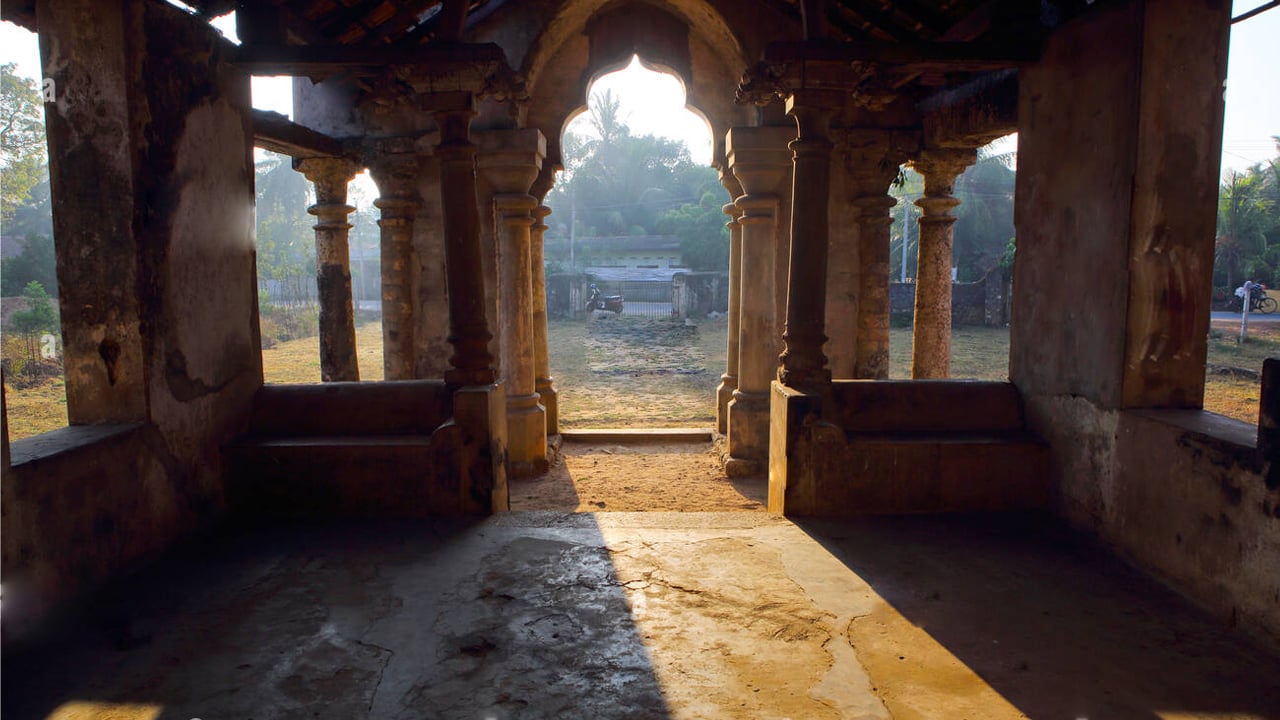
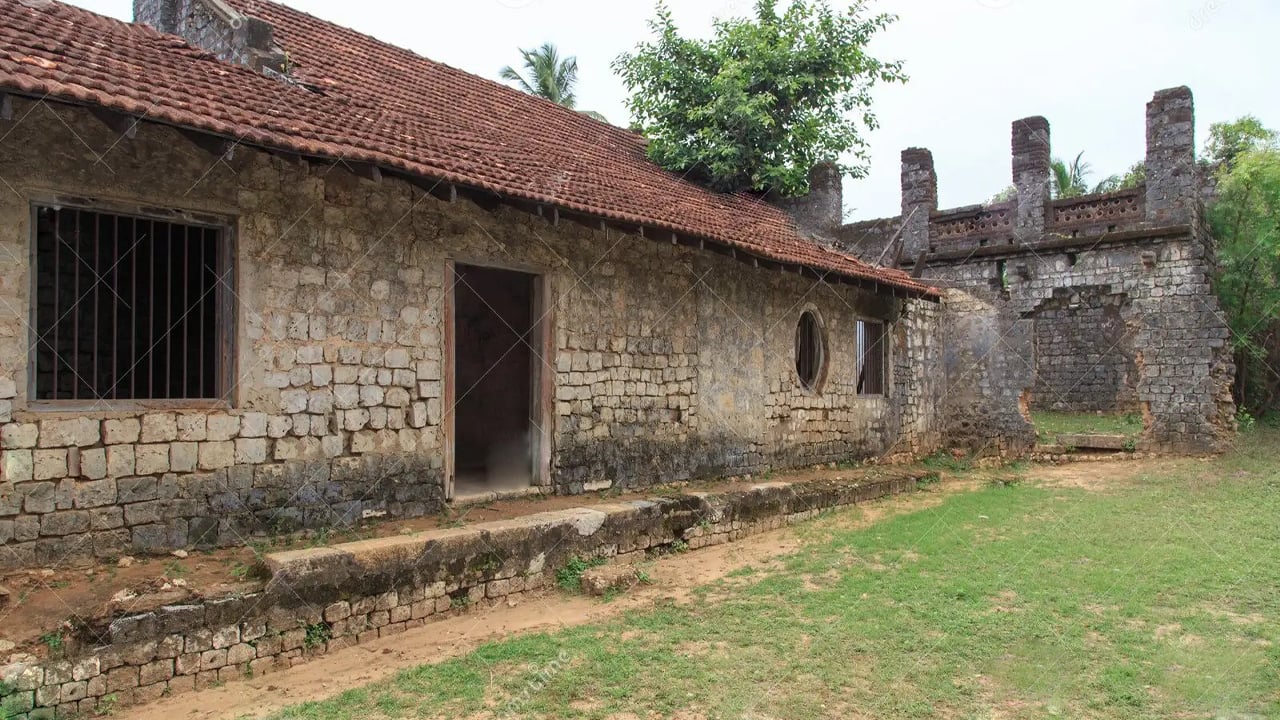
About one kilometre along the Point Pedro road from the Nallur Kandaswamy Kovil, a large abandoned mansion stands on the left side of the road, half-consumed by vegetation. Known in Tamil as Manthiri Manai — literally, the Minister's Abode — this crumbling structure is one of Jaffna's most intriguing architectural mysteries. Its walls blend colonial European proportions with South Indian Hindu ornamentation, a combination that raises as many questions as it answers.
What is the history behind Manthiri Manai?
The honest answer is that no single account has been established beyond doubt. Several competing theories have circulated among historians and local residents for generations. The most romanticised version connects the mansion to the court of King Sangili, the last regional king of the Jaffna Kingdom, suggesting it served either as a wing of the royal palace or as the private residence of one of his ministers — which would explain the name.
A more sceptical reading, cited in a Tamilnet article from October 2009, dismisses any royal association and argues that the building is a chaultry — a rest-house or charitable lodge — constructed in the early nineteenth century. According to this account, it was built by a philanthropist from the Va'n'naarpa'n'nai area of Jaffna, around the same time as the adjacent belfry of the Chaddai-naathar temple. Proponents of this view note that it is unlikely a building of such scale and prominence could have royal origins without any documentary trace surviving in Dutch, Portuguese, or later British records.
Neither theory can be entirely ruled out. What is clear is that the building predates modern Jaffna in some meaningful way, and that its hybrid architectural grammar — thick lime-and-brick walls, arched openings, decorative motifs drawn from the Hindu temple tradition — reflects the layered cultural history of the northern peninsula.
What does the architecture of Manthiri Manai look like?
The mansion's most striking feature is the dialogue between its two dominant influences. The structural logic — the proportioned facades, the arched doorways, the heavy masonry — follows colonial conventions likely absorbed from the Dutch or early British period. Overlaid on this framework are decorative elements that belong firmly to the Dravidian Hindu tradition: moulded plasterwork, rhythmic pilaster forms, and ornamental registers that echo the language of nearby temples.
Around 100 metres before the mansion on the same road stands the Poothathamby Arch, a separate structure whose own origins are equally unclear. The two monuments together create an informal heritage corridor just beyond the Nallur precinct, suggesting this stretch of road once held considerable civic or ceremonial importance.
Who manages Manthiri Manai today?
The site has been taken over by Sri Lanka's Department of Archaeology, which has indicated its intention to conserve and eventually restore the structure. Active restoration work in the Northern Province has progressed unevenly over the years, partly because of the region's complex recent history, but the formal custodianship of the Department means the building is at least protected from further encroachment or demolition. Visitors should expect a work-in-progress site rather than a fully interpreted heritage attraction.
How do I get to Manthiri Manai from Jaffna city?
The mansion is straightforward to reach independently. From Nallur Kandaswamy Kovil — itself a landmark visible from most parts of central Jaffna — follow the Point Pedro road north for roughly one kilometre. The building appears on the left-hand side of the road. Tuk-tuks from Jaffna town are the most convenient option for a short trip; any driver familiar with the Nallur area will know the route. There is no formal car park, but the road shoulder near the site is generally passable.
What else can I see near Manthiri Manai?
The immediate surroundings reward an unhurried half-day. The Nallur Kandaswamy Kovil, one of the most architecturally significant Hindu temples in Sri Lanka, is a natural starting point. The Jaffna Archaeological Museum in the Dutch Fort area provides broader context for the peninsula's layered colonial past. Further along the Point Pedro road, the landscapes of the northern coast open up — flat, wind-scoured, and scattered with palmyra palms that define the Jaffna skyline.
For visitors combining the north with a wider Sri Lanka itinerary, the ancient city of Polonnaruwa offers a counterpoint in the form of a fully excavated and documented medieval capital, allowing the informality of Manthiri Manai's mysteries to sit in richer archaeological context.
Is Manthiri Manai worth visiting?
For travellers with a genuine interest in vernacular architecture, colonial-era heritage, or the specific cultural history of the Jaffna peninsula, the answer is yes. The site is not polished or interpreted in the way a mainstream heritage attraction would be, and that is partly what makes it compelling — it asks the visitor to do some of the intellectual work. For those passing through Jaffna primarily to see Nallur Kovil, adding the fifteen-minute detour to Manthiri Manai costs little and adds considerably to the experience of the area.
It is worth tempering expectations about access: parts of the structure may be cordoned off depending on the state of ongoing conservation work, and there are no on-site guides, signage, or facilities. Visiting in the morning, before the heat builds on the open road, is generally more comfortable.
Nearby places
12 places within about 25 km, nearest first.
- Nallur Kandaswamy Kovil Festival in Jaffnaunder 1 km
- Jaffna Archaeological Museumunder 1 km
- Nallur Kandaswamy Kovilunder 1 km
- Archaeological Museum Jaffnaunder 1 km
- Sankili Thoppuunder 1 km
- Rio Ice Cream Jaffnaunder 1 km
- Jaffna Marketunder 1 km
- Jaffna Fish marketunder 1 km
- Kokuvil Railway Station1 km
- Ruins of King Sangiliyan’s Minister’s Residence, Jaffna1 km
- Kondavil Railway Station2 km
- Ponnalai Varatharaja Perumal Kovil3 km