Sri Lanka's traditional musical instruments are far more than performance tools — they are living artifacts of a civilization shaped by Buddhist ritual, royal ceremony, and village life. Passed down through generations of specialist craftsmen and hereditary musician families, these instruments carry sound and meaning in equal measure. Understanding them deepens any visit to the island, whether you encounter them at a temple courtyard, a festival procession, or a village cultural show.
What are the most important traditional instruments in Sri Lanka?
Sri Lankan classical music recognizes a core group of percussion, wind, and string instruments, each with a defined role in performance and ritual contexts.
Drums and percussion
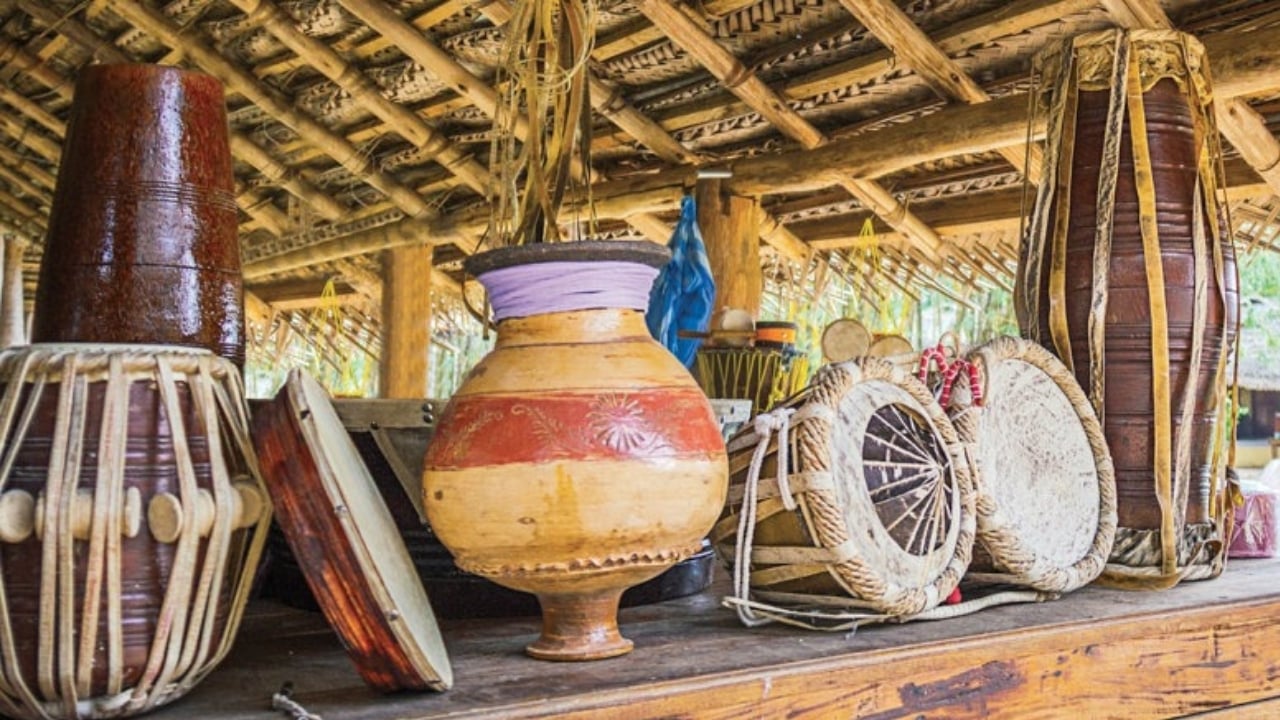
- Rabana — A flat, frame drum that ranges in diameter from a small hand-held version to a large floor drum around which several players sit simultaneously. It is considered sacred in many contexts and is played at Buddhist festivals, weddings, and the Sinhala New Year.
- Thammattama — A double-headed drum played with two sticks. It forms part of the formal Kandyan percussion ensemble and is heard in temple processions and Kandyan dance performances.
- Geta beraya — A barrel drum considered the principal percussion instrument of the Kandyan tradition. Its deep, resonant sound anchors the rhythm in Esala Perahera Festival processions.
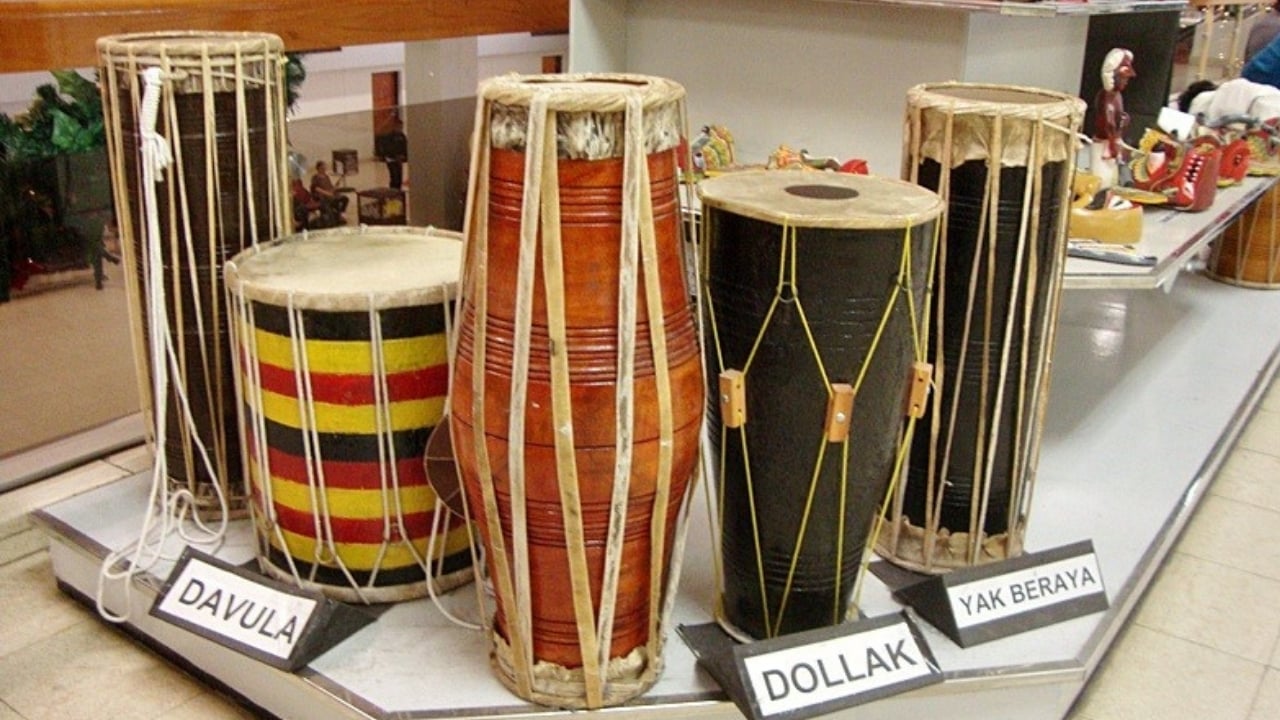
- Davula — A cylindrical double-headed drum associated with the low-country tradition. It is beaten on one end with a stick and on the other with the bare hand, producing contrasting tones.
- Udakkiya — A small hourglass-shaped drum, similar in form to the Indian udukku, used in certain ritual and exorcism ceremonies.
Wind instruments
- Horanewa — A conical double-reed instrument, somewhat comparable to an oboe, used prominently in Kandyan ceremonies and temple rituals. Its penetrating tone is designed to carry outdoors over crowd noise.
- Kombu — A long curved horn, typically made from metal, sounded at ceremonial occasions. Its sole function is announcement and procession rather than melody.
- Hakgediya (conch shell) — Blown at the opening of Buddhist religious events. The conch is regarded as an auspicious symbol across multiple South and Southeast Asian traditions.
String instruments
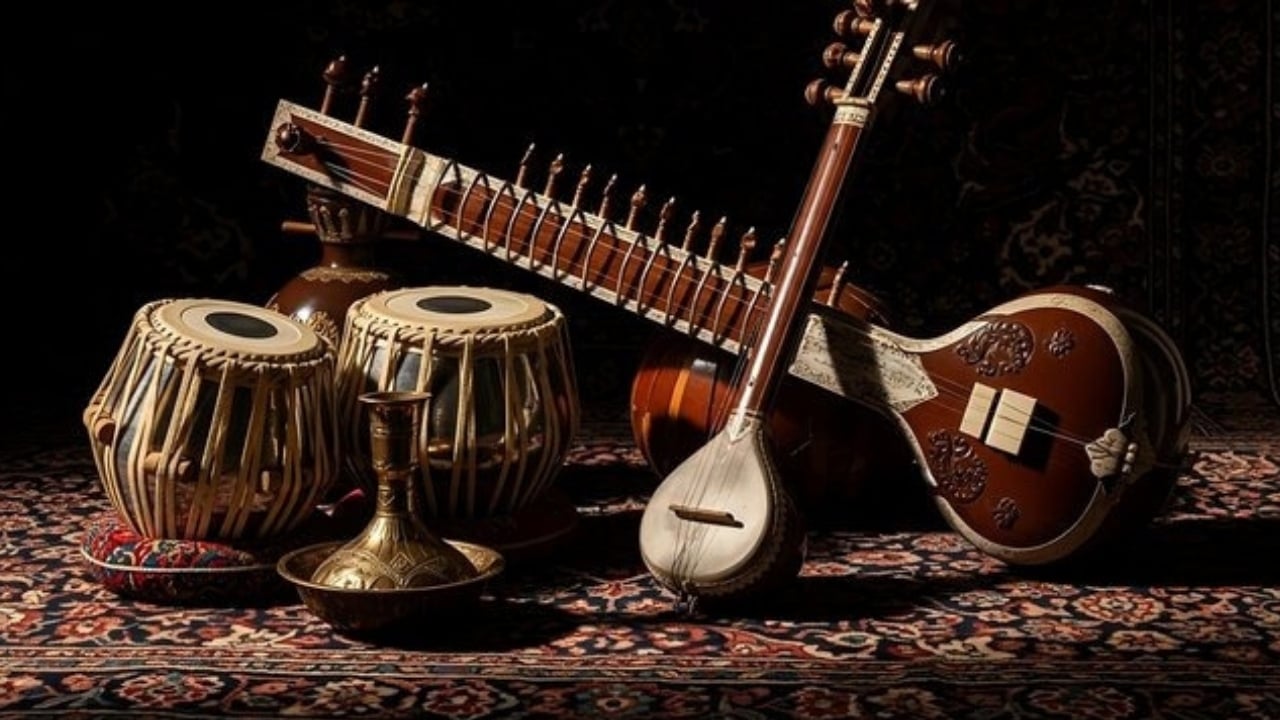
- Sitar — Adopted into Sri Lankan classical music through centuries of South Indian cultural exchange, the sitar is used in more formal, concert-oriented settings rather than outdoor ritual.
- Ravanahatha — A bowed string instrument believed by some musicologists to be among the oldest bowed instruments in Asia. It consists of a bamboo neck, a coconut-shell resonator, and horsehair strings, and is associated with devotional music traditions in parts of South Asia.
How are these instruments made?
Traditional Sri Lankan instrument-making relies on locally sourced natural materials. Drumskins are typically fashioned from animal hide — monitor lizard, goat, or cattle — stretched and cured to achieve precise acoustic properties. The drum bodies are carved from jak wood (Artocarpus heterophyllus) or other dense timbers, chosen for resonance and durability in humid tropical conditions.
Wind instruments such as the horanewa demand exceptional metalwork: the bell and body are often fashioned from brass or bronze, while the reed is crafted from a locally harvested plant material. Skilled craftsmen — many of whom belong to hereditary artisan communities — continue to make instruments by hand, treating the process as much a ritual preparation as a craft exercise.
The coconut palm, whose shell forms the resonator of instruments like the ravanahatha, is one of Sri Lanka's most versatile natural resources. Its structural properties make it an effective acoustic chamber. For more on this plant's broader role in Sri Lankan life, see the page on Cocos nucifera.
What role do these instruments play in Sri Lankan ceremonies?
The relationship between music and religious practice in Sri Lanka is ancient and continuous. At Buddhist temples, dawn and dusk are marked by the sound of drums and conch shells. Perahera processions — most famously the annual Kandyan Esala Perahera — are accompanied by ensembles that include the geta beraya, thammattama, horanewa, and kombu. The combined effect is less a concert than a ritual soundscape, designed to honour the Sacred Tooth Relic and invoke collective merit.
In low-country traditions, drumming is central to tovil ceremonies — all-night healing rituals in which specialist drummers and dancers work to propitiate deities associated with illness or misfortune. The rhythmic sequences used in these ceremonies are highly codified and require years of apprenticeship to master.
At a domestic level, the rabana is intimately associated with the Sinhala New Year (Avurudu) in April, when women gather to play the large floor version collaboratively, the interlocking rhythms symbolizing community and celebration.
Where can visitors hear traditional Sri Lankan music live?
The most immersive way to experience these instruments is in their natural performance context. The following options suit different travel itineraries:
- Kandyan cultural shows — Held nightly in Kandy at dedicated performance venues near the Temple of the Tooth. These typically include Kandyan dance with live drumming and flute accompaniment, and are accessible to independent visitors.
- Temple ceremonies — Early morning and evening puja at major Buddhist temples across the island involve live drumming and conch calls. Behaviour guidelines apply: dress conservatively and observe quietly.
- Village demonstrations — Some cultural villages and craft centres around Sigiriya and Kandy offer arranged demonstrations where master musicians explain and play individual instruments up close.
- Festival seasons — The period from December to April sees a concentration of festivals when traditional music is performed outdoors. July and August bring the Esala Perahera, the single most spectacular showcase of Kandyan musical tradition.
Visitors staying in the hill country can combine a Kandy city tour with an evening cultural performance for an efficient introduction to both the architecture and the performing arts of the Kandyan Kingdom era.
When is the best time to experience traditional music in Sri Lanka?
No month is silent, but two periods stand out. The Sinhala and Tamil New Year in April brings widespread public celebration with rabana playing, street music, and village games across the island. The Esala Perahera in Kandy, held over roughly two weeks in July or August depending on the lunar calendar, is the most elaborate procession in the country and the most concentrated display of traditional Kandyan musical performance anywhere in the world.
Religious full-moon days (Poya days) throughout the year are also reliable moments to encounter live ceremonial music at temples, without the crowds of the major festivals.
Can visitors buy traditional Sri Lankan instruments?
Hand-crafted instruments are available through specialist workshops in Kandy, Ambalangoda, and Colombo's Pettah market district. Quality varies considerably: tourist-grade rabanaya and small hand drums are widely available, while performance-quality instruments require a visit to a specialist craftsman or a recommendation from a knowledgeable guide. Buyers should verify that any animal-skin components comply with their home country's import regulations before purchasing.
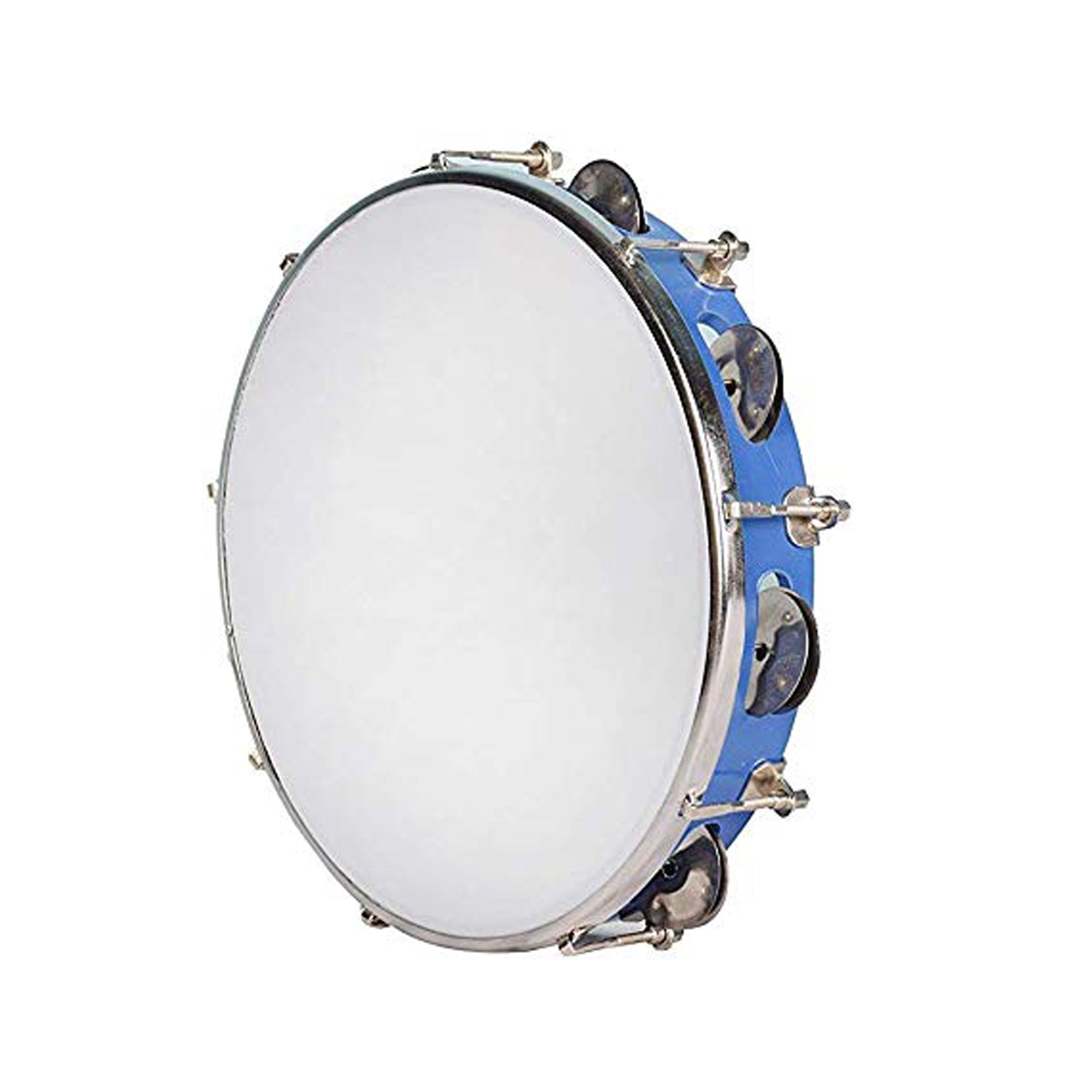
For those interested in taking home a playable souvenir, the chal hand drum is one of the more compact and musically accessible options, requiring no specialist technique to produce a satisfying sound.
How do Sri Lankan instruments compare with South Indian classical instruments?
Sri Lanka's musical traditions share deep roots with South Indian Carnatic music, reflecting centuries of cultural and religious exchange across the Palk Strait. The horanewa is structurally related to the South Indian nadaswaram, and the thammattama shares lineage with the mridangam family. However, Sri Lankan instruments have evolved distinct tonal qualities, tuning conventions, and ceremonial functions that set them apart. The Kandyan tradition in particular developed a relatively self-contained performance system under the patronage of the Kandyan kings, producing instrument types and rhythmic cycles not found elsewhere in South Asia.