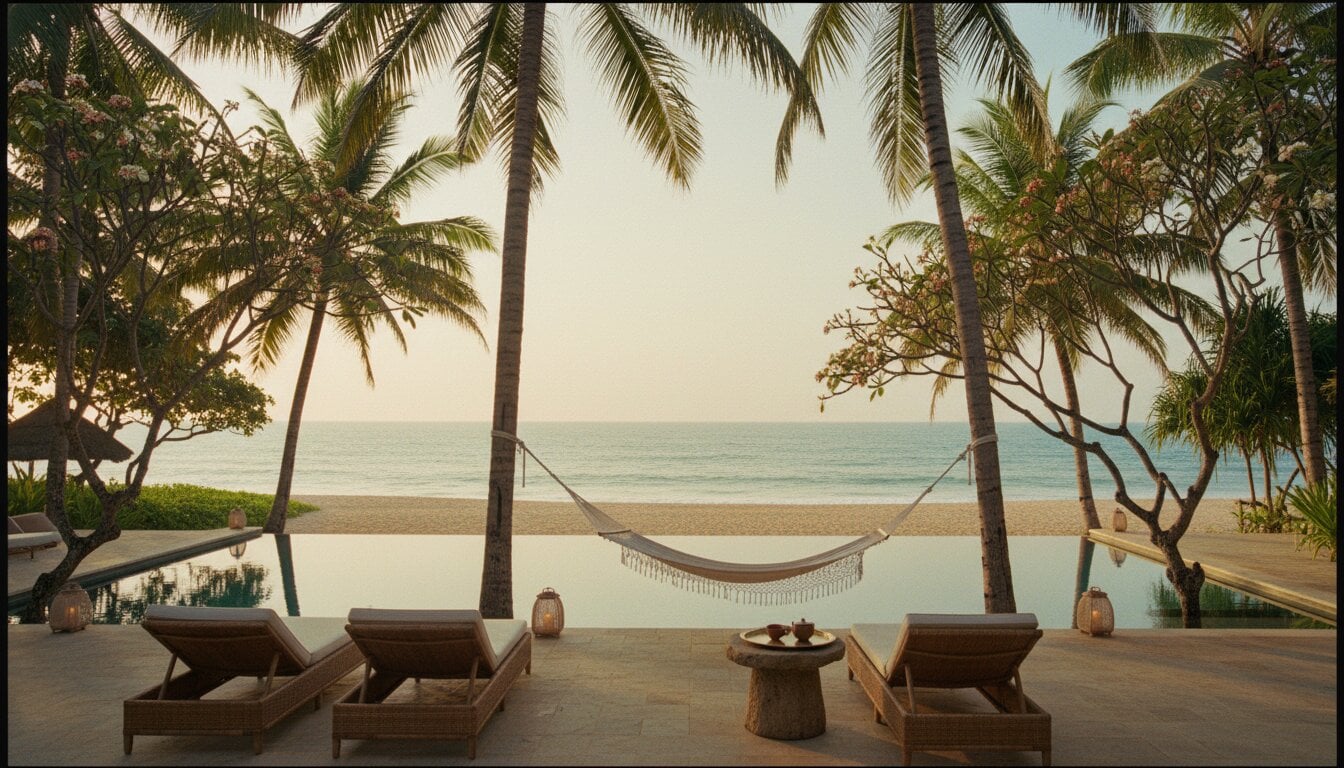
Marble Beach sits quietly on the eastern coast of Sri Lanka, a short distance from Trincomalee. Unlike the well-worn beach strips of the south and west, this shoreline has remained largely free from commercial development — in part because it falls within a naval-controlled area that has effectively shielded it from overdevelopment. The result is a clean, unhurried stretch of coast that rewards travellers willing to seek it out.
What makes Marble Beach different from other Sri Lanka beaches?
The beach takes its name from the unusually smooth, marble-like texture of the sand underfoot — fine-grained and pale, it has a compacted feel that sets it apart from the coarser sands found elsewhere on the island. Combined with consistently calm, shallow water during the dry season, this gives the beach a polished, almost curated appearance that is entirely natural.
Because access falls under naval administration, visitors will notice that the area is kept notably clean and orderly. There are no rows of sun-lounger vendors or persistent hawkers. Facilities tend to be modest but functional, including shaded picnic areas suitable for families spending a full day by the water.
What can you do at Marble Beach?
The primary draw is the water itself. During the dry season on the east coast — roughly from April through September — the sea here is exceptionally calm, making it safe and comfortable for swimming even for those who are not strong swimmers. The gentle conditions also suit snorkelling; the near-shore coral and marine life, while not as dramatic as Pigeon Island, are worth exploring with a mask and fins.
- Swimming: Calm, shallow entry with minimal current during the dry season.
- Snorkelling: Bring your own equipment or hire locally; near-shore reefs offer modest but pleasant marine life.
- Photography: The bay frames well against the surrounding hills, particularly in the early morning and late afternoon light.
- Picnicking: Shaded rest areas make this a practical choice for a leisurely half-day or full-day outing.
- Sunbathing: The absence of heavy foot traffic means you can find a quiet patch of sand without effort.
What are the views like from Marble Beach?
The beach faces Koddiyar Bay, one of the largest natural harbours in Asia. From the shoreline you can see the bay open out toward the Indian Ocean, with gentle hills rolling in the background. The combination of still water and elevated topography in the distance makes this a genuinely photogenic spot — especially during golden hour when the light catches the surface of the bay.
When is the best time to visit Marble Beach?
The eastern coast of Sri Lanka operates on the opposite monsoon cycle from the west and south. The dry season runs from approximately April to early October, which is when Marble Beach is at its best — calm seas, low humidity, and reliable sunshine. From October through February, the northeast monsoon brings heavier rainfall and rougher seas to this coast, making swimming less advisable and access occasionally disrupted.
| Season | Months | Conditions |
|---|---|---|
| Dry (recommended) | April – September | Calm seas, good visibility, warm and sunny |
| Shoulder | October, March | Mixed; occasional rain but still visitable |
| Northeast monsoon | November – February | Rough seas, heavy rainfall, not ideal for swimming |
How do I get to Marble Beach from Colombo?
Trincomalee is around 260 km from Colombo, typically a four- to five-hour drive depending on the route and traffic. The most direct road route runs via Habarana and Kantalai. Alternatively, there is a train service from Colombo to Trincomalee, though journey times are longer and schedules limited — the drive is generally more practical for independent travellers.
From central Trincomalee, Marble Beach is roughly 5 km, accessible by tuk-tuk or private vehicle. Note that as the beach is within a controlled area, you may be required to show identification at the entrance checkpoint. This is a straightforward process for most visitors and is worth anticipating rather than being caught off-guard.
Where should I stay when visiting Marble Beach?
Trincomalee town offers a range of guesthouses and hotels to suit different budgets. There is also accommodation closer to the beach itself, including the Marble Beach Air Force Resort, which sits directly on the site and is open to civilian visitors. Staying here gives easy beach access and avoids the need for a daily commute from town. For travellers combining Marble Beach with the wider east coast — Nilaveli, Uppuveli, or Arugam Bay — a private transfer arranged in advance simplifies the logistics considerably.
Is Marble Beach suitable for families with children?
Yes. The calm, shallow water, the absence of aggressive commercial activity, and the availability of shaded picnic areas make Marble Beach a practical and comfortable choice for families. The controlled access also means the beach is generally safer and less crowded than fully open public beaches. Young children can paddle confidently in the shallow entry zone during the dry season, when there is minimal swell.
What else is worth visiting near Marble Beach?
Trincomalee itself offers several worthwhile sites within easy reach. The Koneswaram Temple, perched on Swami Rock above the sea, is one of the most significant Hindu shrines on the island. Fort Frederick, a colonial-era fortification on the same headland, offers coastal views and a glimpse of layered history — Portuguese, Dutch, and British. Nilaveli Beach, around 15 km north of Trincomalee, is another long, quiet stretch of sand and serves as the departure point for Pigeon Island National Park, Sri Lanka's only coral reef national park and an outstanding snorkelling destination.
- Koneswaram Temple – Swami Rock, Trincomalee
- Fort Frederick – colonial fort on the Trincomalee headland
- Nilaveli Beach – quieter alternative about 15 km north
- Pigeon Island National Park – coral reef snorkelling and reef sharks
- Kanniya Hot Springs – ancient spring complex a short drive inland
Nearby places
13 places within about 25 km, nearest first.
- China Bey Railway Stationunder 1 km
- Kinniyaunder 1 km
- Trincomalee Railway Station1 km
- Koddiyar Bay2 km
- Trincomale Port Cruise Terminal2 km
- Orr's Hill Army Museum2 km
- Trincomalee Harbour2 km
- Trincomalee Seaport2 km
- Hoods Tower Museum2 km
- China Bay Airport5 km
- Aathi Koneswaram Temple11 km
- kurinchakerny Bridge13 km
- Seruvila14 km
Related reading
6 pages on closely related subjects.