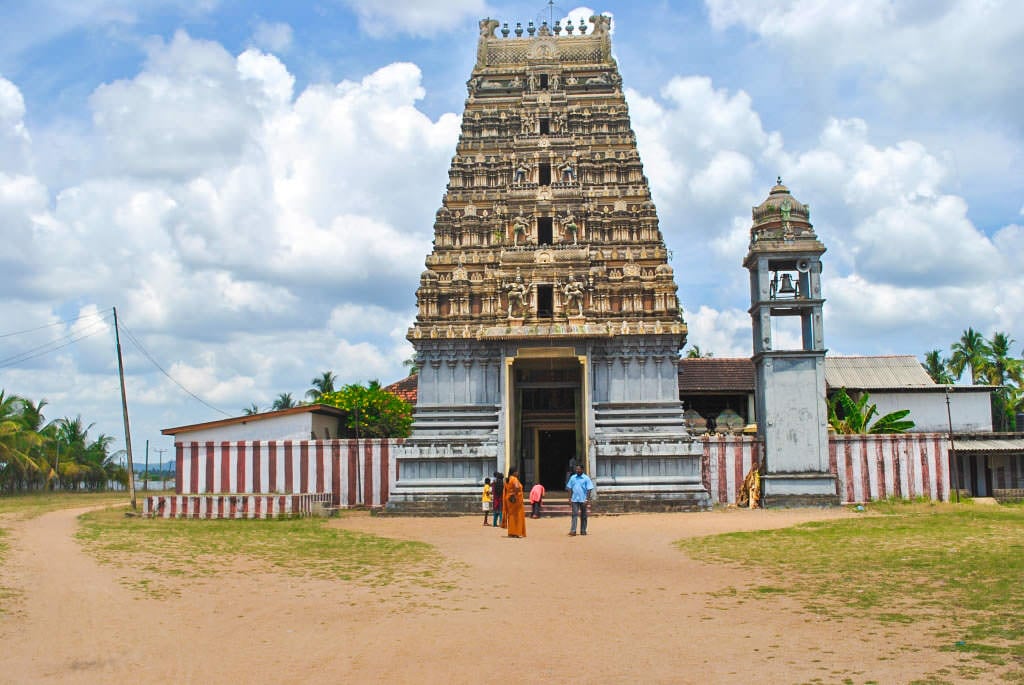
Aathi Koneswaram Temple stands in the village of Thambalagamuwa in the Trincomalee District, roughly 24 kilometres from Trincomalee town. Its Tamil name translates as the "Temple of the Original Lord of Konesvaram," a title that carries the full weight of the shrine's reason for existing: to preserve and honour the sacred heritage of the ancient Koneswaram complex after Portuguese colonial officers destroyed the Temple of Thousand Pillars in 1622.
What is the history of Aathi Koneswaram Temple?
Before Portuguese forces arrived on Sri Lanka's east coast in the early 17th century, Thambalagamuwa formed part of a semi-independent feudal division known as Thambalagamuwa Pattu. The surrounding paddy-rich landscape supported a prosperous agricultural community whose local chiefs operated with considerable autonomy. When the Temple of Thousand Pillars was razed in 1622, devotees are said to have rescued the presiding deity's idol and transported it inland to Thambalagamuwa, where the present temple was subsequently constructed to house it.
The idol of the presiding deity, Ati Konanayakar, is attributed to the later Chola period (roughly 1070–1279 CE) based on its metallic composition and sculptural style, while the idol of the consort, Hamsagamanambike — another name for the Mother Goddess Amman — is considered earlier, dating to the early Chola period. Both attributions are derived from art-historical analysis rather than written records, but they align closely with the Tirukonasala Purana tradition that links this temple directly to the Koneswaram lineage. The Dutch, who displaced the Portuguese in 1656, further transformed the political landscape of the east coast, yet Thambalagamuwa and its temple endured as a place of continuing worship.
The main sanctum is the only surviving element of the original 17th-century construction. The prominent Gopuram — the ornamental entrance tower — was added in 1953 and ranks among the tallest such towers in the Eastern Province. The temple is built primarily of stone and is enclosed by two concentric circumambulatory pathways, a layout consistent with classical Dravidian temple architecture.
Who are the deities worshipped at Aathi Koneswaram?
Shiva, venerated here under the name Ati Konanayakar, is the principal deity. His consort Hamsagamanambike occupies a central position alongside him. The temple complex also accommodates significant shrines dedicated to Pattini Amman and Kathirkaswami, both of whom attract distinct devotional communities and separate festival calendars.
- Pulleyar (Ganesha) — guardian at the entrance, invoked at the start of worship
- Navagraha — the nine celestial bodies, important for astrological observances
- Murugan (Murunkan) — son of Shiva, especially revered across Tamil communities
- Valli and Tevayani — the two consorts of Murugan, with their own small shrines
The presence of both Pattini Amman — a deity venerated by Sinhala Buddhists and Tamil Hindus alike — and the Shiva-centred tradition means the temple draws a genuinely mixed congregation. Daily services follow the canonical schedule laid out in Hindu scripture, and the annual festival draws Tamil and Sinhala devotees from across the Trincomalee District.
What festivals are celebrated at the temple?
The primary annual festival centres on the presiding deity and follows the timing prescribed by the Hindu liturgical calendar. Separate festivals honour Pattini Amman and Kathirkaswami, giving the temple a near-continuous cycle of ritual observance through much of the year. The Pattini Amman festival is of particular note because it bridges ethnic and religious boundaries: both Tamil Hindu families and Sinhala Buddhist households have historically participated, reflecting a tradition of shared veneration that predates the modern political divisions of the district.
Visitors who arrive during festival periods will find the Gopuram illuminated, processions moving along the outer circumambulatory pathway, and offerings of flowers, camphor, and cooked food presented at each shrine. Outside festival season, the atmosphere is quieter and more contemplative, which many visitors find equally rewarding.
How did the civil war affect Aathi Koneswaram Temple?
During the armed conflict that intensified through the 1980s and 1990s, Thambalagamuwa village was largely abandoned as residents fled the fighting in the Trincomalee District. The temple fell into disuse and suffered from neglect. Following the ceasefire and, in particular, after 2004, villagers began returning to Thambalagamuwa and the process of restoring the temple began in earnest. The restoration has focused on structural conservation of the original stone sanctum and the maintenance of the 1953 Gopuram, while the ritual life of the temple — daily services and annual festivals — has been reinstated.
The recovery of Thambalagamuwa is a small but telling example of the broader cultural and demographic rebuilding that has taken place across the Eastern Province since the end of the conflict in 2009.
What else is worth visiting near Thambalagamuwa?
Trincomalee town, around 24 kilometres away, is the natural base for a visit. The town itself contains the famous Koneswaram temple at Swami Rock — the coastal successor site to the Temple of Thousand Pillars — making it rewarding to visit both shrines in sequence to appreciate the historical continuity between them. Pigeon Island, one of Sri Lanka's designated marine national parks, lies just offshore from Nilaveli north of Trincomalee and offers excellent coral-reef snorkelling. The Eastern Province's paddy landscapes, visible around Thambalagamuwa itself, echo the agricultural heritage that made this settlement prosperous for centuries.
How do I get to Aathi Koneswaram Temple from Trincomalee?
The temple is approximately 24 kilometres south of Trincomalee town via the coastal and inland road network. A private vehicle or hired driver is the most practical option, as public bus services to Thambalagamuwa village run infrequently. The journey typically takes around 45 minutes depending on road conditions. There is no formal car park, but space for vehicles is available near the temple entrance. Visitors should dress modestly — shoulders and legs covered — and remove footwear before entering the temple premises, as is standard at Hindu shrines across Sri Lanka.
Practical information for visitors
| Detail | Information |
|---|---|
| Location | Thambalagamuwa village, Trincomalee District |
| Distance from Trincomalee | Approximately 24 km |
| Principal deity | Ati Konanayakar (Shiva) |
| Gopuram (entrance tower) | Added 1953; among the tallest in the Eastern Province |
| Dress code | Modest clothing required; remove footwear at entrance |
| Best time to visit | During annual festivals or early morning for daily puja |
| Photography | Check with temple priests before photographing the inner sanctum |
Nearby places
13 places within about 25 km, nearest first.
- kurinchakerny Bridge2 km
- Seruvila6 km
- China Bay Airport6 km
- China Bey Railway Station11 km
- Kinniya11 km
- Marble Beach11 km
- Koddiyar Bay12 km
- Trincomale Port Cruise Terminal12 km
- Kantale Railway Station18 km
- Seruwawila Mangala Raja Maha Stupa19 km
- Mollipatana Railway Station20 km
- Kantale City20 km
- Thampalakamam Railway Station20 km