Mirissa Fisheries Harbour is a working fishing port on the south coast of Sri Lanka, tucked into the sheltered eastern corner of Weligama Bay just west of Mirissa village. It is one of the busiest fishing harbours on the southern coast, home to a fleet of around three hundred boats, and it has a second identity that most visitors know it by: this is where Mirissa's whale-watching boats set out every morning in season. Come early and you see both lives of the harbour at once, the night's catch coming ashore on one quay while visitors in life jackets board on another.
The Harbour at a Glance
The harbour was commissioned in 1966 and is run today by the Ceylon Fishery Harbours Corporation, the state body set up in 1972 to operate Sri Lanka's fishery harbours. It is a compact port. A single main breakwater, 456 metres long, curls around a basin of about six hectares, dredged to a depth of three metres, with a little over 400 metres of quay wall along its edges. The land side covers just two hectares, which is why the quays feel crowded on a busy morning.
| Detail | Mirissa Fisheries Harbour |
|---|---|
| Location | Weligama Bay, Mirissa, Matara District, Southern Province |
| Distance from Colombo | About 154 km by road |
| Commissioned | 1966 |
| Operator | Ceylon Fishery Harbours Corporation |
| Basin and land area | 6.2 ha of water, 2 ha of land |
| Main breakwater | 456 m |
| Quay walls | Three sections of 100 m, 256 m and 73 m |
| Dredged depth | 3 m |
| Berthing capacity | About 300 boats of the 3.5 to 5 tonne class |
| Shore facilities | Fish auction hall, boat workshop, net-mending area, 5-tonne boat lift, fuel, fresh water, radio room and canteen |
The three-metre depth tells you what kind of harbour this is. It is built for the island's smaller and mid-sized fishing craft rather than for deep-draught trawlers, and those boats, working from Weligama Bay out to the deep water beyond it, are the backbone of fishing along this stretch of coast.
Why the Harbour Is Here
Most of Sri Lanka's southern coast faces straight into the open Indian Ocean, and from May to about September the southwest monsoon throws heavy swell against it. Weligama Bay is one of the few places where the land wraps around the water, and the Mirissa headland shelters its eastern corner. Put a breakwater there and boats can come and go in weather that would keep them on the beach elsewhere.
The harbour also sits unusually close to deep water. Off this part of the coast the continental shelf is narrow, and the seabed drops away steeply within a few kilometres of land. That brings open-ocean fish such as tuna within a day's run of the harbour, and it is the same reason great whales pass close enough to shore for Mirissa to have become one of the best-known whale-watching bases in the world.
A Morning at the Harbour
The harbour is at its most interesting early, from first light until the middle of the morning. Boats that have been out overnight or for several days nose in past the breakwater, tie up along the crowded quay, and start passing their catch ashore in plastic crates packed with ice. Fish are laid out on the floor of the auction hall and along the quayside, and the buying starts almost at once: fish traders, hotel and restaurant buyers and people with a cool box on the back of a motorbike bid for lots, and the fish are weighed, loaded and gone within the hour.
Around the edges the rest of the harbour's working life carries on. Fishermen sit on the quay mending nets, boats are lifted out for repairs beside the workshop, ice goes into the holds for the next trip, and fuel and fresh water go aboard. The rows of brightly painted hulls packed into the basin make the harbour one of the most photographed spots on the south coast.
What Is Landed
Mirissa is known above all for tuna. Yellowfin, skipjack and bigeye tuna come in alongside seer fish (Spanish mackerel), sailfish and marlin, trevally, snapper, mullet, butterfish, and squid and prawns from closer inshore. What you see on the quay changes with the season and with how far the boats have gone.
From here the catch spreads across the south. The best tuna may be graded for export or sold to the hotels, while much of the rest goes to local markets and kitchens. Skipjack is the fish behind Maldive fish, the hard, smoke-cured tuna that Sri Lankan cooks grate into sambols and curries, and tuna is the usual fish for ambul thiyal, the sour black pepper and goraka curry of the southern coast. The seafood grills along Mirissa Beach buy much of their fish from this harbour, which is why the "catch of the day" there usually is exactly that.
The Whale-Watching Harbour
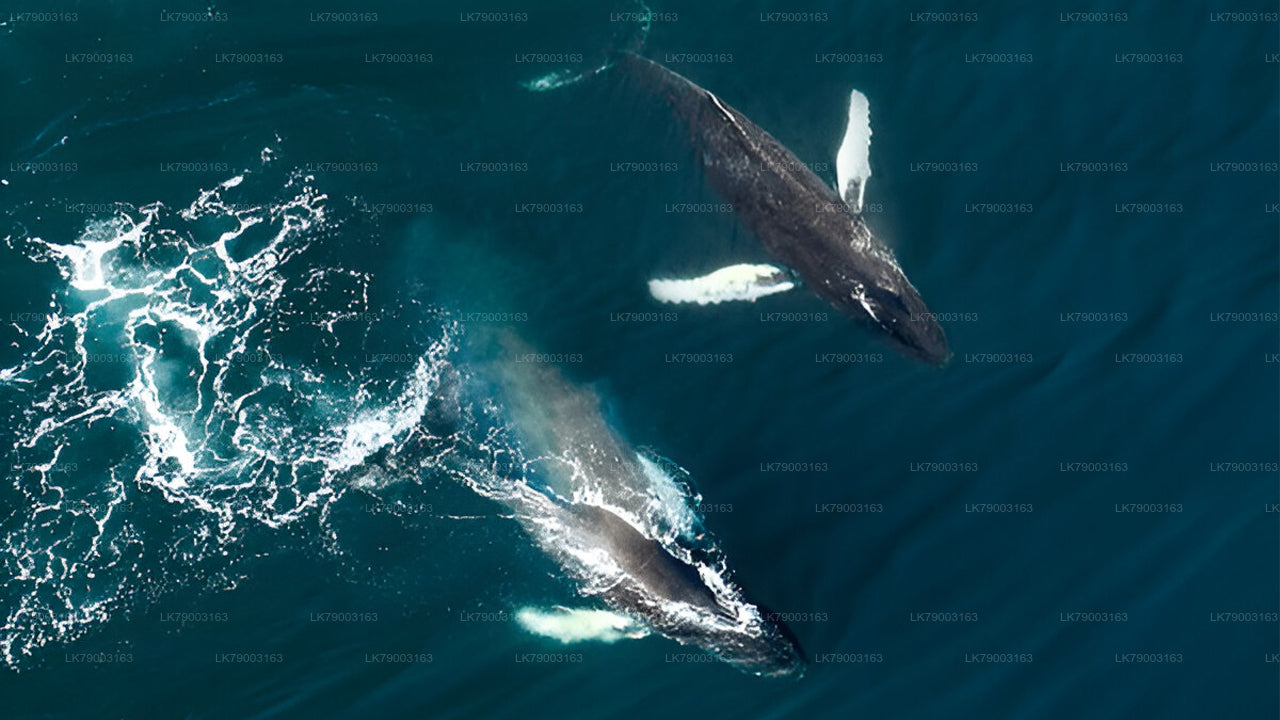
From roughly November to April, when the sea on the south coast is calm, the harbour is the starting point for Mirissa's whale-watching trips. Boats usually leave between about 6 and 7 in the morning, when the sea is flattest, and head south into deep water off Dondra Head, a run that can take an hour or more. The main hope is the blue whale, the largest animal on earth, which is seen off this coast with unusual regularity. Sperm whales, Bryde's whales and large schools of spinner dolphins are also regularly seen, though no trip can promise a sighting. Most trips return between late morning and early afternoon. Outside that season the southwest monsoon makes the sea rough, and most whale-watching boats stop running.
Whale watching in Sri Lanka is regulated. Under the Sea Mammals (Observation, Regulation and Control) Regulations of 2012, whale-watching boats need an annual licence from the Department of Wildlife Conservation, must keep at least 100 metres from the animals, and may not chase, surround or block their path. Swimming or diving with whales needs the prior approval of the Department's Director General, and the Sri Lanka Coast Guard monitors boats in the Mirissa area. Some unlicensed operators still offer swim-with-whales trips, often on boats licensed only for sport fishing. For the whales' sake and your own safety, book with a licensed operator and do not join a trip that promises to put you in the water with whales.
The same deep water draws sport anglers. Deep-sea fishing charters from Mirissa go out after tuna, wahoo, dorado and billfish, and sunset and overnight cruises also start from the harbour.
Visiting the Harbour
You do not need to join a boat trip to see the harbour. There is no published entry charge, but it is a working port, not a tourist attraction, and it pays to behave like a guest:
- Go early. The catch comes in and the auction runs from around dawn, and whale-watching boats leave from about 6 to 7 a.m. in season. By late morning the quays are quiet.
- Keep out of the way. Crates, carts, ice and fish move fast, and people are working to a clock. Stand back from the auction floor and from boats being unloaded, and never step aboard a boat without being invited.
- Ask before you photograph people. Most fishermen are happy to be photographed, but a gesture or a smile first is simple courtesy, and some will say no.
- Wear shoes with grip. The quays are wet, slippery and covered in fish scales and ice melt. Sandals with soles are better than flip-flops, and nothing you mind getting dirty.
- Bring cash. If you want to buy fish, or pay for a boat trip booked on the spot, card payments are rarely possible.
- Expect the smell. It is a fish harbour, and by mid-morning in the heat it smells like one.
The south coast's fishing communities were among the hardest hit by the Indian Ocean tsunami of 26 December 2004, which damaged homes, guesthouses, shops, schools and temples in Mirissa and killed fourteen people in the village. The harbour and its fleet were rebuilt, but the families who work here remember that day, and it is worth keeping that in mind on a busy quay.
Getting There
The harbour lies on Harbour Road, off the Galle to Matara coast road (the A2), on the Weligama side of Mirissa, a short tuk-tuk ride or a walk of about half an hour from the middle of Mirissa Beach. Mirissa Railway Station and Weligama Railway Station, both on the coastal line from Colombo, are close by. By road, Mirissa is about 154 km from Colombo, and the Southern Expressway's Kokmaduwa interchange is roughly 13 km away. If you are booked on a whale-watching trip, most operators include a pick-up from Mirissa or Weligama hotels, or tell you exactly where on the quay to meet their boat.
Nearby
- Mirissa Beach, the crescent of sand and palms east of the harbour, and Coconut Tree Hill, the palm-covered headland at its far end.
- Weligama Beach and Weligama town, around the bay to the west, with gentle surf and Taprobane Island just offshore.
- The stilt fishermen of the coast between Weligama and Koggala, who fish from poles set into the shallows, a very different tradition from the harbour's boats.
- Other fishing ports and markets worth comparing: Galle Harbour along the coast to the west, Dikkowita Fishery Harbour near Colombo, and the Negombo Fish Market.
Luoghi nelle vicinanze
9 luoghi entro circa 25 km, dal più vicino.
- Coconut Tree Hillmeno di 1 km
- Mirissa Samudragiri Viharayameno di 1 km
- Mirissa Railway Stationmeno di 1 km
- Mirissa Beach2 km
- Città di Mirissa2 km
- Polwathumodara Railway Station3 km
- Kumbalgama Railway Station3 km
- Secret Beach3 km
- Kamburugamuwa Railway Station4 km
Letture correlate
9 pagine su argomenti strettamente correlati.