


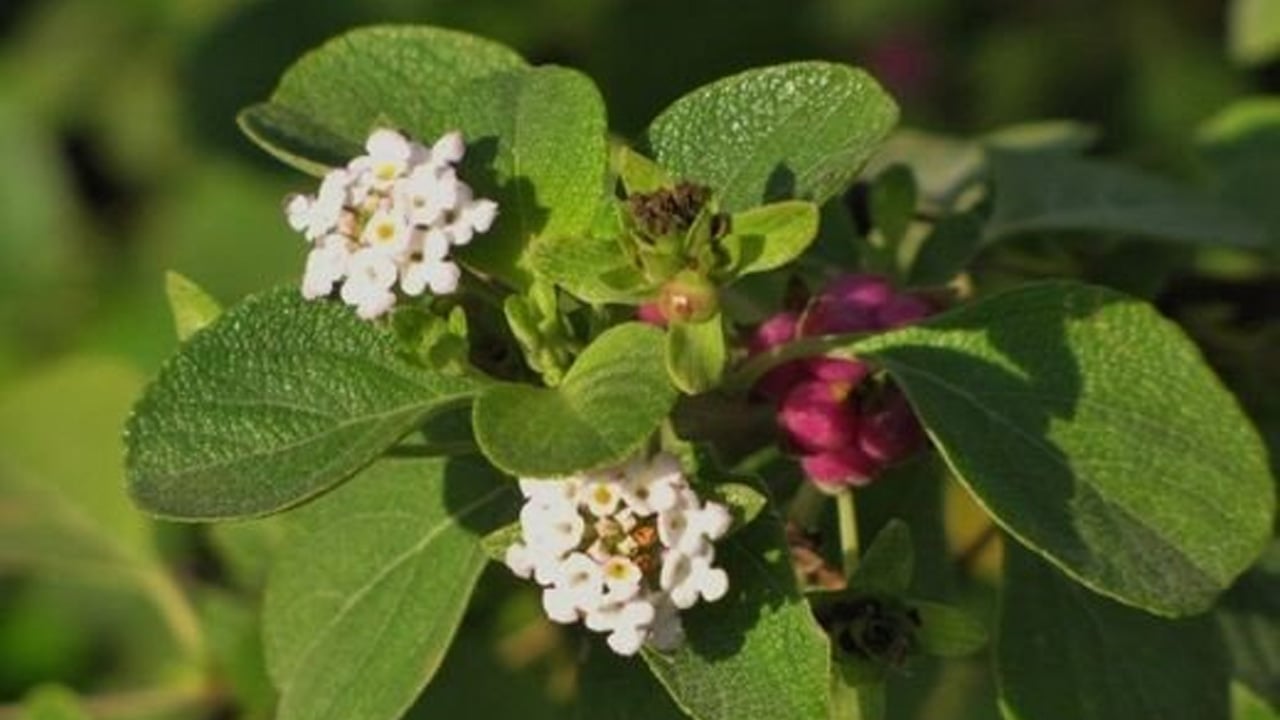

Wild Lantana — known locally as Baloliya — is one of the most recognisable shrubs across Sri Lanka's roadsides, forest edges, and disturbed grasslands. Originally native to tropical and subtropical America, it has naturalised so thoroughly across the island that many visitors assume it is indigenous. Its clusters of small, multi-coloured flowers attract a constant stream of butterflies and bees, making it an ecologically active presence even where it is botanically out of place.
What does Wild Lantana look like?
Lantana camara is a woody shrub that typically reaches around 1.5 to 1.8 metres in height, though it can spread considerably wider when left unmanaged. The leaves are dark green, ovate, and noticeably rough to the touch; crushing them releases a pungent, resinous scent that many people find distinctive rather than pleasant.
The flowers are the plant's most striking feature. They form tight, dome-shaped clusters and display a remarkable colour range — yellow, orange, red, pink, and purple often appear simultaneously on a single plant. Individual florets change colour as they mature, so an older cluster may show several shades at once. After flowering, small berry-like fruits develop, ripening from green through to dark purple or near-black.
Where does Wild Lantana grow in Sri Lanka?
Lantana thrives in warm, sun-drenched conditions and is highly drought-tolerant once established. In Sri Lanka it colonises roadsides, overgrazed pastures, tea estate margins, and the edges of national parks with equal ease. It is particularly common in the dry and intermediate zones, but it appears across elevations from coastal lowlands up into the hill country.
Its presence around protected areas such as Udawalawe National Park and Wilpattu National Park has been noted by conservationists, since dense Lantana thickets can outcompete native ground-cover vegetation and reduce habitat quality for browsing herbivores. Management of the plant within and around park boundaries is an ongoing conservation challenge.
Is Wild Lantana invasive?
Yes — and this is an important part of its ecological story. Lantana camara is listed among the world's most problematic invasive plant species. Birds readily consume its ripe fruits and disperse the seeds widely, allowing the plant to establish quickly in cleared or degraded land. Once a stand takes hold, its dense growth and allelopathic properties (chemicals released from its roots and leaf litter) can suppress the germination of native seedlings beneath it.
In Sri Lanka, as in many tropical countries, land managers use a combination of mechanical clearance and targeted replanting of native species to contain Lantana in ecologically sensitive zones. Travellers who notice large monocultures of the shrub at forest edges are often seeing the aftermath of disturbance — logging, fire, or overgrazing — that gave the plant its opening.
What attracts wildlife to Wild Lantana?
Despite its invasive reputation, Lantana does provide genuine ecological services in the landscapes it occupies. Its nectar-rich flowers attract a wide range of butterflies, including several species common to Sri Lanka's lowland forests. Bees forage heavily on the blooms, and certain sunbird species visit the flowers regularly.
The ripe fruits are eaten by bulbuls, mynas, and other frugivorous birds — which is precisely how the seeds spread so effectively. Mammals generally avoid the foliage, partly because the leaves contain lantadene compounds that are toxic to livestock and, to a lesser degree, other herbivores. This toxicity is one reason Lantana spreads so successfully in grazed landscapes: cattle leave it alone while consuming competing plants around it.
Does Wild Lantana have medicinal or traditional uses?
Several traditional medicine systems across South Asia and Africa have recorded uses for Lantana, typically involving leaf poultices or decoctions applied externally for skin conditions, and preparations said to have anti-inflammatory properties. However, the plant contains pentacyclic triterpenoids (lantadene A and B) that are hepatotoxic at sufficient doses, particularly in livestock but also potentially in humans.
Caution is strongly advised. Parts of the plant — especially the unripe berries — should never be consumed without expert guidance. Any medicinal use should be discussed with a qualified practitioner familiar with the specific preparation and dose. The ripe black fruits are less toxic than unripe green ones, but even ripe berries have caused poisoning in children.
How is Wild Lantana used in gardens and landscapes?
In controlled garden settings, selected Lantana cultivars are genuinely useful ornamental plants. Their long flowering season, low water requirement once established, and strong appeal to pollinators make them popular in tropical gardens across Sri Lanka. They are often used as informal hedges, ground cover on steep or eroded slopes, or as filler plants in low-maintenance beds.
- Pollinator gardens: few shrubs attract as many butterfly species over as long a season.
- Erosion control: the spreading root system stabilises loose or sloped soil effectively.
- Low-maintenance colour: Lantana requires minimal fertilisation and tolerates periods of drought.
- Container planting: dwarf cultivars work well in pots and planters on terraces or balconies.
Gardeners in Sri Lanka are advised to use sterile or low-seed cultivars where possible, deadhead spent blooms before fruit sets, and avoid planting near natural forest edges where seed dispersal into wild land is likely.
How do you grow and care for Wild Lantana?
Lantana is undemanding once it is in the right conditions. The key requirements are as follows:
| Factor | Requirement |
|---|---|
| Sunlight | Full sun; at least 6 hours of direct light daily |
| Soil | Well-drained; tolerates poor, sandy, or rocky soils |
| Watering | Moderate until established; drought-tolerant thereafter |
| Temperature | Warm tropical to subtropical; not frost-tolerant |
| Pruning | Cut back hard after each flush of flowering to maintain shape and encourage new blooms |
| Fertiliser | Light; over-fertilising encourages foliage at the expense of flowers |
In Sri Lanka's humid lowlands, Lantana will flower almost year-round. In the cooler hill country, flowering may slow somewhat during the coldest months between December and February.
What is the conservation status of Wild Lantana?
Lantana camara is not threatened as a species — quite the opposite. Its global spread is considered one of the more significant botanical conservation challenges in tropical ecosystems. The IUCN recognises invasive species as one of the leading drivers of biodiversity loss worldwide, and Lantana features prominently in regional management plans across South and Southeast Asia, Africa, and the Pacific.
In Sri Lanka, native forest understory plants in areas such as the Sinharaja Forest Reserve buffer zones are particularly at risk where Lantana has been allowed to establish. Conservation volunteers and forest department staff periodically undertake clearing operations in the most sensitive areas.
Related reading
6 pages on closely related subjects.

