
Chrysanthemums, known in Sinhala as Kapuru Mala, are among the most widely cultivated flowering plants in the world. With a cultivation history stretching back more than 2,000 years in China, they have spread across Asia, Europe, and beyond, valued equally for their ornamental beauty, cultural meaning, and practical uses in cuisine and traditional herbal teas. In Sri Lanka, they are a familiar sight in home gardens, temple offerings, and decorative floral arrangements.
What do chrysanthemums look like?
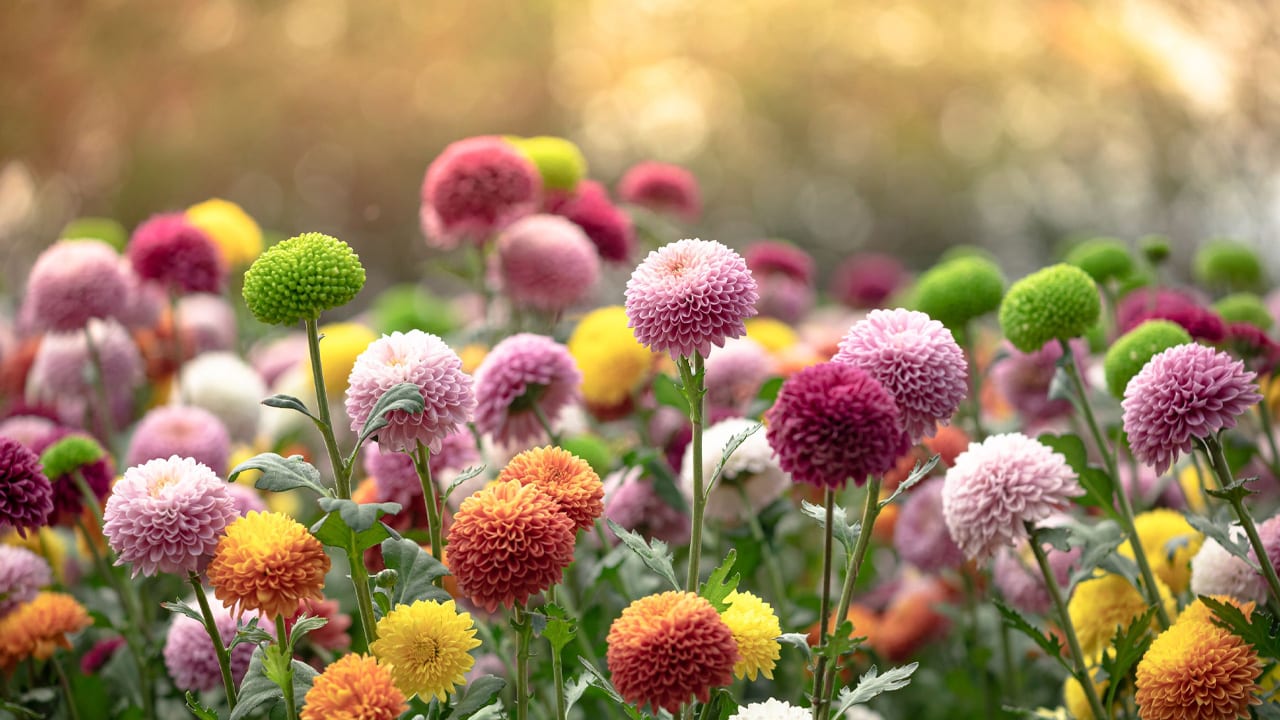
Chrysanthemums produce flowers in a remarkably wide range of colours — yellow, white, red, purple, pink, and orange — and in forms that vary from simple daisy-like petals to dense pom-pom blooms and intricately layered arrangements. The plants themselves are compact to moderately large, with most garden varieties growing between 30 and 90 cm (1–3 feet) in height. Their leaves are dark green with distinctly serrated edges, and the foliage provides a dense backdrop that sets off the flowers well.
This variety in form and colour is one reason chrysanthemums remain a staple in horticulture worldwide. Garden centres and plant nurseries typically distinguish between spray types, which carry multiple smaller flowers per stem, and standard types, which are pruned to produce one large bloom per stem.
Where are chrysanthemums originally from?
The genus Chrysanthemum is native to Asia and northeastern Europe, with China recognised as the primary centre of domestication. Chinese records of chrysanthemum cultivation date to at least the 15th century BCE. By the 8th century CE, the plant had reached Japan, where it was adopted by the imperial court and became one of the country's most important cultural symbols. European gardeners encountered chrysanthemums in the 17th century, and selective breeding in the centuries since has produced the enormous diversity of cultivars available today.
What is the cultural significance of chrysanthemums?
Few flowers carry as much symbolic weight across different cultures as the chrysanthemum.
- China: The chrysanthemum represents longevity, vitality, and steadfastness. It is one of the Four Gentlemen — along with plum, orchid, and bamboo — that feature prominently in classical Chinese painting and poetry.
- Japan: The sixteen-petalled chrysanthemum is the emblem of the Japanese Imperial family, and the Chrysanthemum Throne is the formal term for the Japanese monarchy. The annual Kiku Matsuri festival, held at shrines and botanical gardens across the country each autumn, celebrates the flower with elaborate sculptural displays.
- Western cultures: In much of Europe and North America, chrysanthemums are associated with friendship and joy, and are a common choice for autumn bouquets and centrepieces. In some southern European countries, however, they are strongly associated with funerals and are not typically given as gifts in other contexts.
- Sri Lanka: Chrysanthemums appear frequently in religious contexts — offered at temples and used to decorate shrines during important festivals. Their long vase life makes them practical for offerings that need to remain fresh over several days.
What are the main uses of chrysanthemums?
Chrysanthemums are useful well beyond the flower bed. Their applications span ornamental horticulture, traditional herbal tea, and the kitchen.
- Ornamental: Grown in gardens, public parks, and window boxes for their seasonal colour. They are a mainstay of autumn planting schemes in temperate climates.
- Floral arrangements: Cut chrysanthemums have a long vase life — often two weeks or more — which makes them commercially important in the global cut-flower trade.
- Herbal tea: Dried chrysanthemum flowers are brewed into a herbal tea that is part of the traditional Chinese medicine heritage. This preparation, known as júhuā chá, remains widely consumed across East Asia as an everyday drink.
- Edible: Certain varieties — particularly those with small, pale petals — are used as a vegetable in Asian cooking. Young leaves are blanched or stir-fried, while flowers appear as garnishes in salads and hot pots.
- Pest control: Pyrethrin, a natural insecticide derived from chrysanthemum flowers, has been used for centuries and remains an ingredient in some modern organic pesticides.
How do you grow and care for chrysanthemums?
Chrysanthemums are rewarding garden plants but do have specific requirements. Meeting them consistently is the difference between a brief flush of colour and a long, productive flowering season.
| Requirement | Guidance |
|---|---|
| Light | Full sun — at least 6 hours of direct sunlight daily. Insufficient light leads to weak, leggy growth and fewer flowers. |
| Watering | Regular watering during dry periods, keeping the soil consistently moist but well-drained. Waterlogged roots encourage fungal disease. |
| Temperature | Cooler temperatures suit chrysanthemums best. They are natural short-day plants, triggered to flower as days shorten in autumn. |
| Soil | Fertile, well-drained soil with a pH between 6.0 and 7.0. Enrich with compost before planting. |
| Pruning | Pinch back growing tips in spring and early summer to promote bushy growth and more flower buds. Deadhead spent blooms to extend flowering. |
| Feeding | Apply a balanced, slow-release fertiliser at planting, switching to a low-nitrogen feed as flower buds form. |
In Sri Lanka's tropical climate, chrysanthemums perform best at higher elevations where temperatures are cooler. Hill-country gardens around Nuwara Eliya and Ella are particularly well-suited to growing them successfully. In the lowlands, they can be cultivated but may require partial shade during the hottest hours of the day and careful attention to drainage during the monsoon.
Are there different types of chrysanthemums?
Horticulturalists classify chrysanthemums into a number of recognised bloom forms, each with a distinctive appearance. The most commonly encountered include:
- Single: One or two rows of petals around a central disc — similar in appearance to a daisy.
- Pompon: Fully double, spherical blooms with short, tightly packed petals. These are very popular in cut-flower markets.
- Decorative: Fully double blooms with flat or slightly incurved petals and no visible centre disc.
- Spoon: Petals that widen at the tip into a spoon-shaped form.
- Spider: Long, tube-like petals that extend outward and curve at the tips.
Most ornamental chrysanthemums sold in Sri Lanka belong to the decorative or pompon categories, though single-flower types are also used in religious offerings.
How do chrysanthemums relate to Sri Lankan culture and gardens?
While chrysanthemums are not native to Sri Lanka, they have been embraced as garden ornamentals and temple flowers for generations. They complement other important plant species in Sri Lankan traditional practice — much as Syzygium aromaticum and other aromatic plants are part of Ayurvedic heritage and ritual, chrysanthemums occupy a place in everyday floral culture, particularly in offerings associated with religious observance.
In the hill country, where cooler air allows for better blooming, you will find chrysanthemums in private gardens and at roadside plant stalls. Their availability coincides broadly with the cooler months, and they remain one of the more affordable long-lasting cut flowers available locally.