


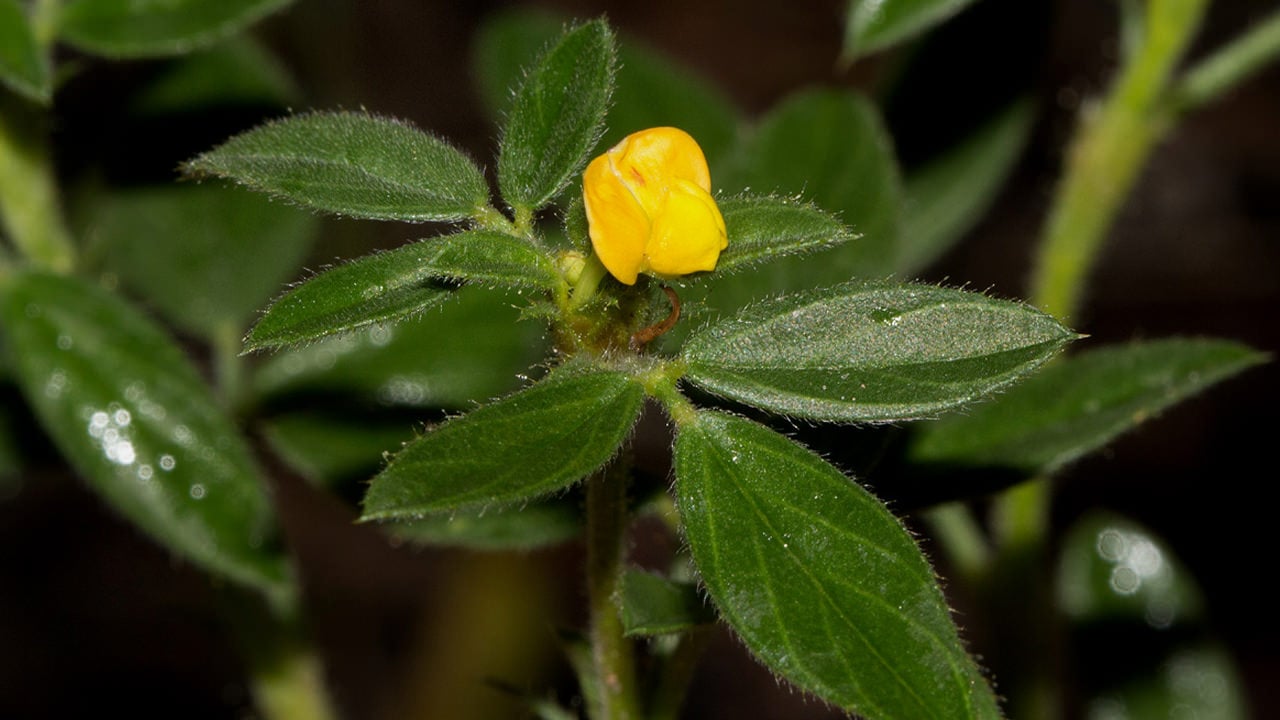
Stylosanthes fruticosa, commonly called African stylo, wild lucerne, or shrubby pencil-flower, is a small perennial herb in the legume family Fabaceae. Native across a broad arc from Cape Verde and sub-Saharan Africa through the Arabian Peninsula, India, Sri Lanka, and Myanmar, it has also been introduced to Hawaii. In Sri Lanka it appears in a range of habitats — from coastal lowlands to mid-elevation scrublands — and holds a recognised place in the island's Ayurvedic pharmacopoeia.
What does Stylosanthes fruticosa look like?
The plant is a small shrubby herb, sometimes only short-lived, with erect or occasionally prostrate stems growing up to 1 m long. Stems are densely hairy and can be bristly to the touch. Leaves are trifoliolate — meaning each leaf is divided into three leaflets — with individual leaflets that are elliptic to lance-shaped, up to 3.3 cm long, and covered in a soft, velvety texture with bristly hairs. Leaf margins are entire and often slightly thickened.
Flowers are borne in dense heads at leaf axils and at the tips of branches, with normally only one flower opening at a time. The flower shape is typical of the pea family (papilionoid): the standard petal is creamy-white to orange-yellow with distinctive red veining and a red base, while the wings and keel are yellow. The seed pod is small — 4–9 mm long — has one to two segments, and carries a short beak at its tip.
Where does Stylosanthes fruticosa grow?
This species is notably adaptable. It tolerates acid soils, light shade, and even occasional light frosts, and can complete its life cycle on as little as 300 mm of rainfall per year. Its altitudinal range extends from sea level to around 2,000 m (6,600 ft), which in a Sri Lankan context means it can be found from coastal scrub margins up through the foothills toward the central highlands.
Within Sri Lanka, wild lucerne tends to appear along roadsides, in dry and intermediate zone grasslands, and at the edges of secondary forest. Areas around dry-zone ecosystems — including the buffer zones of parks such as Wilpattu National Park — provide suitable open habitat. It is also recorded from the wetter Sabaragamuwa lowlands and the margins of forest reserves in the wet zone.
Why is Stylosanthes fruticosa valued as a forage plant?
Livestock readily graze Stylosanthes fruticosa, and its ability to fix atmospheric nitrogen — a trait shared by most Fabaceae members — means it can improve soil fertility in degraded pastures. Its drought tolerance and capacity to grow on marginal, acidic soils make it particularly useful in tropical smallholder farming systems where improved pasture grasses may not establish reliably.
As a legume, it contributes protein-rich forage even during dry periods when grass quality declines. These qualities have seen African stylo deliberately introduced and trialled as a pasture improvement species in several tropical countries, though in Sri Lanka it is most often encountered as a naturally occurring component of existing grassland and scrub communities.
What is the Ayurvedic significance of Stylosanthes fruticosa in Sri Lanka?
Stylosanthes fruticosa is formally listed in the catalogue of Ayurvedic medicinal plants of Sri Lanka, which is maintained under the country's Ayurveda Act and overseen by the Department of Ayurveda. This inclusion reflects centuries of documented traditional use, though specific therapeutic applications vary across regional traditions within Sri Lanka and across the broader South Asian Ayurvedic canon.
Sri Lanka's Ayurvedic plant heritage is unusually rich, partly because the island sits at a botanical crossroads between the Indian subcontinent and Southeast Asia. Other significant plants in this tradition include Pongamia pinnata and Acacia chundra, both of which share overlapping dry-zone habitats with Stylosanthes fruticosa. Practitioners and researchers consulting this pharmacopoeia can access the official catalogue through the Sri Lanka Department of Ayurveda.
How does Stylosanthes fruticosa relate to Sri Lanka's broader botanical landscape?
Sri Lanka supports an exceptionally diverse native flora for its size — the island is one of 36 recognised global biodiversity hotspots — and legumes like Stylosanthes fruticosa play a foundational ecological role. By fixing nitrogen and providing dense ground cover, they help stabilise thin tropical soils and support invertebrate communities that in turn sustain insectivorous birds and reptiles.
Visitors with an interest in Sri Lanka's plant life will find that nature-focused experiences — whether in dry-zone national parks, Sinharaja Forest Reserve, or the mid-country tea highlands — offer incidental encounters with a remarkable range of native and naturalised flora. Guided experiences that focus on ethnobotany and Ayurvedic plant knowledge are increasingly available as part of responsible tourism itineraries.
Is Stylosanthes fruticosa related to Cordyline fruticosa?
Despite sharing the species epithet fruticosa (Latin for "shrubby"), Stylosanthes fruticosa and Cordyline fruticosa are entirely unrelated plants from different families and continents of origin. Stylosanthes fruticosa is a leguminous herb native to Africa and Asia; Cordyline fruticosa is a monocot from the family Asparagaceae, widely grown as an ornamental for its colourful foliage. The shared epithet is a coincidence of descriptive taxonomy, not an indicator of botanical kinship.
Taxonomic summary
| Attribute | Detail |
|---|---|
| Scientific name | Stylosanthes fruticosa (Retz.) Alston |
| Synonym | Arachis fruticosa |
| Family | Fabaceae (Leguminosae) |
| Common names | African stylo, wild lucerne, shrubby pencil-flower |
| Native range | Cape Verde, sub-Saharan Africa, Madagascar, Arabian Peninsula, India, Sri Lanka, Myanmar |
| Introduced range | Hawaii |
| Growth habit | Shrubby perennial herb, stems to 1 m |
| Altitude range | Sea level to approximately 2,000 m |
| Minimum rainfall | Around 300 mm per year |
| Sri Lanka status | Native; listed in Ayurvedic medicinal plant catalogue |
