Avicennia officinalis, commonly known as the Indian mangrove, is one of the most ecologically significant mangrove species found across coastal and riverine habitats in South and Southeast Asia. Its genus name honours Ibn Sina — the celebrated medieval Iranian physician and polymath — reflecting the plant's long-standing role in traditional medicine and local livelihoods. In Sri Lanka, it is known in Sinhala as මොටමුණ්ඩ (Motamunda) and tends to favour the quieter, clay-rich banks of inland rivers rather than the open coastline.
What does Avicennia officinalis look like?
Young specimens of Avicennia officinalis develop a low, dense bushy crown that makes them easy to overlook among taller riverine vegetation. As the tree matures, it adopts a more upright, columnar form and can reach around 15 m in height, with some individuals reportedly exceeding 25–30 m under favourable conditions.
- Leaves: Shiny green on the upper surface, roughly 10 cm long by 5 cm wide, with rounded tips and a distinctive golden-brown underside. Leaves are arranged in opposite pairs along the stems.
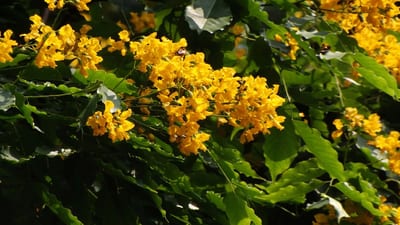
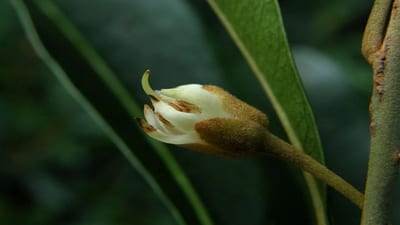
- Flowers: Orange-yellow to lemon-yellow, and notably the largest flowers among all Avicennia species, measuring 6–10 mm in diameter when fully open. The blossoms attract a variety of pollinating insects.
- Bark: Smooth in texture, ranging from dirty green to dark grey in colour. Unlike many other tree species, the bark does not flake and is only lightly fissured.
- Fruit: Green or brown, heart-shaped, and abruptly narrowed to a short beak. Fruits are typically 2.5 cm or more in length.
Like other members of the Avicennia genus, A. officinalis produces pneumatophores — pencil-like aerial roots that project upward from the soil surface, allowing the tree to absorb oxygen in the anaerobic, waterlogged conditions typical of mangrove environments.
Where does Avicennia officinalis grow in Sri Lanka?
Avicennia officinalis is found sporadically along river banks across Sri Lanka's wetter lowland zones. Unlike some mangrove species that thrive in dense coastal thickets directly exposed to tidal saltwater, this species shows a preference for clay soils further inland along tidal rivers and estuaries. It is rarely encountered on open shorelines.
One of the best-documented mangrove ecosystems in Sri Lanka where species such as A. officinalis may be observed is the Madu Ganga estuary near Balapitiya on the southwest coast — a RAMSAR-listed wetland of international importance. Guided boat trips through this network of waterways offer an accessible way to study the layered structure of Sri Lanka's mangrove forests at close range.
Where else in the world does this species occur?
Avicennia officinalis has a wide Indo-Pacific distribution, occurring across a broad arc from the western Indian Ocean to the western Pacific. Countries where the species is recorded include Iran, Bangladesh, India, Myanmar, Thailand, Cambodia, Vietnam, Malaysia, Brunei, Indonesia, the Philippines, Singapore, Papua New Guinea, and Sri Lanka. Within this range, populations vary in density depending on local hydrology, salinity levels, and land-use pressures.
What are the traditional and practical uses of Avicennia officinalis?
Communities living alongside mangrove forests have made use of Avicennia officinalis in several practical ways over generations. The fruit is edible and has been consumed by local communities in various parts of its range, typically after preparation to reduce any bitterness. The dense, hard wood burns well and has historically served as a reliable source of firewood in coastal and riverine communities where other fuel sources may be limited.
Traditionally, sap from the tree has also been recorded as having applications in folk medicine, including use as a contraceptive agent — though such applications are not part of modern clinical practice and should be understood in their ethnobotanical context. The species also has potential value in coastal protection: mangrove stands buffer shorelines against wave energy, trap sediment, and help stabilise river banks against erosion.
Why are mangrove forests ecologically important?
Mangroves like Avicennia officinalis support disproportionately high levels of biodiversity relative to the area they cover. The root systems create sheltered nursery habitats for juvenile fish, crustaceans, and molluscs, making them critically linked to nearshore fisheries. They also sequester significant quantities of carbon in their biomass and waterlogged soils, making their conservation relevant to global climate discussions.
In Sri Lanka, mangrove cover declined substantially during the latter half of the twentieth century due to coastal development, aquaculture expansion, and unsustainable harvesting. Conservation programmes supported by government agencies and international bodies have worked to restore key estuarine habitats since the early 2000s, and several protected wetlands now give legal cover to the remaining stands. Responsible wildlife and nature tourism — such as the boat safaris available on the Madu River Safari — can help sustain the economic case for protecting these ecosystems.
How does Avicennia officinalis compare with other mangrove species?
| Feature | Avicennia officinalis | Typical coastal mangrove (e.g. Rhizophora spp.) |
|---|---|---|
| Preferred habitat | Inland riverbanks, clay soil | Open coastline, tidal mudflats |
| Root adaptation | Pencil-like pneumatophores | Arching prop roots |
| Flower size | Largest in the Avicennia genus | Typically smaller |
| Bark character | Smooth, non-flaking | Varies by species |
| Mature height | Up to 15 m, occasionally more | Typically 5–10 m in Sri Lanka |
What conservation status does Avicennia officinalis have?
Avicennia officinalis is listed on the IUCN Red List. While the species is not currently considered globally threatened, localised populations face pressure from habitat loss, particularly where estuarine land is converted for agriculture or construction. Sri Lanka's Wilpattu National Park catchment and associated coastal wetlands support some of the country's more intact northern mangrove systems, underscoring the importance of protected-area networks for species such as this.
In the context of broader biodiversity conservation in Sri Lanka, understanding individual species like A. officinalis is part of a wider effort to document and protect the island's remarkable range of plant life — from coastal mangroves to interior rainforests such as the Sinharaja Forest Reserve.