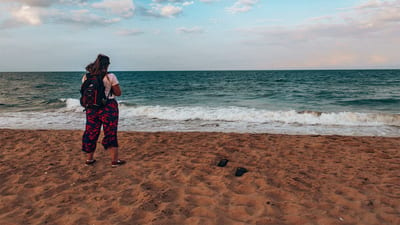
Puttalam District occupies Sri Lanka's northwestern seaboard, covering roughly 3,072 km² of coast, lagoon, scrub forest and paddy land. Together with Kurunegala District it forms the North Western Province, and it is one of the few parts of the island where Buddhism, Roman Catholicism, Hinduism and Islam have coexisted for centuries — a character that is still visible in the district's temples, churches and mosques.
What does Puttalam District cover?
The district capital, Puttalam town, sits on the shore of a broad coastal lagoon. The boundaries run north to the Kala Oya and Modaragam Aru rivers, east to Anuradhapura and Kurunegala districts, south to the Ma Oya, and west to the Indian Ocean. The coastline is not a single beach strip but a broken edge of peninsulas, barrier islands and backwater channels, the most significant of which is the Kalpitiya Peninsula.
The terrain moves quickly inland from mangrove fringe to low scrub jungle. Much of that jungle falls within — or borders — Wilpattu National Park, Sri Lanka's largest national park by area, whose western sections touch Puttalam District.
What is Kalpitiya and why do travellers visit?
Kalpitiya is a narrow peninsula that juts northward into the Puttalam Lagoon, separating it from the open sea. The sheltered water on its eastern side is ideal for shallow-water fishing and supports an active prawn and fish farming industry — a livelihood that has shaped the peninsula's villages for generations.
On the oceanside, Bar Reef lies just offshore — a marine sanctuary recognised as one of the largest coral reef systems in Sri Lanka. Between roughly November and April, the waters around Kalpitiya and the adjacent Bar Reef are among the most reliable spots in South Asia to encounter spinner dolphins, and blue and sperm whales pass through during the peak season. Kitesurfing has grown steadily as a sport here, with consistent winds from May to October drawing enthusiasts from across the region.
- Whale and dolphin watching — typically November to April for blue whales; spinner dolphins present for much of the year
- Kitesurfing — best from May to October when the southwest monsoon delivers steady winds
- Shallow-sea fishing — traditional outrigger fishing communities welcome visitors
- Bar Reef snorkelling — access by boat from Kalpitiya jetty; best visibility between December and March
How does Wilpattu National Park relate to Puttalam District?
Wilpattu's main entrance gate at Hunuwilgama is reached via Puttalam town, making the district the practical gateway to the park. The park is best known for its villus — natural, seasonally flooded lakes surrounded by white sand — and for one of the highest leopard densities of any protected area in Sri Lanka. Sloth bears, Asian elephants, Sri Lankan spotted deer, and mugger crocodiles are also regularly sighted. The park is generally open year-round, though leopard sightings are particularly common during the dry season (roughly May to September) when animals concentrate around the villus.
What religious and historical sites are in Puttalam District?
The district's multi-faith character is expressed in a series of pilgrimage sites that draw Sri Lankans from across the island.
- Munneswaram Hindu Temple — one of the oldest and most venerated Shaivite temples in Sri Lanka, located near Chilaw. Its annual festival draws large crowds of Tamil and Sinhalese devotees alike.
- St. Anne's Church, Thalawila — a Catholic shrine on the western coast of the Kalpitiya Peninsula. The feast of St. Anne in late July brings pilgrims from across Sri Lanka and beyond.
- Iranawila Rajamaha Viharaya — a historic Buddhist temple at Iranawila, reflecting the early Buddhist settlement of the region during the Anuradhapura kingdom period.
Buddhism took root here during the early Anuradhapura era, and the district's temples record that continuity. The Roman Catholic presence dates largely from the Portuguese colonial period (16th–17th centuries), when Chilaw and the coastal fishing communities converted in significant numbers.
What is the economy of Puttalam District built on?
Salt production is one of the most visible industries: the broad, shallow lagoons around Puttalam town are ideal for solar salt pans, and the district supplies a substantial share of Sri Lanka's commercial salt. Prawn farming — particularly in the backwaters of Kalpitiya — is a significant export earner. Coconut cultivation covers much of the inland area; the North Western Province as a whole is one of Sri Lanka's primary coconut-growing regions, and the coconut palm is woven into every aspect of local food, craft and construction.
Fishing — both artisanal inshore fishing and small-scale deep-sea operations — remains a core livelihood along the entire coast. The Puttalam Lagoon supports a separate ecosystem of subsistence and commercial fishing distinct from the open-sea fishery off Kalpitiya.
When is the best time to visit Puttalam District?
The district experiences two distinct monsoon influences. The northeast monsoon (roughly November to March) brings drier, calmer conditions to the west coast — the best window for whale watching off Kalpitiya and snorkelling at Bar Reef. The southwest monsoon (May to September) brings rain but also the consistent winds that make Kalpitiya a kitesurfing destination.
| Activity | Best months |
|---|---|
| Blue whale watching | November – April |
| Kitesurfing | May – October |
| Wilpattu leopard safaris | May – September (dry season) |
| Bar Reef snorkelling | December – March |
| St. Anne's pilgrimage (Thalawila) | Late July |
How do I get to Puttalam District from Colombo?
Puttalam town lies around 130 km north of Colombo, typically a 2.5–3 hour drive along the A3 coastal road through Negombo and Chilaw. Private transfers are the most flexible option, especially if you plan to visit Wilpattu or Kalpitiya in the same trip. An intercity bus service operates between Colombo's Central Bus Stand and Puttalam, and the journey is similarly timed. Trains on the Puttalam Line also run from Colombo via Chilaw to Puttalam town.
For Kalpitiya specifically, the peninsula is reached by continuing north from Puttalam town along a causeway road — a further 30–40 minutes by road.
What other attractions are worth combining with Puttalam?
Puttalam District pairs naturally with a broader northwest Sri Lanka itinerary. Chilaw's Dutch-era fort and its active fish market make a worthwhile detour on the drive north. The Negombo lagoon and its Catholic fishing communities lie about an hour south, sharing a similar coastal character. Further afield, the ancient capital of Anuradhapura is accessible in under two hours from Puttalam, making it possible to link a coastal stay with the Cultural Triangle.
Nearby places
14 places within about 25 km, nearest first.
- Puttalam Cityunder 1 km
- Puttalam Railway Stationunder 1 km
- Thilladiya Railway Station2 km
- Erukkalam Pendu Railway Station2 km
- Thalawila2 km
- Urani River Safari2 km
- Nooranagar Railway Station3 km
- Deduru Oya6 km
- Anawilundawa6 km
- Palavi Railway Station6 km
- Mangalaeliya Railway Station8 km
- Pulachchikulam Railway Station9 km
- Muthiyankattuwa Thaddayamale10 km
- Battaluoya Railway Station11 km