


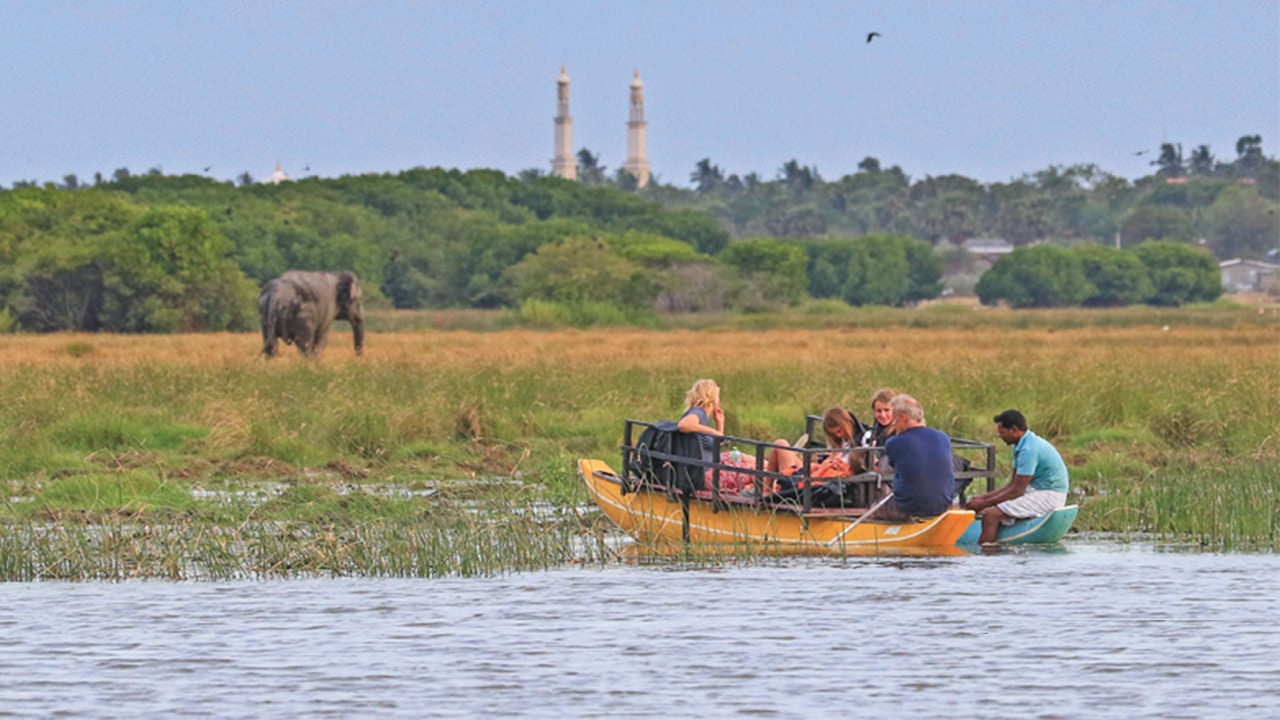
Urani Lagoon sits quietly in Sri Lanka's North Western Province, yet it shelters one of the island's most diverse coastal ecosystems. A boat journey across its calm waters brings you within close range of wildlife that most visitors associate only with inland national parks — wild Asian Elephants wading at the lagoon's edge, Saltwater Crocodiles resting on mudbanks, and a canopy of mangrove forest that muffles the outside world. For those who want to see Sri Lanka's wilder side without the crowded jeep tracks of the southern circuit, Urani is a compelling alternative.
What wildlife can I see on the Urani River Safari?
Researchers have recorded a total of 270 faunal species in and around Urani Lagoon and its surrounding ecosystems. That figure spans mammals, reptiles, fish, crustaceans, and a remarkable variety of birds.
Two of the species listed among the seven priority animals by Sri Lanka's Department of Wildlife Conservation are found here: the Asian Elephant (Elephas maximus) and the Saltwater Crocodile (Crocodylus porosus). Urani is considered one of the few places in the country where wild elephants can be observed at close range from a boat, as they regularly come to the lagoon shore to drink and bathe. For a closer look at crocodile behaviour in a river setting, the Crocodile Watching guide explains what to expect during a typical sighting.
- Asian Elephant — frequently seen at the lagoon's edge, especially in the early morning and late afternoon
- Saltwater Crocodile — largest reptile species in Sri Lanka; adults can exceed five metres in length
- Water Monitor (Varanus salvator) — common along the mangrove margins
- Fishing Cat (Prionailurus viverrinus) — elusive but present in the reed beds
- Multiple species of freshwater and brackish-water fish and invertebrates
What birds can I see at Urani Lagoon?
Of the 270 species recorded, 130 are birds — a number that reflects the lagoon's position as both a year-round habitat and a staging point for migratory species moving along the Asian flyway. Resident birds favour the mangrove and marshy habitats, while seasonal visitors swell the count considerably between October and March.
Species commonly observed include the Purple Heron, Grey Heron, Little Egret, Indian Cormorant, Lesser Whistling Duck, and various kingfishers. Waders such as the Common Sandpiper and Black-winged Stilt are particularly active along the shallow margins. Birding is rewarding at any time of day, though the hour after dawn tends to produce the most activity before the heat sets in.
- Resident waterbirds: herons, egrets, cormorants, kingfishers, painted storks
- Migratory waders: sandpipers, plovers, stilts (October to March)
- Raptors: Brahminy Kite, White-bellied Sea Eagle, Osprey
- Mangrove specialists: Mangrove Whistler, Common Iora, Purple-rumped Sunbird
What is the mangrove ecosystem like at Urani?
The lagoon's fringing mangrove forest is one of its most ecologically significant features. Thirteen species of true mangroves and mangrove associates have been documented here, forming dense corridors of pneumatophores, prop roots, and interlocking canopy that provide shelter, breeding habitat, and nursery grounds for juvenile marine species.
Healthy mangrove systems like Urani's also act as a natural buffer against coastal erosion and storm surge — a function that became especially evident after the 2004 Indian Ocean tsunami caused widespread damage along Sri Lanka's coastline. The variety of mangrove species at Urani is comparable in richness to that found at Madu Ganga, Sri Lanka's other well-known mangrove lagoon on the southwestern coast.
During a boat safari, guides typically navigate narrow channels through the mangrove interior, where the temperature drops noticeably and the birdsong becomes more concentrated. Avoid reaching into the water or disturbing root systems — the ecosystem is resilient but sensitive to direct disturbance.
When is the best time to visit Urani for a river safari?
Urani Lagoon lies in the dry zone of the North Western Province, which means it receives most of its rainfall from the northeast monsoon (roughly October to January). Outside that window — from February through September — conditions are generally calmer and more predictable for boat travel.
Wildlife activity does not follow a strict seasonal pattern the way it does at an inland park, since the lagoon provides a permanent water source. However, elephant sightings near the shore tend to increase during dry-season months when terrestrial water sources become scarce. Migratory bird counts peak between November and February, so if birds are your priority, the early northeast-monsoon tail is worth the slightly wetter conditions.
| Season | Months | Conditions | Best for |
|---|---|---|---|
| Dry season | Feb – Sep | Low rainfall, calm lagoon | Elephant sightings, clear photography |
| Monsoon / transition | Oct – Jan | Occasional rain, lush vegetation | Migratory birds, fewer visitors |
How do I get to Urani Lagoon from Colombo?
Urani is located near Puttalam in the North Western Province, roughly 130 kilometres north of Colombo. The most practical route is along the A3 coastal highway through Negombo and Chilaw, a drive that typically takes around two and a half to three hours depending on traffic. The road passes through the Puttalam Lagoon area before reaching Urani.
There is no scheduled public-boat service for the safari itself; most visitors arrange a private boat through local operators or as part of an organised tour. A private vehicle from Colombo is the most comfortable option, as public transport to the immediate lagoon area is limited. Arranging a Negombo City Tour as an add-on makes a logical half-day combination if you are already travelling along the coastal strip north of Colombo.
What should I bring and how should I prepare?
The open-boat environment means sun exposure can be significant, especially between mid-morning and early afternoon. Light, long-sleeved clothing in neutral colours is more practical than shorts and a t-shirt — it protects against both the sun and insects active near the mangrove margins.
- Sunscreen and a wide-brimmed hat
- Insect repellent (DEET-based formulas are most effective near mangroves)
- Binoculars — essential for birding and useful for spotting crocodiles at distance
- A telephoto lens or a compact camera with optical zoom
- A light waterproof layer in case of afternoon showers
- Water and snacks — facilities near the lagoon are limited
Keep noise to a minimum once the boat enters the mangrove channels. Elephants in particular are sensitive to sound, and a quiet approach dramatically increases the chance of a prolonged sighting rather than a brief glimpse as they retreat into the tree line.
Is Urani River Safari suitable for families and first-time wildlife visitors?
Yes, with some caveats. The boat journey itself is gentle and does not require any physical exertion, making it accessible for most ages and fitness levels. Children tend to be captivated by the crocodile and elephant sightings, which are often at unexpectedly close range. That said, parents should ensure young children remain seated in the boat at all times and understand that the wildlife is genuinely wild — not a managed encounter.
First-time visitors to Sri Lanka's wildlife areas often find a lagoon safari a less overwhelming introduction than a large national park, since the boat naturally regulates pace and proximity. Those who want to follow up with a more intense jungle experience might consider Wilpattu National Park, which lies a short distance to the north and is one of the largest protected areas in Sri Lanka.
Nearby places
11 places within about 25 km, nearest first.
Related reading
3 pages on closely related subjects.


