

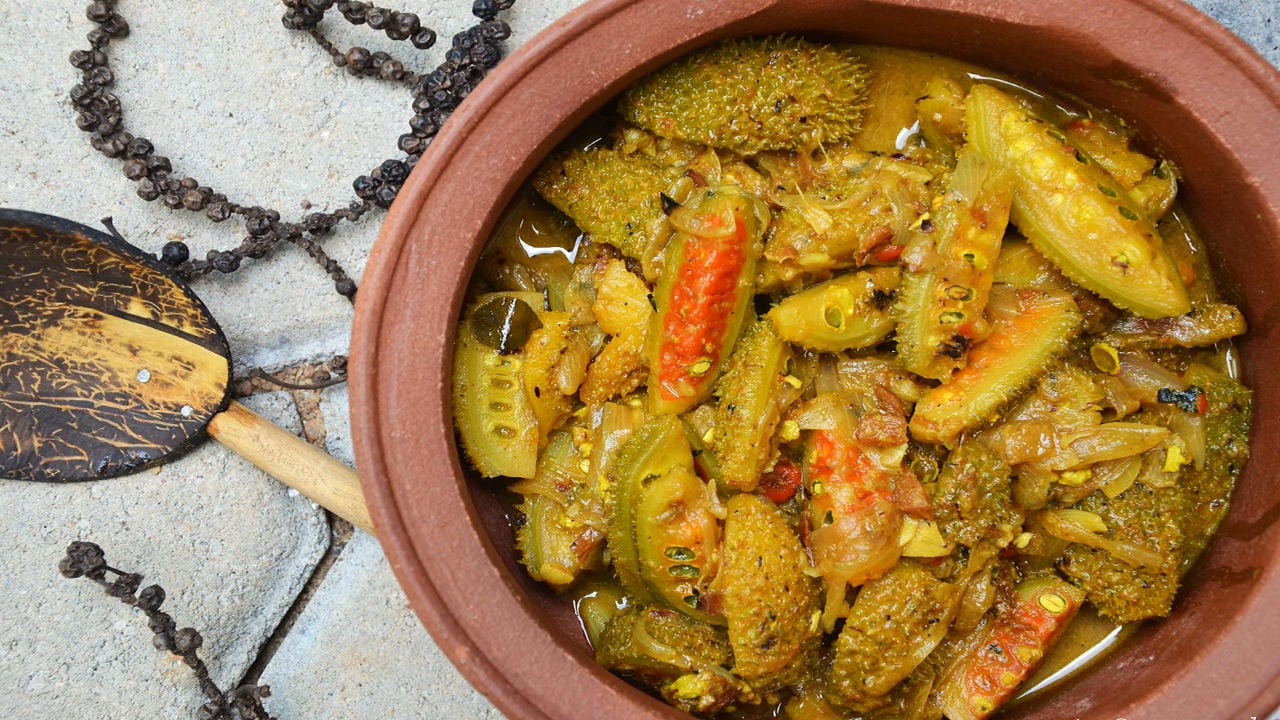


Thumba Karavila (තුම්බ කරවිල) is a small, spiny gourd that has occupied a quiet but important place in Sri Lankan village life for centuries. Known to Ayurvedic physicians across the island for its wide-ranging medicinal properties, the plant is far more than a seasonal vegetable. Its botanical name is Momordica dioica, and it belongs to the Cucurbitaceae family — the same broad family as cucumber, pumpkin, and the common bitter gourd. In Sanskrit it is called Vahisi or Karkufaki; in English it goes by teasle gourd or spine gourd.
The plant grows as a climbing vine and produces small, oval fruits covered in soft spines. Unlike its better-known cousin the bitter gourd, Thumba Karavila has a milder bitterness that becomes almost pleasant when cooked with the right spices. It is harvested extensively in the dry and intermediate zones of Sri Lanka and features in both home cooking and traditional Ayurvedic formulations such as syrups (arishta) and medicated ointments.
What are the traditional uses of Thumba Karavila in Ayurveda?
Ayurvedic practitioners have long valued Momordica dioica as a multi-purpose medicinal plant. The fruit, root, seeds, and leaves are each used in different preparations. Formulated ointments derived from the plant are applied topically, while the juice is extracted and consumed internally for a range of conditions. The plant pairs naturally with other classical Ayurvedic ingredients — practitioners sometimes combine it with preparations like Yogaraja Guggulu or Kaishore Guggulu as part of broader therapeutic regimens.
Village healers across Sri Lanka's rural districts have historically recommended Thumba Karavila juice as a general health tonic, particularly during the harvest months when the fruit is most abundant and fresh.
What are the main health benefits of Momordica dioica?
Research into Momordica dioica has been growing steadily, and the findings broadly support traditional knowledge. The plant contains a range of bioactive compounds — flavonoids, alkaloids, saponins, and terpenoids — that underpin its therapeutic reputation. The following are the most documented benefits:
- Cardiovascular support: Thumba Karavila juice is traditionally recommended for people with elevated blood pressure. Its antioxidant activity is thought to support healthy blood vessel function and reduce arterial narrowing over time.
- Immune system activity: The plant demonstrates anti-allergic, antioxidant, antibacterial, analgesic, and anti-inflammatory properties in laboratory studies, suggesting broad immunomodulatory potential.
- Skin and eczema relief: Fresh juice applied topically has been used to manage eczema and other inflammatory skin conditions, consistent with the plant's known anti-inflammatory profile.
- Liver protection: Momordica dioica shows antilipid peroxidase activity, meaning it may help prevent the oxidation of fats in liver tissue. This makes it a plant of particular interest for managing fatty liver conditions.
- Diabetes management: The fruit has documented hypoglycaemic properties. It appears to protect and support the regeneration of pancreatic beta cells, and research indicates it can improve both insulin secretion and insulin sensitivity, helping regulate blood glucose across multiple mechanisms.
- Neuroprotective effects: Studies suggest that compounds in the plant may support brain function through pathways involving the central nervous system, pointing to potential value in neurological health.
- Antioxidant and anti-cancer activity: Emerging research has identified antioxidant compounds in Thumba Karavila that may help neutralise free radicals associated with cellular damage and cancer risk, though clinical evidence in humans remains limited.
It is worth noting that while traditional use and early research are both encouraging, Thumba Karavila should be regarded as a complementary support rather than a standalone treatment for any diagnosed medical condition.
How is Thumba Karavila used in Sri Lankan cooking?
Outside the apothecary, Thumba Karavila is a respected kitchen ingredient. It is most commonly prepared as a dry curry or stir-fry, often with mustard seeds, dried chilli, and fresh coconut — a combination that tempers its mild bitterness into a savoury depth. The texture of the cooked fruit is firm but not tough, and it absorbs spice well.
In village households, Thumba Karavila is frequently paired with Ceylon black pepper, which not only adds heat but is itself recognised in Ayurveda as a bioavailability enhancer — potentially making the medicinal compounds in the gourd more accessible to the body. The fruit is also occasionally pickled or included in mixed vegetable preparations alongside other garden produce.
It is worth distinguishing Thumba Karavila from the common bitter gourd (Momordica charantia), which is a larger, more intensely bitter fruit and a separate species. Both belong to the same genus, and both are used medicinally and culinarily across South Asia, but their flavour profiles and phytochemical compositions differ.
Where does Momordica dioica grow in Sri Lanka?
The plant is found across Sri Lanka's dry zone and intermediate zone, often growing wild along roadsides, field margins, and the edges of home gardens. It is particularly common in the North Central, North Western, and Uva provinces. Cultivation is generally low-input: the vine climbs readily on simple trellises and requires little more than well-drained soil and reasonable sunlight.
The plant's deep root system — its tubers can be substantial — means it is reasonably drought-tolerant once established, making it well-suited to Sri Lanka's seasonal dry periods. Villagers typically harvest the immature green fruits for cooking, leaving some to mature and save seed for the following season.
How does Thumba Karavila fit into Sri Lanka's broader medicinal plant tradition?
Sri Lanka's indigenous pharmacopoeia is remarkably rich. Plants like Thumba Karavila sit alongside other species that have shaped local medicine for millennia. The island's tropical climate and biodiversity — spanning wet and dry zones, montane forests, and coastal ecosystems — have produced an unusually dense concentration of medicinal flora. Institutions such as the Department of Ayurveda continue to document and promote these plants as part of the country's intangible cultural heritage.
Momordica dioica occupies a particular niche in this tradition: it is neither an obscure forest rarity nor a fully domesticated crop, but something in between — a semi-wild plant that village communities have managed, harvested, and incorporated into daily life across generations. That continuity of knowledge is itself a form of conservation.
Travellers with an interest in traditional medicine and food systems may find meaningful encounters with plants like Thumba Karavila on village walks and agro-tourism experiences organised as part of wider Sri Lanka itineraries.
Other species in this genus
1 more, sharing the same genus.
