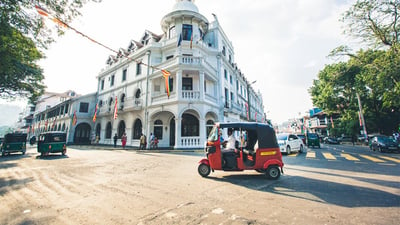
Standing quietly beside the waters of Kandy Lake, the Meera Makam Mosque is one of the most recognisable landmarks in Sri Lanka's cultural capital. Its white-washed domes and refined Islamic ornamentation offer a striking visual contrast to the surrounding Kandyan and colonial-era architecture — a reminder that Kandy has long been a city shaped by many faiths and peoples living in close proximity.
What is the history of Meera Makam Mosque in Kandy?
The mosque takes its name from a revered Muslim saint whose tomb, or makam, is enshrined within the compound. Muslim traders, many of Arab and Malay descent, have been part of Sri Lanka's commercial and social fabric for centuries, and their presence in Kandy dates to the Kandyan Kingdom period. The mosque grew around the shrine over generations, becoming a focal point for the city's Muslim community and a living record of how Islam became rooted in the Kandyan highlands far from the coastal trade ports where it first arrived.
The structure has been maintained and periodically restored by the local Muslim community, preserving its function as an active house of worship while also making it accessible to respectful visitors from outside the faith.
What makes the architecture of Meera Makam Mosque distinctive?
The mosque's exterior is defined by its white domes and arched colonnades, typical of South Asian mosque design with subtle regional adaptations. Look closely and you will find Quranic calligraphy worked into the decorative panels, geometric tilework, and finely latticed screens that filter both light and the sounds of the city. The interplay of these elements creates an interior atmosphere that feels noticeably quieter and cooler than the streets outside.
The shrine chamber housing the saint's tomb is particularly significant for Muslim pilgrims, many of whom travel specifically to offer prayers at the makam. Non-Muslim visitors are generally welcome in the outer areas of the compound, though access to more sacred inner spaces may be restricted during prayer times.
Where exactly is Meera Makam Mosque located in Kandy?
The mosque sits in the lakeside quarter of central Kandy, within easy walking distance of both Kandy Lake and the Temple of the Sacred Tooth Relic. This positioning is no accident — the area around the lake has historically been the most densely layered part of the city in terms of religious and civic institutions. Within a short stroll you can visit a Buddhist temple of world heritage significance, a Hindu kovil, and this mosque, making the lakeside circuit one of the most compact multi-faith heritage walks in South Asia.
For a broader orientation to the city's sites and practical visitor services, the Kandy Tourist Information Center can advise on opening hours and any current access restrictions at religious sites across the city.
When is the best time to visit Meera Makam Mosque?
The mosque is most peaceful in the early morning and late afternoon, outside the five daily prayer times. Friday midday prayers draw the largest congregations, so visits planned around that period will encounter more activity inside the compound — which can itself be an interesting experience, though visitors should be especially mindful of not obstructing worshippers.
In terms of seasons, Kandy is accessible year-round, though the city is particularly busy during the Esala Perahera Festival in July or August, when tens of thousands of pilgrims and tourists converge on the lakeside area. If you prefer a quieter visit to the mosque, plan outside that festival window.
What should visitors wear and know before going?
Modest dress is required for all visitors, regardless of faith. Practically, this means:
- Shoulders and knees should be covered for both men and women.
- Women are typically asked to cover their hair before entering the prayer hall — a scarf or shawl is sufficient.
- Shoes must be removed before stepping inside.
- Photography should be approached with discretion; always ask before photographing worshippers.
- Speaking quietly and avoiding disruptive behaviour in the compound is expected.
The mosque does not charge an entry fee. A small voluntary donation towards its upkeep is always appreciated but never obligatory.
What else can I see near Meera Makam Mosque in Kandy?
The lakeside location means the mosque slots naturally into a half-day walking itinerary that takes in several of Kandy's most significant sites. A Kandy City Tour arranged through Lakpura can cover the mosque, the Temple of the Sacred Tooth Relic, the National Museum of Kandy, and the lake promenade in a single, well-paced outing.
Beyond the immediate lakeside, Kandy's surrounding hills hold tea estates, forest reserves, and the cultural sites of the broader Central Province. Travellers with more time in the region often combine a Kandy base with day excursions toward the highlands or the ancient cities to the north.
How does Meera Makam Mosque fit into Kandy's religious landscape?
Kandy is one of the few cities in Sri Lanka where Buddhist, Hindu, Muslim, and Christian places of worship stand within metres of each other and have done so for generations. The mosque is an integral part of that layered religious geography rather than an outlier. Sri Lanka's Muslim community — known locally as Sri Lankan Moors and Malays — has its own distinct cultural traditions, cuisine, and religious practice shaped by centuries of life on the island rather than simple transplantation from elsewhere. Visiting the mosque with that context in mind turns a brief stop into a more meaningful encounter with the city's actual history.
Nearby places
13 places within about 25 km, nearest first.
- Ulpangeunder 1 km
- Randoli Peraheraunder 1 km
- Magul Maduwa (Royal Audience Hall)under 1 km
- Raja Museumunder 1 km
- Sri Dalada Museumunder 1 km
- Jayatillake Mandapayaunder 1 km
- Maha Vishnu Devalayaunder 1 km
- Natha devalayaunder 1 km
- Udawatta Kele Sanctuaryunder 1 km
- Galmaduwa Viharaya2 km
- Ampitiya3 km
- Degaldoruwa Raja Maha Vihara3 km
- Kundasale5 km
Related reading
5 pages on closely related subjects.