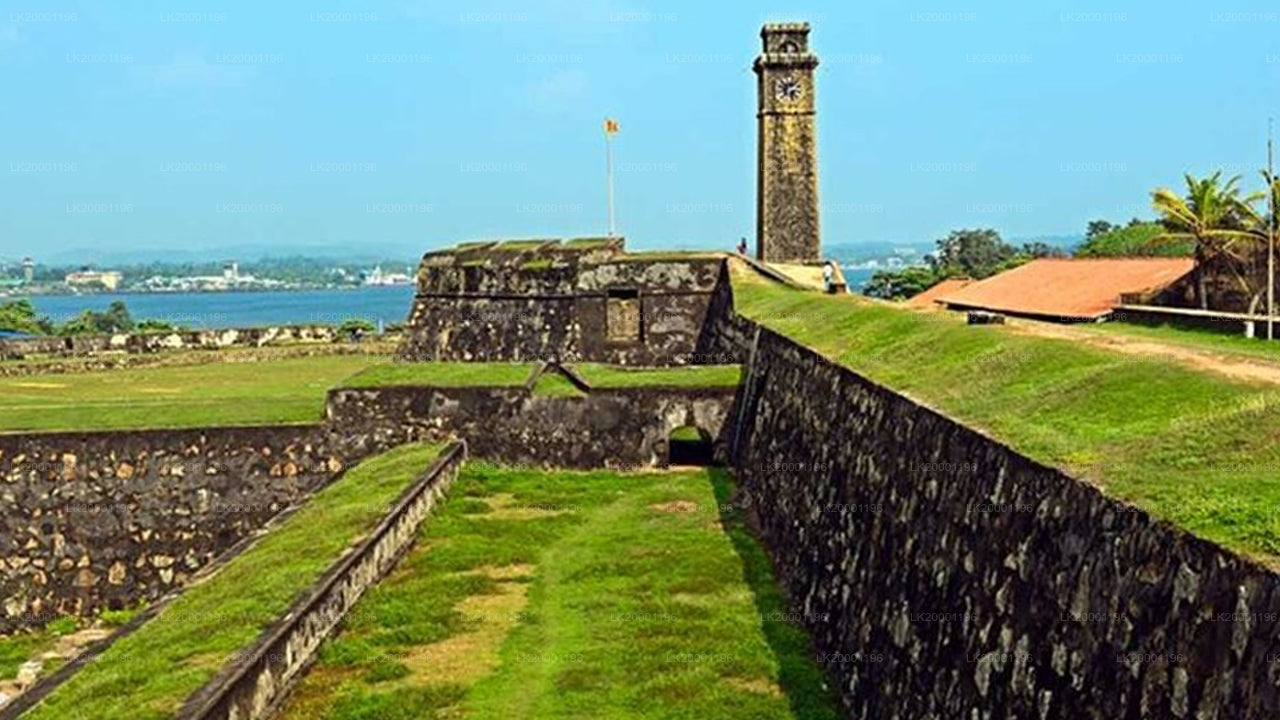
The Old Gate of Galle Fort stands at the northern end of the ramparts, where the road running parallel to the beach — Baladaksha Mawatha — passes through the fortification wall. It is the quieter of the fort's two main entrances, and for that reason it often rewards the unhurried visitor with a close, unobstructed look at one of the most layered pieces of colonial stonework in Sri Lanka.
What is the history behind the Old Gate?
Galle's fortifications passed through three distinct colonial hands — Portuguese, Dutch, and British — and the Old Gate records that transition in stone. When the Portuguese first enclosed the promontory in the early 17th century, a simple gateway stood here. The Dutch East India Company (VOC) expanded and reinforced the entire fort complex after taking Galle from the Portuguese in 1640, embedding their own emblem above the gate as a declaration of ownership.
That changed in 1796, when British forces took control of the Southern Province without a battle. One of the earliest acts of the new administration was to remove the VOC monogram and replace it with a carved plaque bearing the British Royal Coat of Arms — the emblem that visitors see today. The switch was both practical and symbolic: the British were asserting a new order over the most strategically significant harbour on the island's southwestern coast.
For a deeper look at Dutch colonial legacy along the coast, the Dutch Fort in Negombo offers a useful point of comparison, showing how the VOC left its architectural mark at multiple points around Sri Lanka.
What does the Royal Coat of Arms above the gate show?
The plaque carved above the Old Gate is a faithful representation of the British Royal Coat of Arms as it appeared during the reign of King George III. A lion on the right and a unicorn on the left support a central shield surmounted by a crown. Below the shield runs the royal motto in French: Dieu et Mon Droit, meaning "God and My Right" — a claim of divine authority that has appeared on the English royal arms since the medieval period.
Encircling the shield is the Garter motto: Honi soit qui mal y pense, a medieval French phrase most commonly translated as "Shame on him who thinks evil of it." This is the motto of the Order of the Garter, England's oldest order of chivalry, and its presence on the plaque signals the full ceremonial weight of British imperial identity. Both inscriptions being in French is a quirk of English heraldic history, reflecting the Norman roots of the medieval English court.
The stonework is worn but still legible, and the carvings reward close inspection. Stand directly beneath the arch and look up — the depth of the relief carving is appreciable even after more than two centuries of tropical weathering.
How does the Old Gate differ from the Main Gate of Galle Fort?
Galle Fort has two vehicle-accessible entrances. The Main Gate — sometimes called the New Gate — was cut into the ramparts in 1873 to ease the movement of traffic and is the entrance most tour buses use today. It is wider, busier, and flanked by later-period British stonework.
The Old Gate predates it by well over a century and retains the proportions of a fortification entrance designed for pedestrians, horses, and carts rather than motor vehicles. The archway is lower and narrower, the walls on either side are thicker, and the atmosphere is noticeably more intimate. Most visitors arriving by the coastal road from Unawatuna encounter the Old Gate first, which makes it a natural starting point for a walking tour of the fort interior.
| Feature | Old Gate | Main Gate |
|---|---|---|
| Period of current form | Dutch era; British plaque added 1796 | Widened by British, 1873 |
| Emblem above arch | British Royal Coat of Arms (George III) | British Royal Arms (later period) |
| Traffic character | Quieter; pedestrian-friendly | Busier; main vehicle route |
| Road connection | Baladaksha Mawatha (beach road) | Galle–Colombo highway (A2) |
What can I see nearby once I pass through the Old Gate?
Stepping through the Old Gate places you immediately inside the fort's northern quarter. The Dutch Reformed Church — one of the oldest Protestant churches in Asia still in use — is a short walk away along Church Street. The National Maritime Museum occupies a former Dutch warehouse close to the harbour-facing ramparts. Rampart Street itself, running along the seaward wall, is the route most visitors take at dusk when the Indian Ocean colours the horizon.
The fort's grid of streets holds colonial-era mansions, many converted into boutique hotels and cafes, alongside mosques and a functioning lighthouse that has guided ships into Galle Harbour since 1938. A structured Galle city tour is one of the most efficient ways to connect these sites without missing the architectural details that are easy to overlook on an unguided walk.
When is the best time to visit the Old Gate and Galle Fort?
Galle sits on the southwestern coast and its weather follows Sri Lanka's main southwest monsoon. The dry season for this region runs roughly from November through April, when skies are clearer and humidity is lower — conditions that make walking the ramparts considerably more comfortable. December and January tend to attract the heaviest visitor numbers.
The shoulder months of May and October can offer a reasonable compromise: fewer crowds and, on dry-weather days, excellent light for photography around the fortifications. The monsoon months of June to August bring regular rain, though the fort never fully closes and some visitors find the atmospheric mist over the harbour compelling in its own way.
For timing within the day, arriving at the Old Gate in the early morning — before 8 a.m. — gives you the archway and the emblem to yourself, with soft light falling on the carved stonework from the east.
How do I get to the Old Gate from Colombo?
Galle is approximately 120 km south of Colombo along the Southern Expressway (E01). By car or private transfer the journey typically takes around two hours, though travel times vary with traffic at the Colombo end. The Galle railway station sits outside the fort walls; from the station, the Old Gate is a short walk or tuk-tuk ride along the coast road. Intercity express trains from Colombo Fort station make the journey in roughly two to two and a half hours and offer scenic coastal views for much of the route.
Is the Old Gate part of the UNESCO World Heritage Site?
Yes. Galle Fort was inscribed on the UNESCO World Heritage List in 1988 as an outstanding example of a European fortification in South and Southeast Asia that integrated European architectural traditions with South Asian ones. The Old Gate, as an original structural element bearing inscriptions from multiple colonial periods, is part of the protected ensemble. No admission fee is charged to enter the fort through the Old Gate; tickets are required for specific museum sites within the walls.
Nearby places
15 places within about 25 km, nearest first.
- Neptune Bastionunder 1 km
- Zwart Bastion (Black Fort)under 1 km
- Dutch Reformed Church Galleunder 1 km
- Galle Beachunder 1 km
- National Maritime Museum Galleunder 1 km
- Buddhist temple Galle Fortunder 1 km
- Galle Dutch Fortunder 1 km
- Galle International Cricket Stadiumunder 1 km
- Historical Mansion Museumunder 1 km
- Galle Marvels (Galle Titans)under 1 km
- Moon Bastionunder 1 km
- Trion Bastionunder 1 km
- Aeolus Bastionunder 1 km
- Flag rock bastionunder 1 km
- Galle Lighthouseunder 1 km
Other species in this genus
1 more, sharing the same genus.
Related reading
6 pages on closely related subjects.