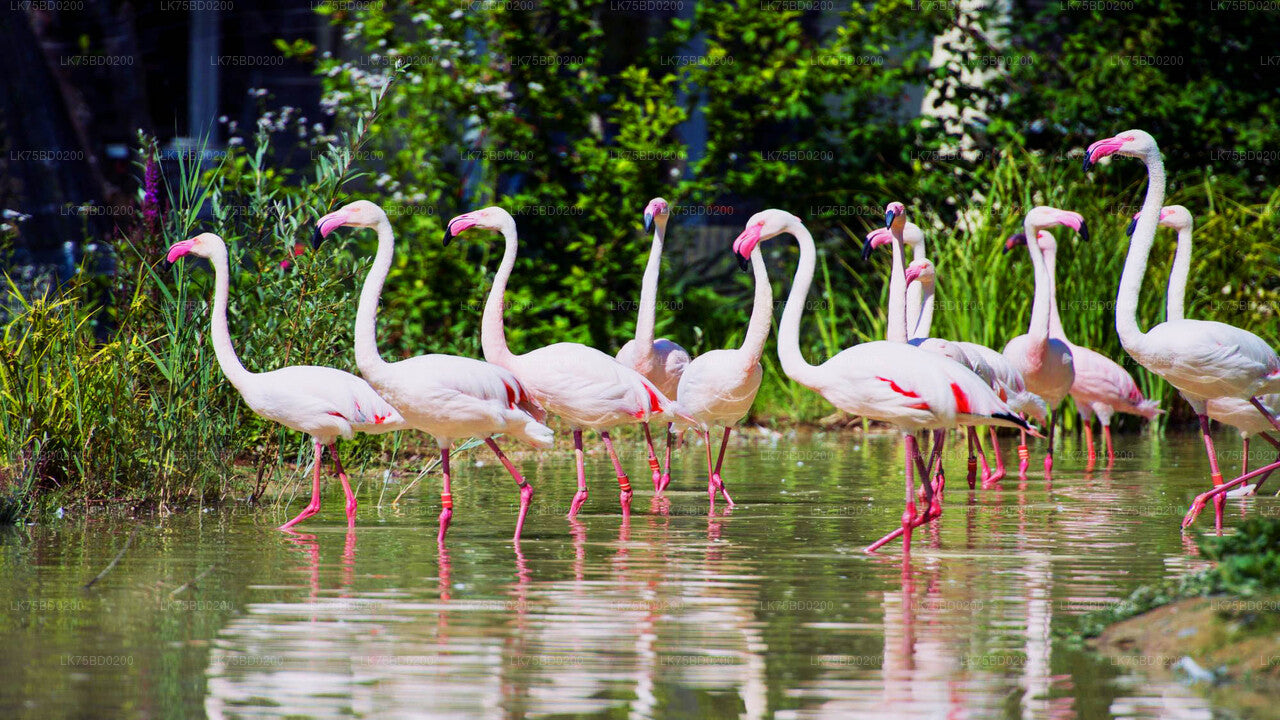
Sri Lanka is not a country most travellers associate with flamingos, yet every year tens of thousands of greater and lesser flamingos gather along the island's southern and northwestern coastlines. The sight of a dense flock wading in shallow lagoons, bills tilted downward in their characteristic filter-feeding arc, is one of those quietly extraordinary wildlife moments that rewards travellers who plan carefully. This guide covers where they congregate, when to visit, and what to expect on the ground.
Where Do Flamingos Gather in Sri Lanka?
The most reliable and accessible flamingo habitat in Sri Lanka is Bundala National Park, a Ramsar-listed wetland on the southern coast near Hambantota. A mosaic of brackish lagoons, saltpans, and scrub forest, Bundala attracts flamingos as part of a larger congregation of migratory waterbirds that can include painted storks, spoonbills, and pelicans. Flamingos typically occupy the wide, shallow pans in the park's western section, where water levels stay low enough for wading.
Further north, the Mannar lagoon system draws flamingos in impressive numbers during the northern-winter migration. The flat, salt-encrusted mudflats around Vankalai — which holds sanctuary status — are particularly productive, though access requires more planning than a visit to Bundala. Smaller numbers are also occasionally reported at Chilaw and Puttalam lagoons along the northwestern coast.
When Is the Best Time to See Flamingos in Sri Lanka?
Flamingos in Sri Lanka are predominantly migratory visitors from breeding colonies in the Indian subcontinent, arriving roughly between October and March. Peak numbers at Bundala are typically seen from November through January, coinciding with the northeast monsoon period when lagoon water levels in the south are optimal for feeding. Outside this window, resident birds may still be present in smaller numbers, but large flocks are unusual.
Early morning visits — ideally at first light — give the best combination of activity and photographic light. Flamingos feed most actively when temperatures are low, and by mid-morning they often rest or move to deeper water.
What Species of Flamingo Can I See?
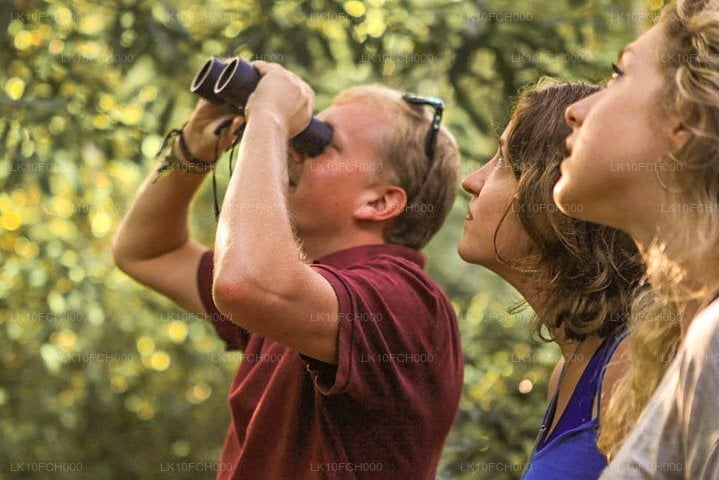
Both species recorded in South Asia turn up in Sri Lanka. The greater flamingo (Phoenicopterus roseus) is the larger of the two, with predominantly pale-pink plumage and a distinctively kinked, pink-and-black bill. The lesser flamingo (Phoeniconaias minor) is smaller, deeper pink overall, and has a dark-crimson bill. Mixed flocks occur at Bundala, though the greater flamingo is generally more numerous. Separating the two at a distance requires binoculars — size difference and bill colour are the key markers.
How Do I Get to Bundala National Park?
Bundala lies approximately 245 km southeast of Colombo, roughly a four-to-five-hour drive along the Southern Expressway and the coastal road through Hambantota. The park entrance is around 18 km east of Hambantota town. Most visitors combine a flamingo excursion at Bundala with a broader southern-coast itinerary that might include Udawalawe National Park for elephant watching or the coastal stretch near Tangalle. There is no public transport to the park gate, so a private vehicle or organised tour is the practical option.
What Should I Bring for Flamingo Watching?
- Binoculars — at least 8×42 magnification. Flamingos feed in open water and often keep a considerable distance from viewing points.
- Telephoto lens — a 400 mm equivalent or longer is useful for frame-filling shots without disturbing the flock.
- Sun protection — Bundala's open lagoon terrain offers very little shade, and the southern sun is intense year-round.
- Light-coloured, neutral clothing — avoid bright colours or patterns that may spook waterbirds.
- Water and snacks — facilities inside Bundala are minimal.
Is Bundala Good for Other Wildlife Too?
Bundala is a serious birding destination well beyond flamingos. Over 200 bird species have been recorded here, including bar-tailed godwits, Eurasian curlews, black-tailed godwits, and several tern species. The park also holds healthy populations of crocodiles, elephants that pass through seasonally, and the endemic Sri Lanka junglefowl. It is one of the few places in the country where a morning game drive can yield a genuinely diverse checklist without retracing familiar ground.
How Does Flamingo Watching Fit into a Broader Sri Lanka Itinerary?
Most travellers combine flamingo watching at Bundala with the southern coastal circuit. A logical route from Colombo runs via the Sinharaja Rainforest for endemic forest birds — the Sinharaja Forest Reserve lies roughly three hours northwest of Bundala — before continuing east through Tangalle to Hambantota. From there, a morning at Bundala fits naturally before heading on to Yala or Udawalawe. Birders on a longer itinerary may choose to add Mannar in the northwest for a second flamingo site alongside other migratory shorebirds unique to that coast.
Tips for Responsible Flamingo Watching
Flamingos are sensitive to disturbance, particularly when feeding in open, exposed lagoons with few escape routes. Keep these points in mind:
- Stay on designated tracks and follow your park-assigned guide's instructions on approach distances.
- Switch off vehicle engines when stationary — idling engines are a frequent cause of flock disturbance.
- Do not use drone photography inside national park boundaries without prior Department of Wildlife Conservation approval.
- Avoid visiting at midday when birds are least active and heat haze degrades visibility across the lagoon.
Sri Lanka's flamingo population is entirely dependent on healthy wetland ecosystems, and Bundala's Ramsar status reflects the ecological importance of these shallow coastal lagoons. Visiting responsibly — and choosing operators who follow park guidelines — directly supports the conservation case for keeping these habitats protected.
Nearby places
8 places within about 25 km, nearest first.
- Bundalaunder 1 km
- Bundala National Parkunder 1 km
- Pannegamuwa Lake4 km
- Weerawila Airport (WRZ)8 km
- Wirawila City11 km
- Weerawila Bird Sanctuary11 km
- Weerawila City11 km
- Deep South11 km
Related reading
5 pages on closely related subjects.