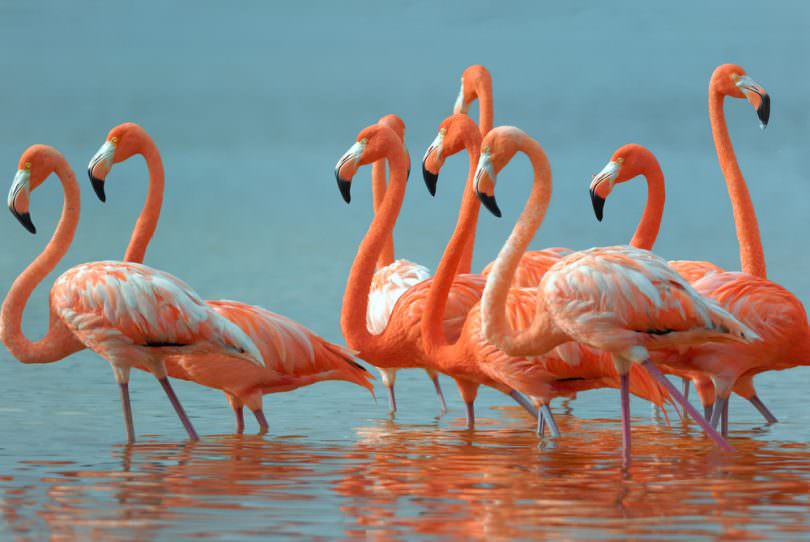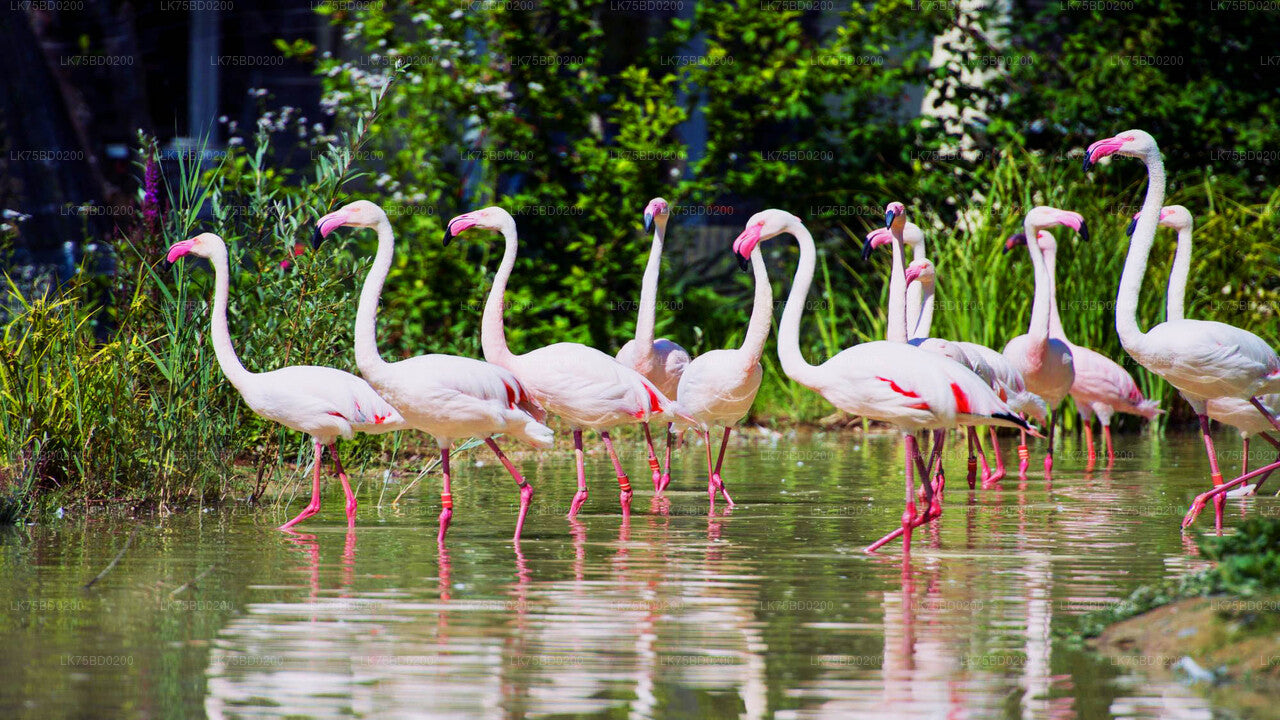

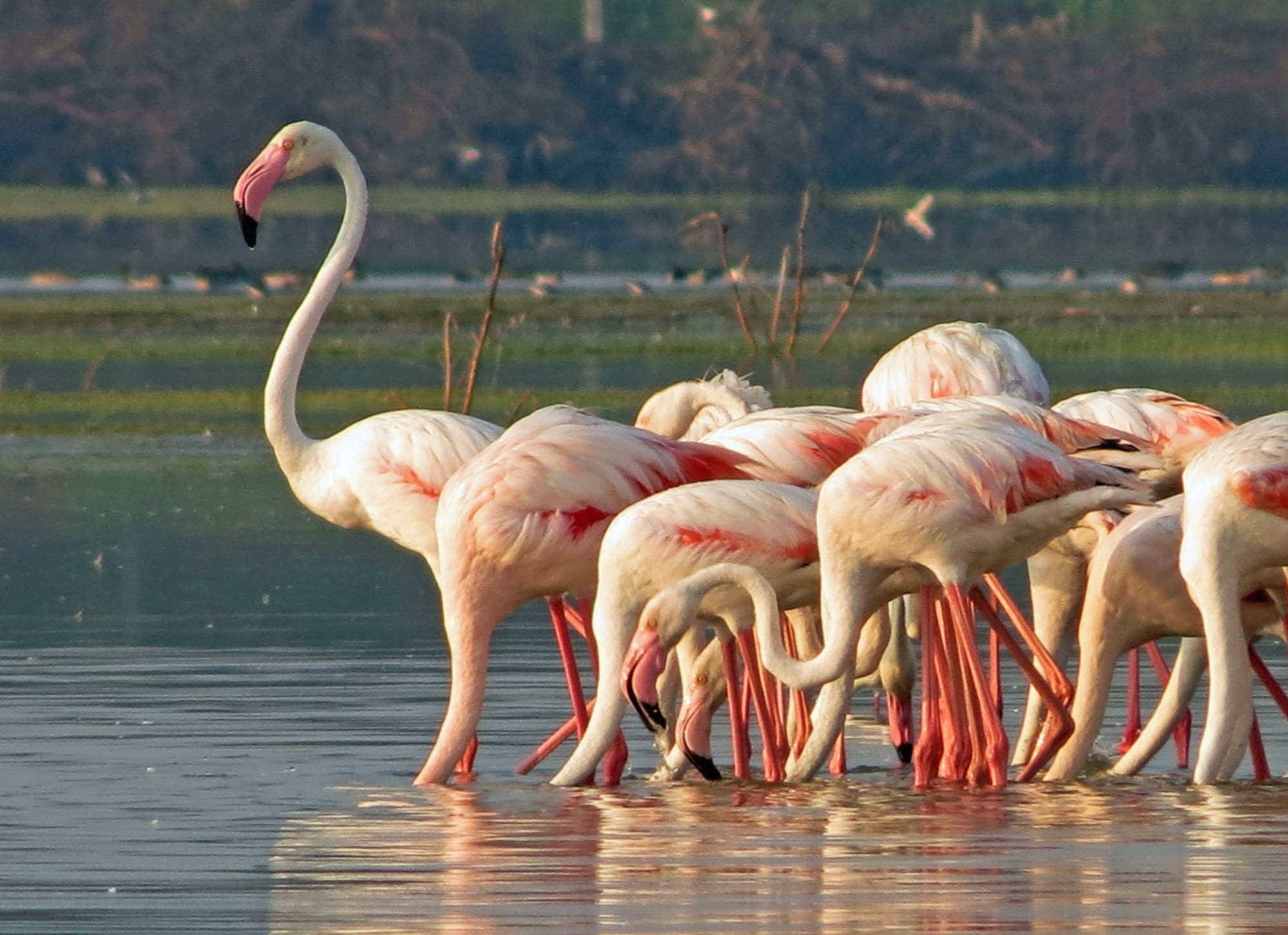
Sri Lanka may not be the first country that comes to mind for flamingo watching, but between October and March each year, flocks of Greater Flamingos descend on the island's northern and eastern wetlands, turning salt pans and shallow lagoons pink. For birders and wildlife photographers, the sight of hundreds of these long-legged birds filtering the shallows in near-silence is one of the quieter, more absorbing spectacles in Sri Lankan nature.
Which species of flamingo visits Sri Lanka?
Sri Lanka receives the Greater Flamingo (Phoenicopterus roseus), the most widespread flamingo species in the world and the only one found on the Indian subcontinent. These are large birds — adults stand around 120 cm tall — with pale pink plumage that deepens in colour with age and diet. Their distinctive downward-bent bill is adapted for filter feeding, allowing them to sieve algae, small crustaceans, and aquatic invertebrates from the water as they wade.
Greater Flamingos are not resident in Sri Lanka. They are seasonal visitors, drawn from breeding and staging grounds in India, Iran, and Pakistan when changing water levels and food availability push them south and east.
When do flamingos arrive in Sri Lanka?
The flamingo season in Sri Lanka runs roughly from October to March, coinciding with the northeast monsoon period in the north and east. Birds typically begin arriving in October and November and are most reliably present from December through February. Numbers fluctuate year to year depending on conditions at their origin sites — in good years, single flocks of several hundred birds have been recorded at key wetlands.
Early morning and late afternoon are the most rewarding times to observe them. During these hours the birds are actively feeding, moving through shallow water in loose coordinated groups, and the light is considerably better for photography.
Where are the best places to see flamingos in Sri Lanka?
The best flamingo sites are concentrated in the arid northwest and the northern peninsula, where extensive salt flats, brackish lagoons, and tidal shallows provide the open, shallow water these birds require.
- Mannar Island and surrounds — The flat, dry landscape around Mannar is arguably the single most reliable flamingo location on the island. The salt pans and lagoons here attract large flocks, and the area is accessible by road from Colombo via the Puttalam coast.
- Vankalai Sanctuary — A protected wetland on the Mannar coast, Vankalai is designated as a Ramsar site and supports an exceptionally diverse waterbird community. Flamingos feed in the shallow mudflats alongside painted storks, pelicans, and spoonbills.
- Kokkilai Lagoon — Located on the east coast between Trincomalee and Mullaitivu, Kokkilai is a large, relatively undisturbed lagoon and one of the premier waterbird sites in Sri Lanka. Flamingos are recorded here regularly during the winter months.
- Jaffna Peninsula lagoons — The extensive shallow lagoons and salt works of the Jaffna Peninsula provide suitable habitat, and flamingos are occasionally seen here, particularly around the Chundikkulam area.
- Bundala National Park — On the south coast near Hambantota, Wilpattu's southern counterpart Bundala is a designated Ramsar wetland that hosts flamingos less regularly than the northern sites, but within a park that is easier to visit from the main tourist circuit. When conditions are right, small flocks appear here between November and February.
What else can birders see at the same sites?
The wetlands that attract flamingos are among the richest waterbird habitats in Sri Lanka. At Vankalai and Mannar, a single visit during peak season might include spot-billed pelicans, great white pelicans, painted storks, Eurasian spoonbills, black-headed ibis, and a wide range of waders including bar-tailed godwit and curlew sandpiper. Sri Lanka sits beneath the Central Asian Flyway, which means these coastal lagoons serve as critical rest and refuelling stops for birds travelling between the Palearctic and the tropics.
The north and east are also home to resident species that rarely appear elsewhere on the island, making a flamingo-focused trip a genuinely distinctive birdwatching itinerary rather than a single-species chase.
How do I reach the main flamingo sites from Colombo?
Mannar is approximately 250 km north of Colombo, reached via the A3 coastal highway through Puttalam or via the inland route through Kurunegala. The drive typically takes around five to six hours. A private vehicle is the most practical option, as public transport to the flamingo-watching points within the area is limited.
Kokkilai Lagoon on the east coast requires either a longer overland journey from Colombo (around seven to eight hours) or a combination of travel via Trincomalee. Bundala National Park, near Hambantota, is more conveniently reached from the southern coast tourist corridor and takes roughly three hours from Colombo along the Southern Expressway.
What should I know before visiting to see flamingos?
- Go with a local guide. The northern wetlands can be difficult to navigate without local knowledge. A guide familiar with current bird positions will save significant time and improve sightings considerably.
- Bring optical equipment. Flamingos are wary birds and typically feed well out into open water. Binoculars of at least 8x42 are recommended; a spotting scope is ideal for photography.
- Respect restricted zones. Parts of the Jaffna Peninsula and the north remain subject to access restrictions or require permits. Check current requirements before travelling.
- The north is hot and dry. Between November and February, daytime temperatures around Mannar regularly exceed 30°C. Early starts are practical as well as ornithologically rewarding.
- Numbers are never guaranteed. Flamingo movements are driven by conditions across a vast migratory network. A site that hosted 400 birds last January may hold very few this year. Build flexibility into your itinerary.
Are flamingos protected in Sri Lanka?
Greater Flamingos are protected under Sri Lanka's Fauna and Flora Protection Ordinance, and several of their key habitats — including Vankalai and Bundala — hold Ramsar Wetland of International Importance status. Sri Lanka is a signatory to the Ramsar Convention, which commits the country to the conservation of these wetlands. The ecological integrity of these lagoons directly affects not only flamingos but the dozens of other waterbird species that depend on them throughout the year.
Visitors are expected to stay on designated tracks, avoid disturbing feeding flocks, and not enter protected core zones without authorisation. Responsible birdwatching at these sites actively supports the case for their continued protection.
Can I combine flamingo watching with other wildlife experiences in Sri Lanka?
A well-planned itinerary can pair flamingo watching in the north with elephant and leopard encounters elsewhere. Wilpattu National Park, Sri Lanka's largest national park, lies en route between Colombo and Mannar and offers excellent safari opportunities for mammals and birds alike. On the south coast, a stop at Bundala for flamingos can be combined with a visit to the coast or nearby Yala. For visitors coming from the cultural triangle area, the drive north to Mannar passes close to ancient sites that reward a detour.