Canavalia ensiformis, commonly known as the horse bean, is a climbing legume of the family Fabaceae. In Sri Lanka it is recorded only as a cultivated plant, not growing wild, and none of its parts are considered edible.
What does Canavalia ensiformis look like?
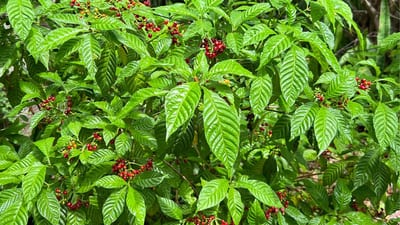
It is a vine, growing as a climbing or trailing perennial. Its leaflets are elliptic to ovate-elliptic in shape, measuring roughly 6 to 20 cm long and 3 to 11 cm wide, with tips that are blunt or abruptly tapered to a point and bases that narrow in a wedge shape. The leaf surfaces are hairless or only lightly covered in fine hairs on both sides.
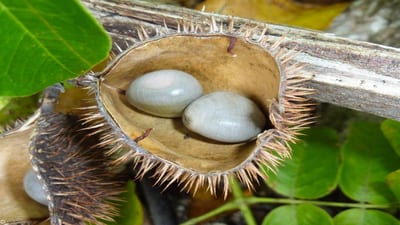
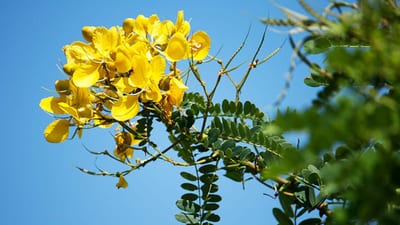
The inflorescence bears numerous flowers on a tuberculate (knobby-textured) stalk, with blooms in shades of rose, lavender or purple. Like many members of the Fabaceae, a pea and bean family that includes climbers, shrubs and trees worldwide, the plant produces its seeds in a pod. Here the fruit is a linear, oblong pod containing numerous seeds, each rounded-oblong in shape, flattened, and white in colour.
Where does Canavalia ensiformis grow in Sri Lanka?
The species is known in Sri Lanka strictly under cultivation. It is not recorded as occurring naturally in the island's forests or wild habitats.
Is Canavalia ensiformis edible?
No part of this plant is listed as edible. It should not be eaten.
What is it called in Sinhala?
In Sinhala, Canavalia ensiformis is known as Sudu avara (සුදු අවර) or Wal avara (වල් අවර). In English it is called the horse bean.
| Attribute | Recorded detail |
|---|---|
| Scientific name | Canavalia ensiformis |
| Family | Fabaceae |
| English name | Horse bean |
| Sinhala / local name | Sudu avara (සුදු අවර) / Wal avara (වල් අවර) |
| Status in Sri Lanka | Only under cultivation |
| Edible parts | None |
| Life form | Climbing or trailing perennial vine |
| Leaflets | Elliptic to ovate-elliptic, 6–20 x 3–11 cm |
| Flowers | Numerous, tuberculate inflorescence; rose, lavender to purple |
| Fruit | Linear oblong pod, numerous-seeded |
| Seeds | Rounded-oblong, compressed, white |
Other species in this genus
1 more, sharing the same genus.