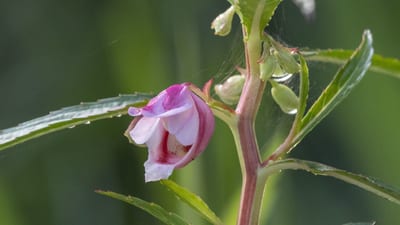
Hygrophila schulli, widely known in Sri Lanka by its Sinhala name Neeramulliya (නීරමුල්ලිය), is a herbaceous perennial plant belonging to the acanthus family (Acanthaceae). It grows naturally in marshy, waterlogged, and seasonally flooded habitats across tropical Asia and Africa, and is a familiar sight along the edges of paddy fields, wetland margins, and slow-moving waterways throughout Sri Lanka. In Ayurvedic and traditional Sinhala medicine, this plant has been valued for centuries — its roots, seeds, and whole plant body are all drawn upon for therapeutic preparations.
What is the botanical profile of Hygrophila schulli?
Hygrophila schulli is an erect perennial herb that can reach up to 1.25 m in height under favourable conditions. Its stem is notably stiff and armed with prominent axillary spines measuring 2–4 cm in length — a feature that distinguishes it easily in the field. The leaves are arranged in whorls of six, elliptic-lanceolate in shape, roughly 4–14.5 cm long and up to 1.2 cm wide, with an acute apex and margins that are entire. The leaf surface is hispid (covered in stiff hairs) on the upper side.
Flowers appear in clusters of 6–8 per whorl and are a distinctive purplish-blue colour, with a corolla tube approximately 1.7 cm in length and stamens that extend beyond the tube. The fruit is an oblong-lanceolate capsule around 1 cm long, and the seeds are small — roughly 0.75 mm across — and orbicular in shape.
- Family: Acanthaceae
- English name: Marsh Barbel
- Sinhala names: Neeramulliya (නීරමුල්ලිය), Katu Ikiriya (කටු ඉකිරිය), Ikiriya (ඉකිරිය)
- Tamil name: Nirmulli
- Sanskrit name: Ikshuraka
- Scientific synonyms: Asteracantha auriculata Nees; Asteracantha lindaviana De Wild. & T.Durand; Hygrophila auriculata
- Conservation status: LC — Least Concerned (National Red List 2020)
Where does Neeramulliya grow in Sri Lanka?
This plant favours consistently moist or wet ground — the kind found beside irrigation channels, along riverbanks, in marshy lowlands, and at the edges of paddy fields. It is most commonly encountered in the wet zone and the drier areas where seasonal flooding occurs. Because it tolerates standing water well, it often colonises the margins of tanks and village reservoirs, particularly in the North Central and Northwestern provinces.
The plant flowers most prolifically during and immediately after the monsoon season, when the purple-blue flower whorls appear in dense clusters along the upper portion of the stem. At this stage it is quite ornamental, and its presence in a wetland is often used informally as an indicator of seasonal water levels.
What are the traditional medicinal uses of Hygrophila schulli?
In Ayurveda and traditional Sinhala medicine, Neeramulliya is classified primarily as a diuretic and aphrodisiac herb. The roots, seeds, and whole plant are used, often in combination with other botanical ingredients, to address a range of conditions. The plant is mentioned in classical Ayurvedic texts under the Sanskrit name Ikshuraka, indicating a long history of documented use across South Asia.
Conditions for which Hygrophila schulli has traditionally been applied include:
- Kidney stones and urinary disorders
- Oedema (fluid retention) and anasarca
- Hepatic (liver) diseases and jaundice
- Dysentery and gastrointestinal complaints
- Gonorrhoea and other urogenital conditions
- Rheumatism and joint inflammation
The seeds in particular are associated with diuretic action and are sometimes prepared as a decoction or incorporated into herbal formulations such as Kaishore Guggulu, a classical Ayurvedic compound used for inflammatory conditions. The leaves and young stems are edible and are occasionally consumed as a leafy vegetable in rural communities.
What are the key medicinal properties attributed to this plant?
Scientific investigations into Hygrophila auriculata (the same species, previously named) have explored several pharmacological activities that lend some support to its traditional applications. Researchers have examined the plant for diuretic, hepatoprotective, and anti-inflammatory effects, among others. These studies are still ongoing in academic literature, and it is worth noting that traditional use does not automatically confirm clinical efficacy for all claimed conditions.
| Plant part used | Primary attributed properties |
|---|---|
| Seeds | Diuretic, aphrodisiac |
| Roots | Hepatoprotective, anti-inflammatory |
| Whole plant | Diuretic, treatment of oedema and urinary complaints |
| Leaves and young stems | Edible; mild nutritional and tonic value |
How is Neeramulliya used in modern herbal practice?
Today, Hygrophila schulli is available in several processed forms — dried whole plant, seed powder, and standardised herbal preparations. Dehydrated preparations retain many of the plant's active constituents and offer a convenient way to incorporate it into dietary or wellness routines. It is commonly stocked in Ayurvedic pharmacies across Sri Lanka and is an ingredient in a number of proprietary herbal formulations aimed at kidney and urinary health.
If you are considering using Neeramulliya therapeutically, it is advisable to consult a registered Ayurvedic practitioner, as appropriate dosage and preparation method depend on the individual's constitution and the specific condition being addressed.
How does Neeramulliya relate to Sri Lanka's broader ethnobotanical heritage?
Sri Lanka's rich tradition of plant-based medicine — rooted in both Ayurveda and indigenous Sinhala medical knowledge (Deshiya Chikitsa) — encompasses hundreds of species that grow in the island's diverse habitats, from coastal wetlands to highland cloud forests. Hygrophila schulli sits within a category of wetland-adapted medicinal plants whose ecological presence is closely tied to healthy water systems. Protecting the marshy habitats in which it grows — including seasonal flood plains and village tank margins — is therefore as important to its continued availability as any cultivation effort.
Other traditional medicinal plants with documented Ayurvedic significance in Sri Lanka include Acacia chundra (used for oral and skin conditions) and Pongamia pinnata, whose seed oil has longstanding applications in traditional skin therapy.