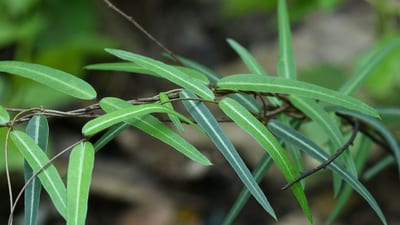
Boerhavia diffusa, widely known in Ayurvedic tradition as Punarnava — a Sanskrit word meaning "that which renews the body" — is a creeping perennial herb belonging to the four o'clock family (Nyctaginaceae). Found growing across tropical and subtropical regions of Asia, Africa, and the Americas, it is particularly prevalent in Sri Lanka, where it has been used in traditional medicine for centuries. Beyond its medicinal reputation, the plant is also harvested as a leafy vegetable in rural communities, making it one of those rare species that bridges the kitchen and the dispensary.
What does Boerhavia diffusa look like?
The plant grows low to the ground, spreading outward in a mat-like fashion with reddish-green stems that can reach up to a metre in length. Its leaves are thick, somewhat fleshy, and pale on the underside. The flowers are tiny — around 5 mm in diameter — and range from pink to red, appearing in small clusters. Pollen grains are spherical and roughly 65 microns in diameter.
The fruit is notably small and covered in a sticky coating, which allows it to cling to the feathers or legs of birds passing nearby. This mechanism accounts for the plant's remarkably wide natural distribution; migratory birds act as accidental carriers, spreading seeds across considerable distances.
What is Punarnava used for in Ayurveda?
In classical Ayurvedic texts, Punarnava is classified as a tridoshic herb — one that helps balance all three doshas (Vata, Pitta, and Kapha) — though it is most strongly associated with reducing excess Kapha. Its Sanskrit name reflects its core therapeutic claim: that it can restore and rejuvenate depleted body tissues.
Traditional Ayurvedic practice attributes a broad range of properties to the plant:
- Anti-inflammatory — used to manage swelling and inflammatory conditions
- Diuretic — supports kidney function and reduces fluid retention
- Expectorant — helps clear mucus from the respiratory tract
- Anticonvulsant and analgesic — particularly associated with the root
- Laxative — mild action on the bowel
- Cardiac tonic — traditionally prescribed for heart-related conditions
- Aphrodisiac and anthelmintic — noted in classical texts
Practitioners working with Ayurvedic formulations such as Yogaraja Guggulu and Kaishore Guggulu often combine Punarnava with other botanicals to address musculoskeletal and metabolic conditions.
Which conditions is Boerhavia diffusa traditionally associated with?
Classical Ayurvedic sources link Punarnava to the management of a wide range of ailments. The list below reflects traditional uses documented in herbal literature; none should be taken as medical advice:
- Amavata (a condition that parallels rheumatoid arthritis in Ayurvedic diagnosis)
- Oedema and generalised swelling
- Jaundice and liver disorders
- Anaemia
- Cardiac disorders and high blood pressure
- Bronchitis and chronic cough
- Urinary tract conditions including strangury
- Eye conditions — the root, mixed with honey, was applied externally for cataract, chronic conjunctivitis, and blepharitis
- Skin disorders, scabies, and leucorrhoea
- Dyspepsia, constipation, and general debility
- Lumbago and myalgia
The plant is described in traditional texts as bitter, astringent, and cooling in nature — a combination that makes it particularly valued as a febrifuge (fever-reducing agent) and diaphoretic.
How is Boerhavia diffusa prepared and consumed?
Different parts of the plant are used in different ways, depending on the intended purpose:
| Plant Part | Common Preparation | Traditional Application |
|---|---|---|
| Root | Decoction or paste | Internal: analgesic, laxative. External: eye conditions when mixed with honey |
| Leaves | Cooked as a green vegetable | Reducing oedema; general nutrition |
| Whole plant | Juice or powder | Diuretic, anti-inflammatory, tonic formulations |
In parts of Sri Lanka, India, and West Africa, the young leaves are sautéed with garlic and spices as a side dish. The taste is mildly bitter, and the leaves are said to hold their texture well when cooked.
Where does Boerhavia diffusa grow in Sri Lanka?
In Sri Lanka, the plant grows as a common wayside herb across the dry and intermediate zones, appearing along roadsides, in disturbed soils, and on the margins of cultivated land. It thrives in sandy or loamy soils with good drainage and is particularly common in the North Central and Northern provinces. The dry-zone districts around Tambuttegama and surrounding areas provide typical habitat.
Because the plant grows prolifically without cultivation, it is gathered from the wild rather than farmed in most parts of the island. Traditional healers (vaidyas) and Ayurvedic pharmacies source the root and leaves from local collectors, particularly after the monsoon rains trigger fresh growth.
Is Boerhavia diffusa the same as hogweed or spiderling?
The plant carries several common English names that can cause confusion. "Spreading hogweed" and "red spiderling" both refer to Boerhavia diffusa, and the name "tarvine" is also used in parts of Australia and the Pacific. None of these should be confused with the unrelated giant hogweed (Heracleum mantegazzianum), which is a hazardous European weed with no connection to this species.
In Sri Lankan vernacular usage, the plant is most often referred to by its Sanskrit-derived Ayurvedic name, Punarnava, which reflects the strong continuity of Ayurvedic practice on the island.
What does current research say about Boerhavia diffusa?
Laboratory and preclinical studies have investigated several of the plant's traditional claims. Researchers have identified compounds including rotenoids, alkaloids (notably punarnavine), and flavonoids that may account for anti-inflammatory, hepatoprotective, and diuretic activity observed in animal models. However, large-scale human clinical trials remain limited, and most claims rest on traditional use and small-scale studies. Anyone considering Punarnava for a specific health condition should consult a qualified Ayurvedic or medical practitioner before use.