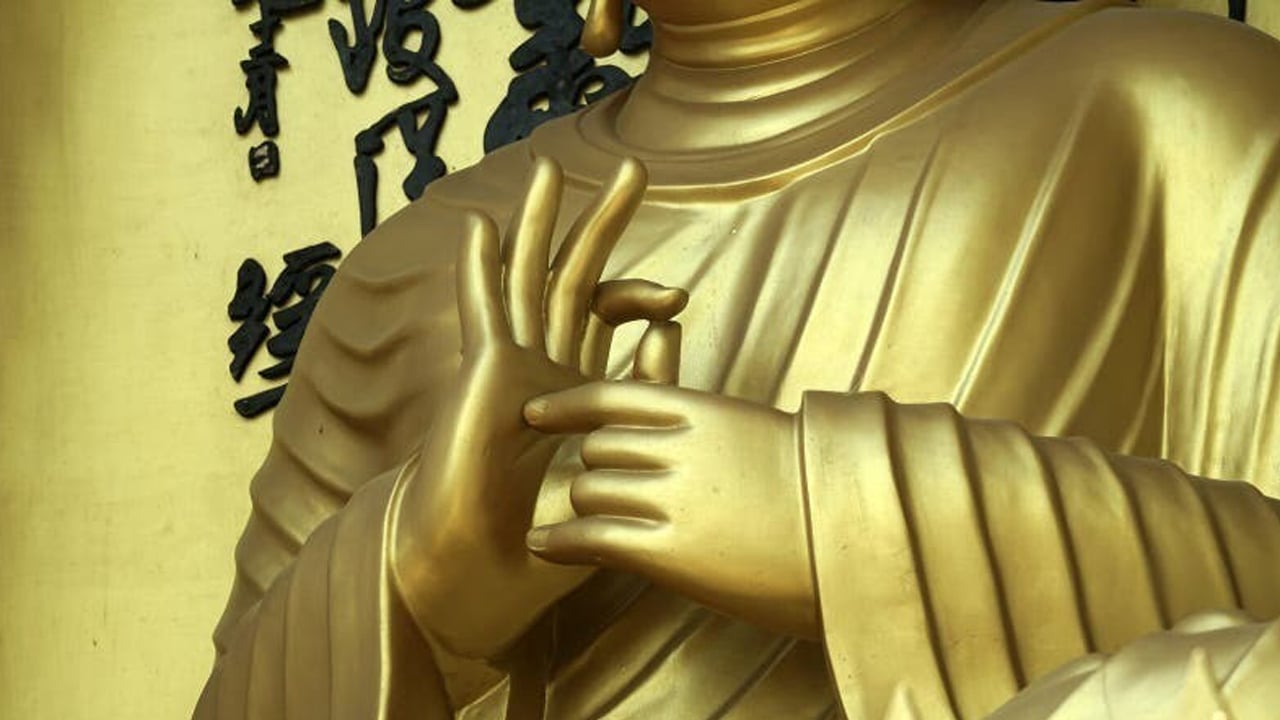
Buddhist mudras are ritual hand gestures that carry precise symbolic meanings, appearing in statues, paintings, and manuscript illustrations across every tradition of Buddhism. Far from decorative convention, each mudra encodes a specific teaching, mental state, or moment in the Buddha's life — making them one of the most compact visual languages in world religion. Understanding them transforms the way you read Buddhist art, whether you encounter an ancient bronze in a Colombo museum or a colossal seated figure carved into the rock at Polonnaruwa.
What is a mudra in Buddhism?
The Sanskrit word mudra literally means "seal" or "mark." In a Buddhist context it refers to a hand position — and sometimes a full-body gesture — that seals a particular quality of mind or a specific moment in Buddhist cosmology. Mudras appear across Theravada, Mahayana, and Vajrayana traditions, though the precise repertoire and interpretation vary by school and region. In Sri Lanka, which follows the Theravada tradition, a relatively focused set of mudras dominates temple iconography.
Mudras function on two levels simultaneously. As iconographic codes, they allow a viewer to identify which aspect of the Buddha or which bodhisattva is depicted without needing a label. As meditative tools, practitioners may hold the same gestures during seated practice, using the physical form to anchor a corresponding inner quality.
What are the most important Buddhist mudras?
The following mudras appear most frequently in Sri Lankan temples, viharas, and Buddhist art collections:
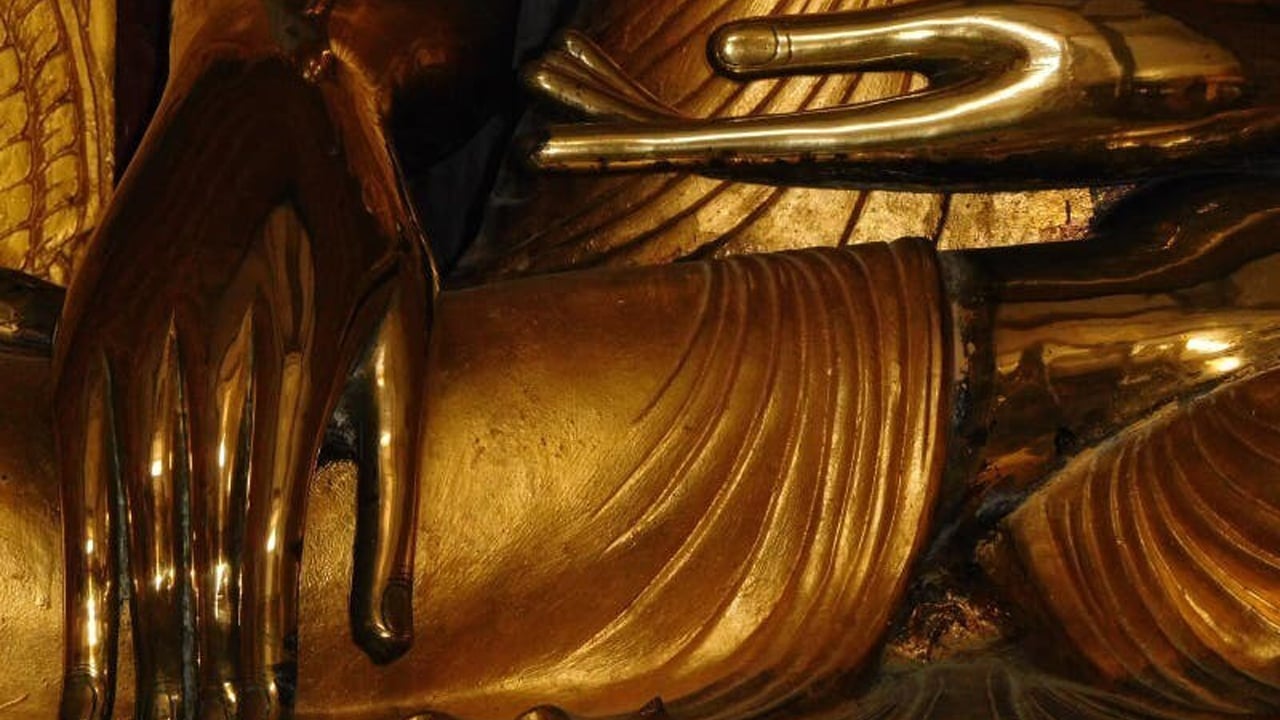
- Dhyana Mudra (Meditation Seal): Both hands rest in the lap, palms facing upward, the right hand placed lightly on the left, thumbs touching to form an oval. This is the mudra of meditation and inner stillness, associated with the Buddha's concentrated state during his progress toward enlightenment.
- Bhumisparsha Mudra (Earth-Touching Seal): The left hand rests palm-up in the lap while the right hand extends over the right knee, fingertips touching the ground. It commemorates the moment the Buddha called the earth goddess to witness his right to claim the seat of enlightenment, defeating Mara's challenge. This is among the most common postures in Sri Lankan image houses.
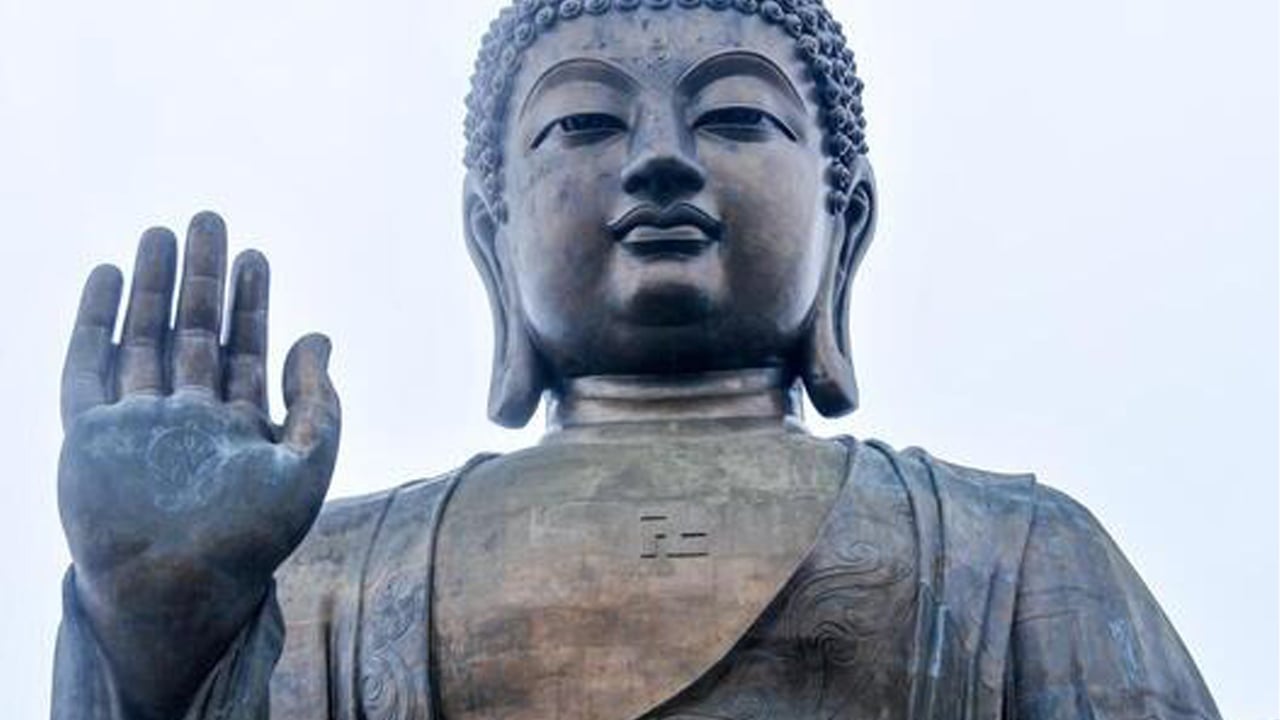
- Abhaya Mudra (Fearlessness Seal): The right hand is raised to shoulder height or above, palm facing outward, fingers extended upward. It conveys protection and the absence of fear — a gesture of reassurance extended from the Buddha to the devotee. Standing Buddha figures in Sri Lanka frequently display this mudra.
- Vitarka Mudra (Discussion Seal): The hand is raised with the thumb and index finger touching to form a circle, the remaining fingers extended. It signals the transmission of teachings and is often associated with the moment of the first sermon at Deer Park, Sarnath. In some traditions the gesture is made with both hands simultaneously, representing an ongoing turning of the Dharma wheel.
- Dharmachakra Mudra (Wheel-Turning Seal): Both hands are held at chest height, each forming the thumb-and-forefinger circle of the Vitarka, with the right hand's fingers touching the left. This explicitly commemorates the first sermon and the setting in motion of the Dharma wheel. It is less common in Theravada statuary than in Mahayana and Vajrayana art but appears in some Sri Lankan paintings.
- Varada Mudra (Gift-Giving Seal): The arm extends downward, palm facing outward and fingers pointing toward the ground — a gesture of generosity and the bestowal of blessings. It often appears on standing figures and is sometimes combined with the Abhaya Mudra (right hand raised, left hand in Varada).
- Karana Mudra (Warding Seal): The hand is raised with the index and little fingers extended while the middle and ring fingers are folded, the thumb holding them down. This gesture is used to dispel negative forces, obstacles, and harmful energies. It appears in both devotional images and Vajrayana ritual contexts.
- Anjali Mudra (Salutation Seal): Both palms are pressed together at chest height, fingers pointing upward. While this gesture predates Buddhism and is shared across South and Southeast Asian traditions, it is the standard gesture of respectful greeting and veneration offered by devotees before shrines and teachers throughout the Buddhist world.
How do mudras relate to Buddhist iconography in Sri Lanka?
Reading a statue begins with the mudra. Once you identify the hand gesture, you can often determine the posture (seated, standing, or reclining), the figure's identity, and the narrative moment depicted — all before reading any accompanying text. Sri Lankan Theravada iconography is somewhat more restrained than Tibetan or East Asian traditions: the Bhumisparsha, Dhyana, Abhaya, and Varada mudras account for the majority of images in ancient sites like Aukana, Dambulla Cave Temple, and Gal Vihara.
Stone and bronze craftsmen of the Anuradhapura and Polonnaruwa periods codified these gestures with great precision. Minor variations in finger angle or wrist height were not accidents — they carried meaning within the workshop traditions of the time. Contemporary conservation scholars use mudra analysis alongside stylistic features to date and attribute unsigned works.
How are mudras used in meditation practice?
In seated meditation, the Dhyana Mudra is the most widely practiced hand position across Theravada communities. The oval formed by the touching thumbs is said to support uninterrupted concentration, and practitioners are encouraged to notice when the hands relax and separate — treating it as a physical reminder to re-engage the mind. The Anjali Mudra opens and closes most formal meditation sessions, framing the practice within a context of respect and intention.
In Vajrayana and some Mahayana contexts, mudras are integrated into more elaborate ritual sequences alongside mantra recitation and visualisation — a triad known as body, speech, and mind practice. Here the mudra engages the body dimension, the mantra engages speech, and the visualised image engages the mind, creating a unified meditative field.
Contemporary mindfulness-based approaches sometimes incorporate simple mudras such as the Dhyana or the Gyan Mudra (thumb and index finger touching, a gesture from the Hindu-Yogic tradition that has migrated into some Buddhist meditation circles) as anchors for attention, independent of their iconographic significance.
Where can you see Buddhist mudras depicted in Sri Lanka?
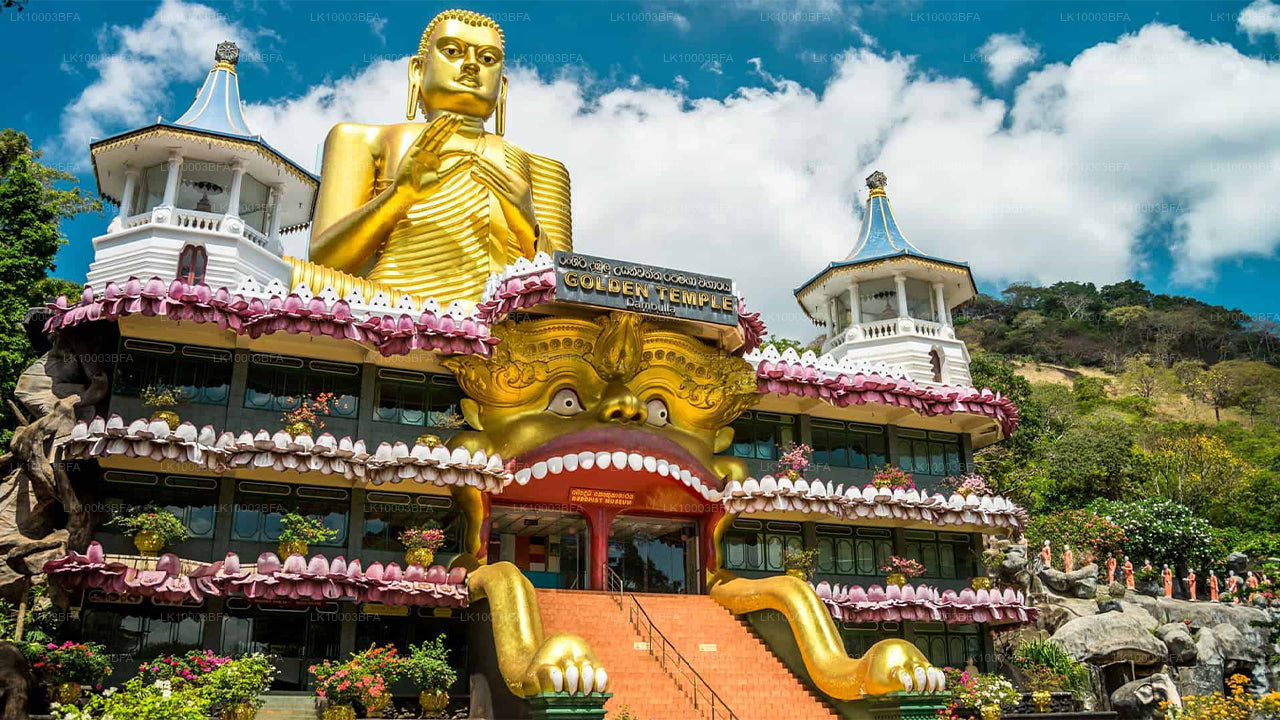
Sri Lanka offers some of the finest surviving examples of Theravada Buddhist sculpture in Asia. The Gal Vihara rock temple near Polonnaruwa presents four monumental figures carved from a single granite face, each in a distinct posture and mudra. The Aukana statue near Kekirawa, around 12 metres tall, displays the Abhaya Mudra with exceptional refinement. The Dambulla Cave Temple complex contains hundreds of painted and sculpted figures spanning multiple periods, allowing visitors to compare mudra conventions across centuries.
If you visit a contemporary temple in Sri Lanka, you are likely to encounter the image house (patimaghara) as a central structure. The primary Buddha image seated at the far end almost invariably displays either the Dhyana or Bhumisparsha Mudra, while flanking figures may show the Abhaya or Varada gestures. Many viharas also display painted narrative murals in which the historical episodes linked to specific mudras — the enlightenment, the first sermon, the descent from the Tusita heaven — are depicted in sequence around the walls.
For context on the stupas and monastic structures that frame these image houses, Lakpura's editorial pages cover the architectural traditions of the sacred sites in detail.
What is the significance of mudras beyond their visual form?
Buddhist philosophy treats gesture, speech, and thought as equally powerful channels of karma and transformation. A mudra is not merely a sign pointing to an idea; in traditional understanding it participates in the reality it represents. Holding the Dhyana Mudra during meditation is not simply a reminder to meditate — it is considered to embody the quality of meditative stillness in the practitioner's body, creating a feedback loop between physical form and mental state.
This understanding is not limited to Buddhism. Parallel ideas appear in Hindu tantra, Christian iconography (where hand positions of blessing carry specific theological weight), and in the gestural codes of classical Indian dance traditions such as Bharatanatyam. What distinguishes the Buddhist mudra system is the degree to which it has been systematised across centuries and transmitted intact through both artistic and living meditation lineages.
For those wishing to deepen their understanding beyond a temple visit, the study of Buddhist iconology — the formal discipline of reading religious images — provides the analytical framework within which mudras are fully interpreted. Lakpura stocks several specialised texts on this subject, including foundational works on Buddhist art history and iconographic canons.
Other species in this genus
2 more, sharing the same genus.
Related reading
9 pages on closely related subjects.