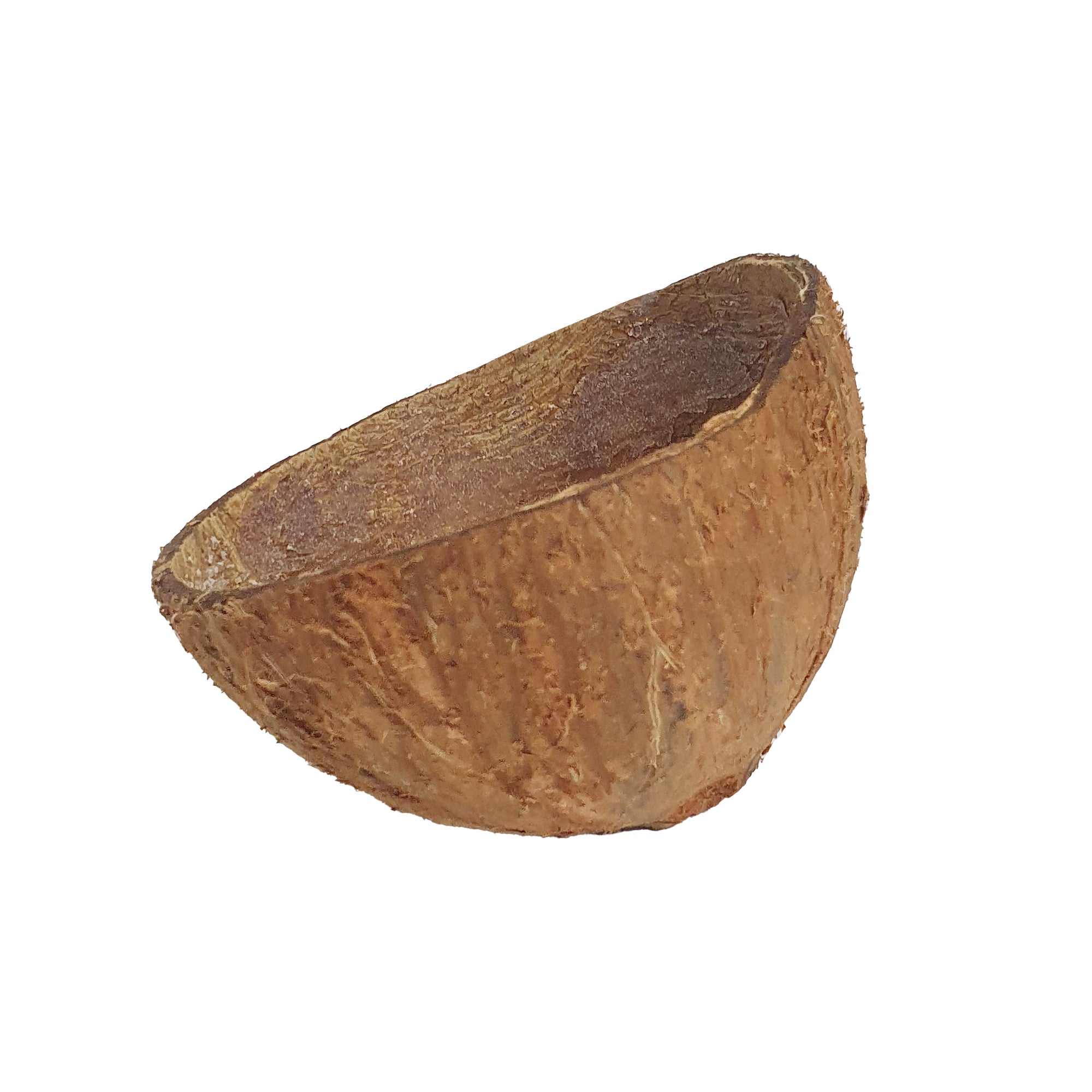
These are raw halves of coconut shell, sold as plain material for making and mending rather than as a finished object. Each one is the genuine outer shell of a coconut grown in Sri Lanka, left unpolished so that the grain, marks and natural colouring of the shell are all still visible.
The preparation is simple. The flesh has been scraped out from the inside and the fibrous outside has been trimmed short, so the halves arrive ready to be cut, sanded, drilled, carved, painted or used as they are. Only the "male" side of the shell is used, the side with no holes, or "eyes", which gives an unbroken curve to work with. Each half has its own unique size, since no two shells are alike.
The shells are 100% natural, eco-friendly and biodegradable, and what was once discarded as an outer cover is now a material with steady demand among makers and gardeners.
Below are some of the ways the halves are commonly put to work:
- Carved and painted wall hangings — the curved surface takes intricate carved and painted designs in the handicraft tradition.
- Masks — the natural dome shape is worked into small decorative masks.
- Wind chimes — several halves can be drilled and strung together to knock against one another in the breeze.
- Candle holders — the hollow half is used as a small open holder for a candle.
- Bowls and tableware — makers cut, sand and finish the halves into small bowls and serving pieces to their own standards.
- Soap dishes — the shell is used as a small dish for a bar of soap at a basin or sink.
- Scoops and spoons — cut into sections and fitted with a handle, the shell forms the bowl of a scoop or spoon.
- Planters — the half works as a small perishable pot for microgreens, smaller herbs and succulents.
- Bird feeders — drilled and hung from a branch, the half holds seed or fat for garden birds.
- Coconut shell charcoal — the shells are burnt down to make charcoal.
- Terrarium accents — a half sits inside a glass terrarium as a natural feature among the planting.
- Small drums — the shell is traditionally used as the body of small drums in percussion instruments.
- Trinket and desk dishes — the half holds rings, keys, coins, pins or paper clips on a shelf or desk.
- Craft and workshop material — the halves are useful for sanding and carving practice, mosaic pieces, buttons, beads and jewellery blanks.
Special note — Kindly note that the size of each shell is unique, while the width is more than or equal to 3.5 inches and the height is more than or equal to 2.5 inches. You will receive two shells in an order, and they will not be from the same coconut. We only use the "male" side, which does not have any holes.