


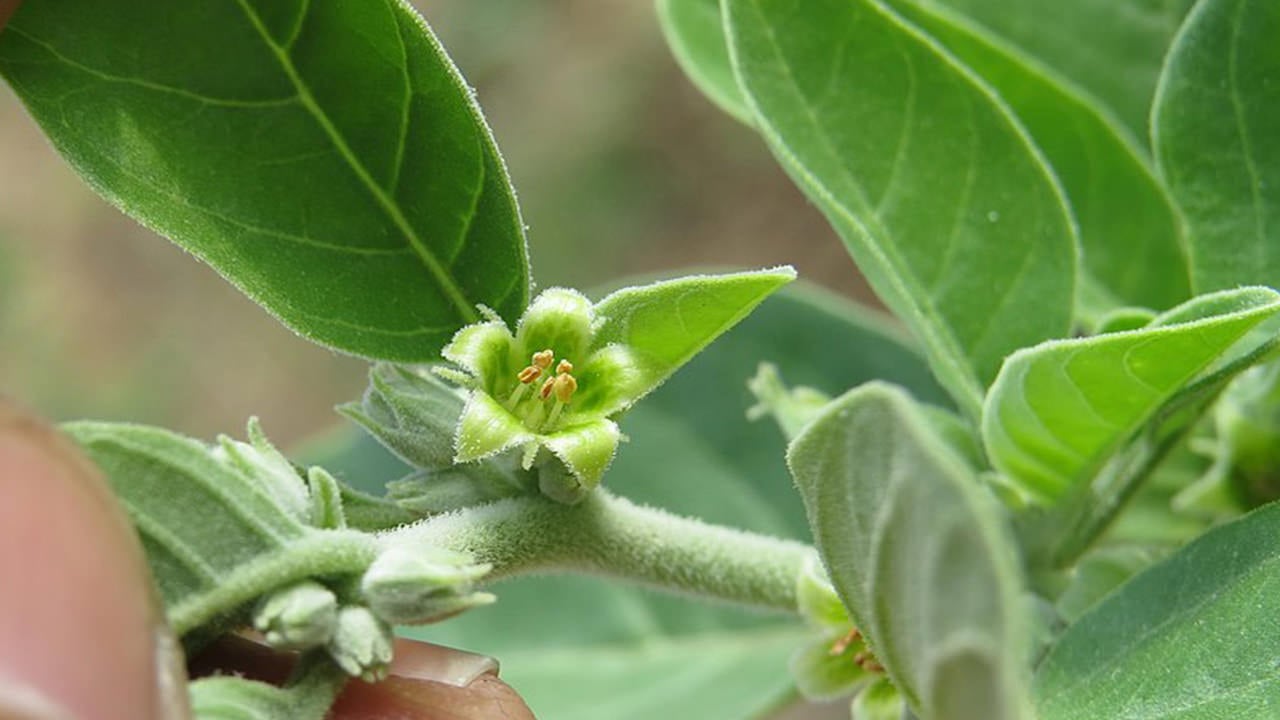


Withania somnifera, commonly known as ashwagandha or winter cherry, is a small evergreen shrub belonging to the Solanaceae (nightshade) family. Native to India, the Middle East, and parts of Africa, it has been a cornerstone of Ayurvedic medicine for thousands of years. In Sri Lanka, it is formally catalogued as part of the island's Ayurvedic medicinal plant heritage, where it is known locally as Ashwagandha (අශ්වගන්ධා).
What is Withania somnifera and how is it identified?
The plant grows as a low, branching shrub typically reaching 35–75 cm in height. Its leaves are oval and slightly downy, while the flowers are small, bell-shaped, and pale green to yellow. The fruit — a small orange-red berry enclosed in a papery husk — gives rise to the alternate common name "winter cherry." Several other species within the genus Withania share a similar appearance, so positive identification typically relies on the combination of leaf texture, berry structure, and root characteristics.
The root is the most commercially and medicinally significant part of the plant. It has a distinctly earthy, slightly bitter aroma that has been described as reminiscent of a horse — a quality that may have contributed to the Sanskrit origin of the name ashwagandha, which translates roughly as "smell of horse."
Where does ashwagandha grow in Sri Lanka?
Within Sri Lanka, Withania somnifera favours open, disturbed, and semi-arid habitats — areas with well-drained, sandy or loamy soils and reliable sun exposure. It is not typically found in dense rainforest or high-elevation cloud forest, preferring drier lowland and mid-country zones. Cultivation for Ayurvedic and herbal supply chains occurs in several parts of the island, often alongside other medicinal species such as Acacia chundra and Pongamia pinnata, both of which share a place in Sri Lanka's traditional botanical pharmacopoeia.
What are the traditional Ayurvedic uses of ashwagandha?
Ashwagandha occupies a significant position in classical Ayurvedic texts, where it is classified as a rasayana — a category of tonifying herbs thought to promote longevity and overall vitality. Traditional practitioners have used preparations derived from the root to address a range of conditions, including:
- Stress and anxiety management, where it is used as an adaptogen
- Insomnia and disrupted sleep patterns
- Generalised fatigue and low energy
- Musculoskeletal discomfort and inflammation
- Nutritional support and immune resilience
Both the root and the berry have historically been incorporated into Ayurvedic formulations. Root powder is frequently prepared as a warm-milk drink, while extracts are used in compound herbal preparations. Related classical formulations found in Sri Lanka's Ayurvedic tradition include compound remedies such as Yogaraja Guggulu and Kaishore Guggulu, which often combine ashwagandha with other botanical ingredients.
What does modern research say about ashwagandha?
Scientific interest in Withania somnifera has grown considerably over recent decades. Clinical studies have explored its effects on cortisol regulation, thyroid function, physical endurance, and cognitive performance. Some trials report statistically significant reductions in self-reported stress and serum cortisol levels among participants taking standardised root extracts. However, research is still maturing: sample sizes are often small, study durations short, and methodologies varied. Health regulators in several countries classify ashwagandha as a dietary supplement rather than a licensed medicine, meaning therapeutic claims remain subject to ongoing scrutiny.
It is important not to conflate ashwagandha with superficially similar plants. Physalis alkekengi also carries the common name "winter cherry" but is botanically unrelated. Similarly, ashwagandha should not be confused with American ginseng, Panax ginseng, or eleuthero — plants from entirely different families that are sometimes grouped together in popular wellness marketing under the broad label of "adaptogens."
How is ashwagandha used in Sri Lanka's wellness and tourism sector?
Sri Lanka's longstanding Ayurvedic tradition means that visitors to the island regularly encounter ashwagandha as part of authentic wellness programmes. Ayurvedic resorts and treatment centres — concentrated particularly in the hill country and the southern coastal belt — incorporate ashwagandha root powder and oil into therapeutic massages, herbal baths, and dietary regimens. These programmes are typically guided by qualified Ayurvedic physicians (vaidyas) who tailor formulations to individual constitutions (prakriti).
For travellers interested in Sri Lanka's botanical heritage more broadly, the island offers remarkable diversity. Ceylon black pepper and Syzygium aromaticum (cloves) represent two of the island's most historically traded medicinal spices, and visits to spice gardens where these plants grow alongside ashwagandha offer a grounded introduction to the country's herbal landscape.
Wellness-focused visitors may also find that a yoga tour itinerary in Sri Lanka naturally incorporates Ayurvedic plant knowledge, with some operators integrating garden visits and practitioner consultations into multi-day programmes.
Botanical quick reference
| Attribute | Detail |
|---|---|
| Scientific name | Withania somnifera |
| Family | Solanaceae |
| Common names | Ashwagandha, winter cherry, Indian ginseng |
| Local name (Sri Lanka) | Ashwagandha (අශ්වගන්ධා) |
| Typical height | 35–75 cm |
| Parts used medicinally | Root (primary), berry |
| Native range | India, Middle East, parts of Africa |
| Habitat in Sri Lanka | Open, disturbed, well-drained lowland areas |
| Ayurvedic classification | Rasayana (tonifying herb) |
Is ashwagandha safe to use?
For most adults, ashwagandha is considered well-tolerated when taken in amounts commonly used in food or traditional preparations. Higher-dose supplementation over extended periods has been associated with occasional reports of gastrointestinal discomfort, and there are documented concerns around its use during pregnancy. Individuals with thyroid conditions, autoimmune disorders, or those taking prescription medications should consult a qualified medical practitioner before beginning any ashwagandha supplementation. Sri Lanka's Ayurvedic practitioners emphasise that traditional use is always contextualised within a broader constitutional assessment — not applied as a one-size-fits-all remedy.
