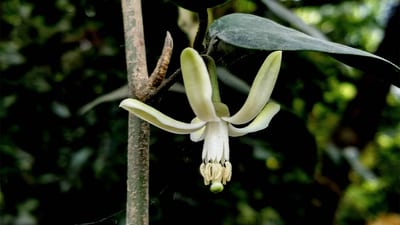
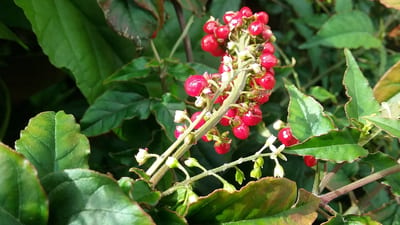
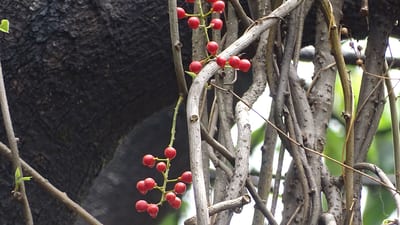
Pothos scandens is an evergreen root climber native to Sri Lanka, known locally as Pota wel. It belongs to the Araceae family, the same botanical family that includes many familiar climbing and foliage aroids, and it is recognised by its glossy winged leaf stalks and clusters of bright red berries.
What does Pothos scandens look like?
This species is a root climber, clinging to its support as it grows upward. Its leaves are simple and entire, meaning the leaf margin is smooth without lobes or teeth, and the venation is reticulate (net-like) with a distinct submarginal vein running just inside the leaf edge.
A notable feature is the petiole, or leaf stalk, which is pulvinate (swollen at the joint) and broadly winged. The winged petioles can reach up to about 5 cm by 1 cm, with an apex that is rounded or slightly notched (emarginate). The plant flowers on hanging branches, and its berries ripen to a shining scarlet or crimson red.
Where does Pothos scandens grow?
Pothos scandens is recorded as native to Sri Lanka. As a root climber in the Araceae family, it grows by attaching itself to tree trunks or other vertical supports, a habit typical of many aroid climbers across the humid tropics.
Can you eat Pothos scandens?
No edible parts are recorded for this species. It should not be treated as a food plant.
What is Pothos scandens called in Sinhala?
In Sinhala, Pothos scandens is known as Pota wel.
| Attribute | Recorded detail |
|---|---|
| Scientific name | Pothos scandens |
| Family | Araceae |
| Sinhala / local name | Pota wel |
| Status in Sri Lanka | Native |
| Edible parts | None |
| Life form | Evergreen root climber |
| Leaves | Simple, entire, reticulate venation with submarginal vein; petiole pulvinate, broadly winged, to 5 x 1 cm, apex rounded to emarginate |
| Flowers | Borne on hanging branches |
| Fruit | Berries, shining scarlet to crimson red |
Other species in this genus
1 more, sharing the same genus.