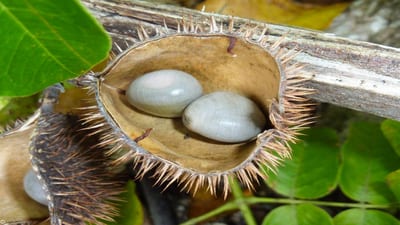
Entada pursaetha, known in Sinhala as Pus Wel (පුස් වැල්), is one of the most distinctive climbing plants found across the tropical forests of Sri Lanka. A member of the legume family, this robust woody liana is recognisable by its exceptionally large seed pods, which rank among the longest of any plant species in the world. Far from being a mere botanical curiosity, Pus Wel has been woven into traditional Sri Lankan Ayurvedic medicine for centuries, valued for a range of therapeutic applications.
What does Entada pursaetha look like?
Entada pursaetha is a large, woody climbing vine that uses surrounding trees as support structures, sometimes reaching considerable heights in the forest canopy. Its leaves are bipinnate — arranged in opposite pairs along each frond — with small, rounded leaflets that give the foliage a delicate, feathery appearance despite the plant's overall vigour.
The flowers are small and white, produced in elongated spikes. The most striking feature, however, is the seed pod. These pods are light brown, slightly curved, and can reach up to one metre in length, making them among the largest legume pods in the plant kingdom. Each pod is segmented, and the individual seeds contained within are broad — typically 4 to 7 cm across — brown, glossy, and rounded or occasionally rectangular in outline. Because of their buoyancy, the seeds are capable of drifting across the ocean, and specimens have reportedly washed ashore as far away as Europe and the Caribbean.
Where does Pus Wel grow in Sri Lanka?
Entada pursaetha is distributed across the lowland and mid-elevation tropical forests of Sri Lanka, typically favouring areas with high rainfall and humid conditions. It is commonly found in and around forest edges, riverine zones, and disturbed secondary forest, where it climbs over existing vegetation in search of light. The plant also occurs across tropical Africa, Asia, and parts of Australia, but Sri Lanka's remaining wet-zone forests — including areas adjacent to the Sinharaja Forest Reserve — provide habitat in which it can still be observed.
The vine tends to be most visible during the dry season when surrounding trees shed leaves, making the large pods easier to spot hanging from the canopy.
What are the traditional medicinal uses of Entada pursaetha?
Within the Sri Lankan and broader South Asian Ayurvedic tradition, various parts of the Entada pursaetha plant — including the seeds, bark, and leaves — have been used to address a range of health conditions. Practitioners have traditionally employed the plant in treatments for:
- Skin diseases — topical preparations from seed or bark extracts
- Fever — decoctions used to reduce elevated body temperature
- Abscesses — poultices applied externally to draw out infection
- Post-partum myalgia — preparations used to ease muscle pain following childbirth
- Sty (hordeolum) — localised eye infections treated with plant-based applications
- Glandular swellings — including lymph node conditions addressed through herbal formulations
- Severe back pain — preparations used as part of pain-management protocols
These applications are documented within the classical Ayurvedic literature as well as in the oral knowledge traditions of Sri Lanka's veda mahattaya (traditional village physicians). The seeds in particular contain saponins and other bioactive compounds that have attracted interest from contemporary pharmacological researchers, though formal clinical validation of many traditional uses remains ongoing.
How does Entada pursaetha fit into Sri Lankan ethnobotany?
Sri Lanka has an extraordinarily rich tradition of plant-based medicine, shaped by centuries of interaction between local knowledge systems and codified Ayurvedic texts brought from the Indian subcontinent. Plants like Entada pursaetha occupy an important niche in this tradition — not as commercially cultivated crops but as forest-gathered resources that rural communities have learned to identify, harvest sustainably, and apply medicinally.
Alongside other leguminous trees and lianas documented in Sri Lanka's forests — such as Acacia chundra — Entada pursaetha represents the intersection of biodiversity and living cultural heritage. Understanding these plants requires both botanical literacy and an appreciation of the social contexts in which traditional medicine operates.
The giant seeds also carry a more playful cultural presence: their smooth, coin-like form makes them memorable natural objects, and they have historically been carried as good-luck charms or curiosities across cultures wherever they wash ashore.
Is Entada pursaetha used in modern research?
Scientific interest in Entada pursaetha has grown in recent decades, with researchers investigating the bioactive constituents of its seeds, bark, and other plant parts. Preliminary studies have pointed to the presence of saponins, alkaloids, and flavonoids — classes of compound associated with anti-inflammatory, antimicrobial, and analgesic activity. These findings broadly align with the plant's traditional applications, though researchers caution that most studies to date have been conducted at laboratory scale rather than in clinical settings.
The plant's capacity for long-distance seed dispersal via ocean currents — a phenomenon known as thalassochory — has also drawn attention from biogeographers studying how tropical species colonised their present ranges across the Indian Ocean basin.
Can visitors encounter Entada pursaetha in Sri Lanka?
For visitors with an interest in tropical botany or traditional medicine, the best opportunities to observe Entada pursaetha in its natural setting are within Sri Lanka's remaining lowland rainforests and forest reserves. Guided botanical walks — offered by community-based ecotourism operations in several regions — can include introductions to medicinal plants including Pus Wel, with context provided by knowledgeable local guides.
Sri Lanka's wet zone is particularly rewarding for plant enthusiasts, offering a concentration of endemic and medicinal species within relatively accessible areas. Combining a botanical interest with visits to broader natural attractions in the region allows travellers to appreciate the ecological complexity that makes the island's forests globally significant.