
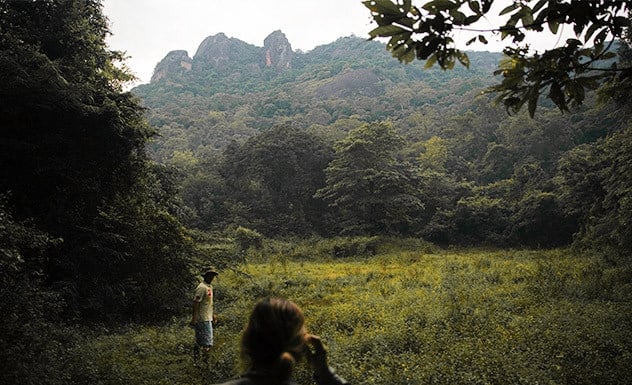


Rising above one of Sri Lanka's least-visited wilderness areas, Monkey Mountain sits within the Gal Oya region of Ampara District — a landscape that remained largely closed to outsiders during the country's civil conflict and has, as a result, stayed remarkably intact. The forest here is dense, the wildlife undisturbed, and the sense of remoteness is genuine. This is not a destination you stumble upon; visiting it takes deliberate planning and rewards those who make the effort.
What makes the Gal Oya region so ecologically significant?
The Gal Oya area supports one of Sri Lanka's most biodiverse lowland ecosystems. Thirty-two species of mammals have been recorded in the surrounding forests, alongside a notable diversity of birds and reptiles. The canopy is thick enough that from the air, the landscape appears as an unbroken green mass — which is precisely why so much of its wildlife has remained undocumented and undisturbed.
The forests bordering Sinharaja Forest Reserve and other protected areas share a similar character: ancient, layered, and host to species that have quietly endured while development reshaped the rest of the island. Gal Oya, however, carries its own particular density and stillness that distinguishes it from more frequently visited reserves.
Bird species vary across different forest strata, and reptile sightings — including endemic lizards and small snakes — are common for observant visitors. Larger mammals such as elephants and leopards are present in the region but rarely encountered on foot.
Who are the Vedda people, and what is their connection to this area?
The Vedda — Sri Lanka's indigenous community and among the oldest continuously surviving peoples on the island — have lived in and around the Gal Oya forest for generations. Their oral traditions, hunting knowledge, and relationship with the land predate recorded Sri Lankan history. The community is small and, in many respects, increasingly marginalised.
Vedda elders have long maintained that the forests surrounding Gal Oya hold an unusually high density of medicinal plants. Whether or not every claim can be verified botanically, the assertion is consistent with what ethnobotanists have documented across the region: a rich variety of plant species with traditional therapeutic applications. That knowledge, accumulated over centuries, is part of what makes this corner of Sri Lanka culturally irreplaceable.
What can you see and do at Monkey Mountain?
The primary draw of Monkey Mountain itself is the climb to its summit, which opens up panoramic views over the surrounding forest canopy. Because the forest below is so thick, the view from the top is one of the few ways to appreciate the true scale of the Gal Oya wilderness — an uninterrupted green horizon that conveys just how little of this land has been disturbed.
Along the trail, wildlife encounters are likely to include:
- A range of bird species, including forest-specialist birds not easily found elsewhere
- Butterflies, some of them endemic or near-endemic to Sri Lanka
- Reptiles including skinks, agamid lizards, and occasionally snakes
- Toque macaques and other primates that give the mountain its common name
The walk itself is rewarding for anyone with a genuine interest in nature and an appetite for off-the-beaten-track experiences. The terrain is forested and can be humid, so appropriate footwear and clothing matter.
How remote is Monkey Mountain, and how do I get there?
Gal Oya National Park — the wider protected area in which this region sits — is located in Ampara District in Sri Lanka's Eastern Province. The nearest town of any size is Ampara, and the journey from Colombo typically takes around six to seven hours by road, depending on the route and traffic conditions.
Public transport to the area is limited, and most visitors arrange private transport. The roads in the immediate vicinity of the national park and Monkey Mountain can be rough, particularly during and after the wet season. A vehicle with reasonable ground clearance is advisable.
There is minimal tourist infrastructure in the area — which is part of its appeal, but also something to factor into planning. Accommodation options near Gal Oya are few and basic; booking in advance is essential.
When is the best time to visit Monkey Mountain?
The Gal Oya region, sitting in the dry zone of eastern Sri Lanka, receives most of its rainfall between October and January from the northeast monsoon. The most comfortable months for a visit are typically between February and September, when conditions are drier and trails are more easily navigated.
The dry season also tends to concentrate wildlife around water sources, making animal sightings more predictable. Birding is productive year-round, though the presence of migratory species adds variety between November and April.
Is Monkey Mountain suitable for families and casual hikers?
The climb to the summit is manageable for reasonably fit walkers, though the combination of heat, humidity, and uneven forest terrain means it is not suitable for very young children or anyone with significant mobility limitations. There are no formal facilities at the site — no marked trail infrastructure, no food vendors, and no ranger station at the mountain itself.
Visitors should carry sufficient water, wear sun protection, and ideally go with a local guide who knows the area. A guide also significantly improves the experience in terms of wildlife identification and safe navigation through the forest.
What else is worth combining with a visit to this area?
Gal Oya National Park offers one of Sri Lanka's most unusual wildlife experiences: boat safaris on Senanayake Samudra, the island's largest inland reservoir, where herds of elephants are sometimes seen swimming between islands. This is a compelling reason to spend at least two nights in the area rather than rushing through on a day trip.
For those building a wider eastern Sri Lanka itinerary, the ancient city of Polonnaruwa lies to the northwest and makes a logical companion destination — historically rich and accessible from many of the same road routes used to reach Ampara.
Nearby places
8 places within about 25 km, nearest first.
- Gal Oya National Parkunder 1 km
- Hathpotha Entrance15 km
- Adawatte Tea Estate20 km
- Gal Oya City22 km
- Senanayake Samudraya23 km
- Namunukula24 km
- Monaragala Town24 km
- Moneragala District24 km
Related reading
5 pages on closely related subjects.
