Among the quieter corners of the Mihintale pilgrimage site stands one of the most thought-provoking archaeological remnants in Sri Lanka: the ruins of a hospital that served monks and laypeople more than a thousand years ago. Far from being a mere footnote to the better-known dagobas and refectory nearby, this complex offers a rare and tangible window into the sophistication of ancient Sri Lankan medicine.
How old are the Mihintale Hospital Ruins?
The surviving structure is attributed to King Sena II, who reigned from approximately 853 to 887 AD. Historians believe, however, that a medical establishment existed on this site considerably earlier, suggesting that Mihintale maintained a tradition of organised healthcare for centuries before the current ruins took shape. The complex is therefore not simply the product of one monarch's patronage but the physical expression of a long-standing commitment to healing as part of monastic life.
What is the layout of the hospital complex?
The entrance to the complex faces south, opening onto a square open-air courtyard that serves as an outer precinct. Visitors moving through this outer court encounter two distinct functional zones before reaching the main ward building.
- Janthagharaya (steam and hot-water bath room): The room on the right contains a square stone tank assembled from carefully fitted stone slabs. This is identified as the Janthagharaya — a hot-water and steam-bath chamber used for therapeutic treatment, a technique consistent with classical Ayurvedic practice.
- Medicine store: The first of two rooms on the left is smaller and is identified by archaeologists as the storage room for medicinal preparations.
- Dana Shalawa (refectory): The second, larger room on the left is thought to have functioned as a refectory or hall where food and medicinal meals were distributed to patients.
In the centre of the outer courtyard stands a large grinding stone — noticeably bigger than a domestic quern — which would have been used to grind herbs and other ingredients into medicines for patients. Its presence in the open court suggests that medicine preparation was an active, communal process rather than something conducted out of sight.
What is inside the main hospital building?
Passing through the outer precinct, you enter the main ward building, which is arranged around a central open court. At the heart of this court stood an image house sheltering two standing Buddha statues — a deliberate placement that oriented every patient room towards a place of devotion and calm. The statues themselves are no longer standing; only their lotus-carved stone bases remain, though these alone are fine examples of early medieval Sri Lankan craftsmanship.
Surrounding the shrine on all sides are the patient rooms. Each room measures roughly ten feet by ten feet, with its entrance facing the Buddha shrine — an arrangement that blended spiritual comfort with practical care. There are 31 rooms in total, with each room estimated to have accommodated around two patients, giving the hospital a working capacity of approximately 60 patients at any one time.
The corner rooms are somewhat larger than the standard wards, and the north-eastern room contains a medicinal trough — a stone vessel likely used to prepare or administer liquid treatments and herbal baths directly within the ward.
What does the hospital reveal about ancient Sri Lankan medicine?
The Mihintale hospital complex is one of the earliest documented hospital buildings in the world, and its design reflects a coherent medical philosophy. The separation of functional zones — pharmacy, steam bath, food preparation, and wards — mirrors principles found in classical Ayurvedic texts such as the Ashtanga Hridayam. The integration of a Buddhist shrine at the centre of the ward block suggests that mental and spiritual wellbeing were considered inseparable from physical recovery.
Ancient Sinhalese medical practice drew on a rich pharmacopeia of local plants. Species such as Pongamia pinnata were among the medicinal plants documented in the region, and the large grinding stone found here is physical proof that plant-based medicine was compounded on-site rather than imported ready-made.
Similar hospital infrastructure has been documented at other ancient capitals — Polonnaruwa has its own well-preserved hospital ruins — but the Mihintale example is notable for its completeness and for the clarity with which each room's function can still be read from the surviving stonework.
How do I get to the Mihintale Hospital Ruins?
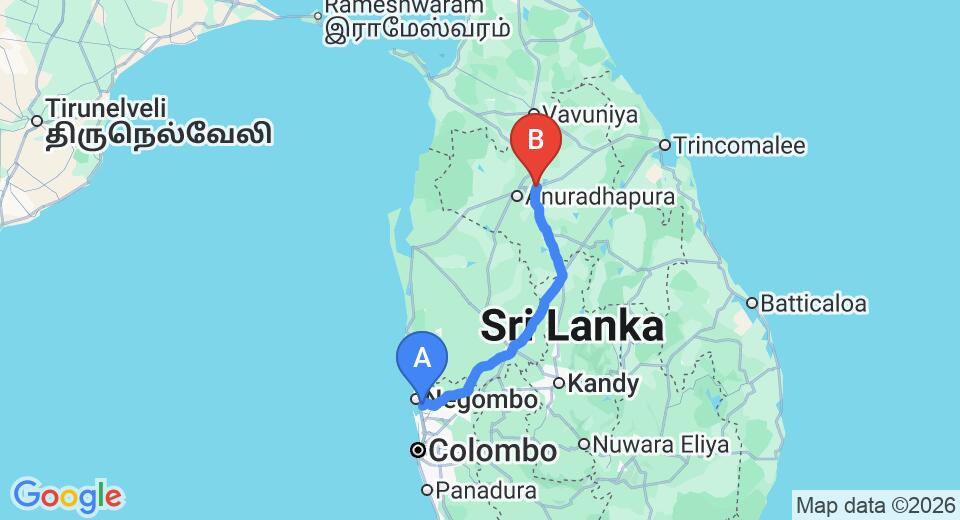
Mihintale is located roughly 13 kilometres east of Anuradhapura along the A9 road, and the site is accessible by car, tuk-tuk, or organised tour. The hospital ruins sit within the broader Mihintale archaeological precinct; most visitors combine them with the climb to the Mahaseya Dagoba and the Ambasthale Dagoba on the same visit. Allow at least half a day for the full site, more if you intend to explore slowly. The nearest town with accommodation is Anuradhapura, though there are a few guesthouses in Mihintale itself.
The site is managed by the Central Cultural Fund and is covered by the Cultural Triangle Round Ticket, which also grants entry to Anuradhapura, Polonnaruwa, Sigiriya, and several other heritage sites. Individual tickets for Mihintale are also available at the site entrance.
When is the best time to visit Mihintale?
The dry season in Sri Lanka's North Central Province runs roughly from May to September, making those months the most comfortable for exploring open-air ruins. The site is busiest during the Poson full-moon festival in June, which draws pilgrims from across the island to celebrate the introduction of Buddhism to Sri Lanka — traditionally associated with Mihintale itself. Visiting outside festival weekends gives you the ruins in relative quiet, which is particularly rewarding at the hospital complex where the atmosphere rewards unhurried attention.
Early mornings are cooler and the low-angle light makes the stone carvings easier to examine. By mid-afternoon the exposed rock can become very hot underfoot, so comfortable, closed footwear is advisable — though shoes must be removed at shrines within the precinct.
Nearby places
12 places within about 25 km, nearest first.
- Ambasthala Stupaunder 1 km
- Kantaka Stupaunder 1 km
- Mihindu Maha Stupa (Seya)under 1 km
- Mihintale Mountainunder 1 km
- Mihindu Caveunder 1 km
- Aradhana galaunder 1 km
- Mihintale Junction Railway Station1 km
- North Central Province4 km
- Jaya Ganga (Yodha Ela)4 km
- Senarathgama Railway Station5 km
- Manakanda7 km
- Thalkote Lake9 km