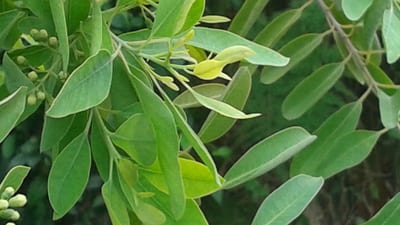
Litsea glutinosa, known locally as Bomee (or Bomi), is a medium-sized tree native to Sri Lanka and found across South and Southeast Asia. A member of the laurel family Lauraceae, it has a long history of use in traditional Ayurvedic medicine and continues to be valued for its therapeutic properties. Despite its cultural significance, certain harvesting practices — particularly the collection of leaf material for incense sticks — place pressure on wild populations.
What does Litsea glutinosa look like?
The tree is medium-sized with thin bark that ranges from grey to dark grey in colour. When the bark is scraped or wetted, it produces a characteristic sliminess — the origin of the common name "slimy Bomee." Leaves can grow up to around 15 cm in length and are ovate to elliptic in shape. Mature foliage is dark green; young leaves emerge with a noticeably soft, delicate texture.
The inflorescences are axillary racemes, appearing along the stems where leaves meet branches. The small fruits are roughly 6 mm in diameter and begin green before ripening to a deep dark purple. A larger-leafed variety, sometimes called "big Bomee," is also recognised and is believed to share broadly similar properties.
Where does Litsea glutinosa grow in Sri Lanka?
In Sri Lanka, Bomee is typically found in secondary forests, scrubland, and disturbed habitats at low to mid-elevations. It tolerates a range of soil types and is often encountered along forest margins and roadsides. The species is also distributed across the Indian subcontinent, southern China, and much of Southeast Asia, giving it one of the wider natural ranges among laurel-family trees in the region.
What are the traditional medicinal uses of Bomee?
In Sri Lankan Ayurvedic practice, the root, bark, and leaves of the Bomee tree are all employed therapeutically. The plant is particularly valued for treating physical trauma and musculoskeletal conditions, including:
- Injuries from falls, blows, or assaults
- Muscle tears and sprains
- Abrasions and surface wounds
- Severe rheumatism and arthritis
- Cases of accidental poisoning or excessive ingestion of certain substances
A traditional topical preparation involves rubbing the inner bark with salted water and applying it as a warm poultice directly to the affected area. This technique is used specifically for sprains, strains, and soft-tissue injuries. The combination of heat and the bark's naturally mucilaginous compounds is thought to reduce inflammation and support healing.
What other uses does Litsea glutinosa have?
Beyond medicine, the bark and leaves of the Bomee tree serve several practical purposes. Extracts from the leaves are used in the manufacture of incense sticks — a commercially driven use that, at scale, can threaten wild populations if bark and foliage are harvested unsustainably. Both bark and leaves have also been used traditionally as natural insect repellents, a property likely linked to the aromatic volatile compounds the plant produces.
The mucilaginous quality of the bark makes it a useful binding agent in various artisanal and traditional contexts, and this same property underlies much of the botanical interest from researchers studying natural adhesives and emulsifiers.
Is Litsea glutinosa under any conservation concern?
The collection of leaf material for incense-stick production is identified as a threat to the long-term survival of wild Bomee populations in Sri Lanka. While the species is not currently listed among the most critically threatened flora, localised overharvesting in accessible forest areas can reduce population density significantly. Responsible sourcing and, where possible, cultivation of the species for commercial use would help ensure its continued availability for both traditional medicine and broader ecological roles.
What is the botanical classification of Litsea glutinosa?
Litsea glutinosa belongs to the genus Litsea within the family Lauraceae — the laurel family that also includes cinnamon, avocado, and bay laurel. The genus Litsea encompasses several hundred species distributed across tropical and subtropical Asia, with Sri Lanka hosting a small but ecologically important subset. The species epithet glutinosa refers directly to the glutinous, sticky character of the bark — a defining physical trait that has shaped both its vernacular name and its traditional applications.