Guduchyadi Oil — known in Sinhala-language Ayurvedic texts as Guduchyadi Thailaya — is one of the most consistently prescribed herbal oils in Sri Lanka's indigenous medical tradition. Its primary botanical ingredient, Tinospora cordifolia (Rasakinda in Sinhala), has been documented in classical Ayurvedic pharmacopoeia for centuries, and the formulation remains in active clinical and household use across the island today.
What is Guduchyadi Oil made from?
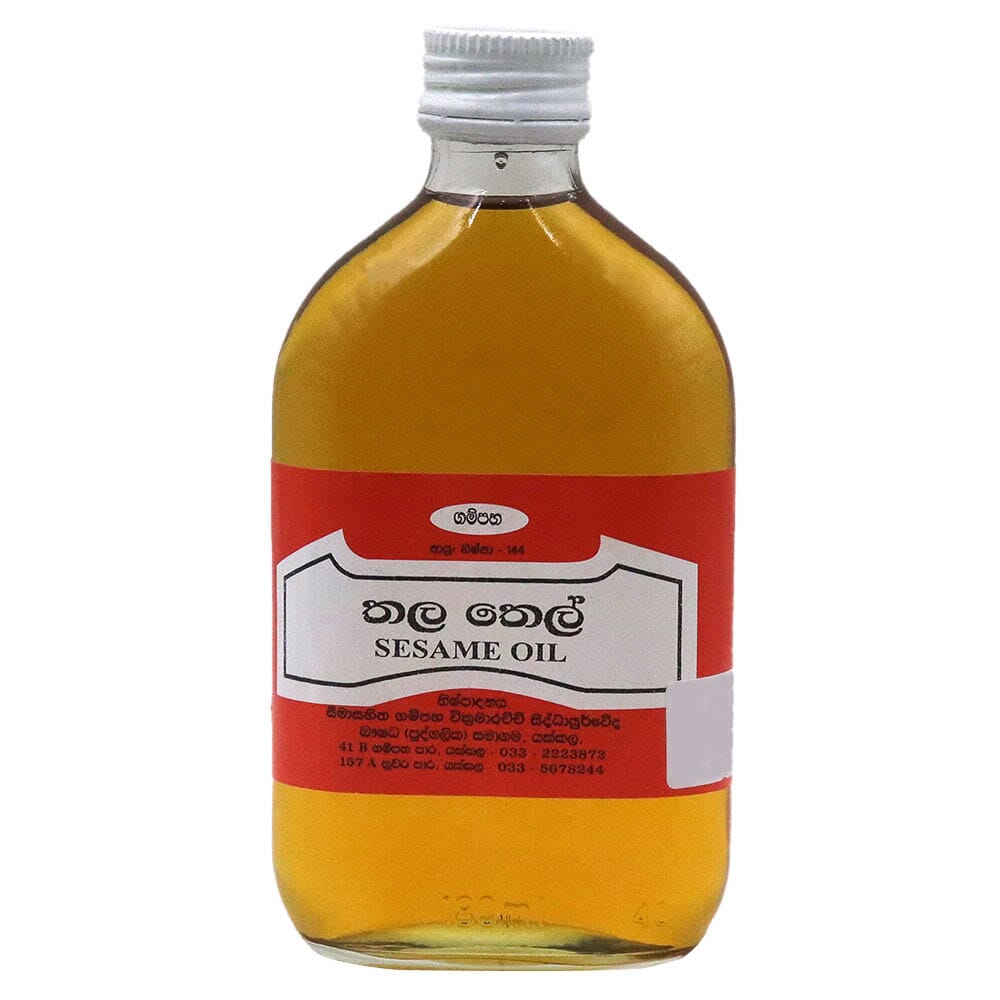
The preparation follows the Pancha Kashaya method — a five-step Ayurvedic process in which a carefully measured decoction is combined with a herbal paste and a base oil, then slow-cooked until the water fully evaporates and the active compounds are absorbed into the carrier. The base is typically coconut oil or sesame oil, both of which are well-suited to Sri Lanka's climate and skin types.
The core herb, Rasakinda (Tinospora cordifolia), is joined by a range of synergistic botanicals that vary slightly between manufacturers and regional traditions. Commonly included ingredients are:
- Sandalwood (Santalum album) — reinforces the cooling, anti-inflammatory action
- Red parboiled rice — adds emollient properties to the formulation
- Licorice root (Glycyrrhiza glabra) — traditionally included for its soothing and anti-inflammatory qualities
- Additional rasayana herbs selected for their tissue-penetrating (sukshma) properties
The resulting oil carries what Ayurvedic texts classify as Sheeta Virya — a cooling potency — which underpins most of its therapeutic applications.
What conditions is Guduchyadi Oil used for?
Sri Lankan practitioners working within the Deshiya Chikitsa (indigenous healing) tradition most frequently recommend Guduchyadi Oil for conditions associated with excess heat and Pitta-Vata imbalance. In a tropical climate where prolonged sun exposure is the norm, these presentations are common.
Primary applications include:
- Chronic headaches and migraines — applied to the scalp and temples, often as part of a daily head massage or a Shirodhara session
- Burning sensations in the eyes and feet — a classic Pitta symptom addressed by the oil's cooling nature
- Joint pain and gouty arthritis — used in Abhyanga (full-body oil massage) to reduce stiffness and support mobility
- Nervous system fatigue and stress-related insomnia — particularly when administered as part of a Shirodhara treatment, where warm oil is poured in a steady stream over the forehead
- General musculoskeletal tension — the oil is believed to penetrate deep into the tissue layers (dhatus) to remove accumulated toxins (Amavisha) while nourishing the joints and muscles
Rasakinda's well-documented role as an immunomodulator adds a dimension beyond simple symptom relief: regular use is thought to strengthen the body's adaptive capacity over time, not merely manage acute discomfort.
How is Guduchyadi Oil applied?
The method and duration of application depend on the condition being addressed and the guidance of the practitioner overseeing the course of treatment. Several approaches are common in both clinical and home settings.
- Scalp and head massage (Shiro Abhyanga) — warm the oil slightly, apply to the scalp in circular motions, and leave for at least 30 minutes before washing. This is the most accessible method for managing headaches and heat-related fatigue at home.
- Full-body massage (Abhyanga) — applied over joint-heavy areas (knees, lower back, ankles) or the full body. In Ayurvedic hospitals, this is typically carried out by trained therapists as part of a structured treatment course.
- Shirodhara — a clinical procedure where a continuous, steady stream of warm oil is directed at a specific point on the forehead. This is performed exclusively by qualified Ayurvedic practitioners and is not a home treatment.
General guidance from traditional practitioners suggests warming the oil to around body temperature before any application, as cold oil is considered less effective at penetrating the skin layers.
How does Guduchyadi Oil balance the doshas?
In Ayurvedic theory, most chronic conditions stem from an imbalance among the three fundamental energies — Vata, Pitta, and Kapha. Guduchyadi Oil targets primarily Pitta (governing heat, inflammation, and metabolism) and Vata (governing movement, the nervous system, and joint function). The Sheeta Virya of the formulation directly counters excess Pitta, while the oil's inherently unctuous (snigdha) quality pacifies aggravated Vata — which is why it proves useful for both inflammatory joint conditions and neurological symptoms like insomnia or anxiety.
This dual action makes Guduchyadi Thailaya more versatile than single-dosha oils, though practitioners generally advise against unsupervised long-term use in individuals with a pronounced Kapha constitution, as cooling, heavy oils can occasionally aggravate that dosha.
Where does Guduchyadi Oil sit within Sri Lanka's Ayurvedic tradition?
Sri Lanka's Ayurvedic system draws from both the classical Sanskrit texts (Charaka Samhita, Ashtanga Hridayam) and a distinct local tradition of Deshiya Chikitsa that evolved independently on the island over at least a thousand years. Formulations like Guduchyadi Thailaya represent the point where these two streams converge: the core pharmacological logic comes from pan-Indian Ayurveda, but local refinements — choice of carrier oil, regional herb variants, proportions — reflect Sri Lanka's specific ecology and climate.
Today, Guduchyadi Oil is manufactured by several licensed producers regulated by the Department of Ayurveda under Sri Lanka's Ministry of Health. It is available in Ayurvedic hospitals, government dispensaries, and through specialist retailers. Quality can vary between producers; oils prepared by established institutions with documented production standards are generally preferred by practitioners. Related formulations used alongside Guduchyadi Oil in clinical practice include Kaishore Guggulu for joint and metabolic conditions, and Yogaraja Guggulu for musculoskeletal support.
Is Guduchyadi Oil safe to use at home?
For external application — head massage, localised joint massage — Guduchyadi Oil is generally considered safe for most adults when used as directed. The key practical cautions are:
- Avoid contact with the eyes directly, even though the oil is prescribed for periorbital burning sensations (in that case, application is around, not in, the eye area).
- Conduct a patch test on a small area of skin before first use, particularly if you have sensitive skin or known plant allergies.
- Pregnant women and individuals with significant health conditions should consult a qualified Ayurvedic physician before beginning any oil therapy.
- Clinical treatments like Shirodhara should never be self-administered — they require professional oversight.
As with all traditional medicinal preparations, Guduchyadi Oil complements rather than replaces professional medical advice. Its role is most effective when integrated into a broader wellness plan designed by someone familiar with both your constitution and the oil's pharmacological character.
Related reading
5 pages on closely related subjects.