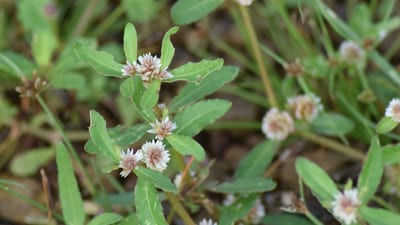
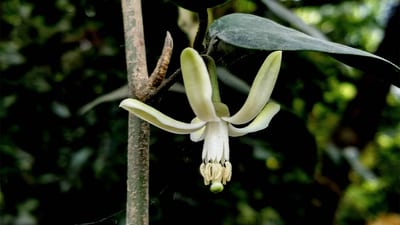
Apluda mutica is a rambling perennial grass native to Sri Lanka, belonging to the family Poaceae, the botanical family that includes grasses, bamboos and cereals. It has no recorded edible parts and no known food use.
What does Apluda mutica look like?
Apluda mutica is a sprawling, climbing-type perennial with long culms (stems) reaching up to about 3 metres, which root at the lower nodes as they trail along the ground or over other vegetation. The leaf blades are flat, ranging from 5 to 25 cm in length and 2 to 10 mm in width, narrowing to a fine point at the tip.
Its inflorescence takes the form of a false panicle that is linear and interrupted along its length, a typical arrangement among many grasses in the Poaceae family. Each spikelet-bearing structure is wrapped in a spatheole that is narrowly ovate when viewed from the side and tapers to a sharp point. The sessile spikelets are small, measuring 2 to 6 mm, with a lower glume that is narrowly elliptic to lanceolate in shape.
Where does Apluda mutica grow?
Apluda mutica is classified as native to Sri Lanka, meaning it occurs naturally on the island, though it is not restricted to Sri Lanka alone as endemic species are. As a rambling grass, it typically grows by scrambling over shrubs and other low vegetation, a habit reflected in its long, rooting culms.
Is Apluda mutica used for food?
No edible parts are recorded for this species. It is not grown or foraged as a food or fodder plant according to the available botanical record.
What is its conservation status?
Apluda mutica is recorded as native to Sri Lanka, a status distinct from endemic, introduced, or naturalised. No separate threat or conservation designation is noted for this species.
| Attribute | Recorded detail |
|---|---|
| Scientific name | Apluda mutica |
| Family | Poaceae |
| Status in Sri Lanka | Native |
| Edible parts | None |
| Life form | Rambling perennial |
| Culm length | Up to about 3 m, rooting from lower nodes |
| Leaf blade | Flat, 5–25 cm x 2–10 mm, attenuate at tip |
| Inflorescence | False panicle, linear, interrupted |
| Spatheole | Narrowly ovate in side view, acuminate |
| Sessile spikelet | 2–6 mm long |
| Lower glume | Narrowly elliptic-lanceolate |