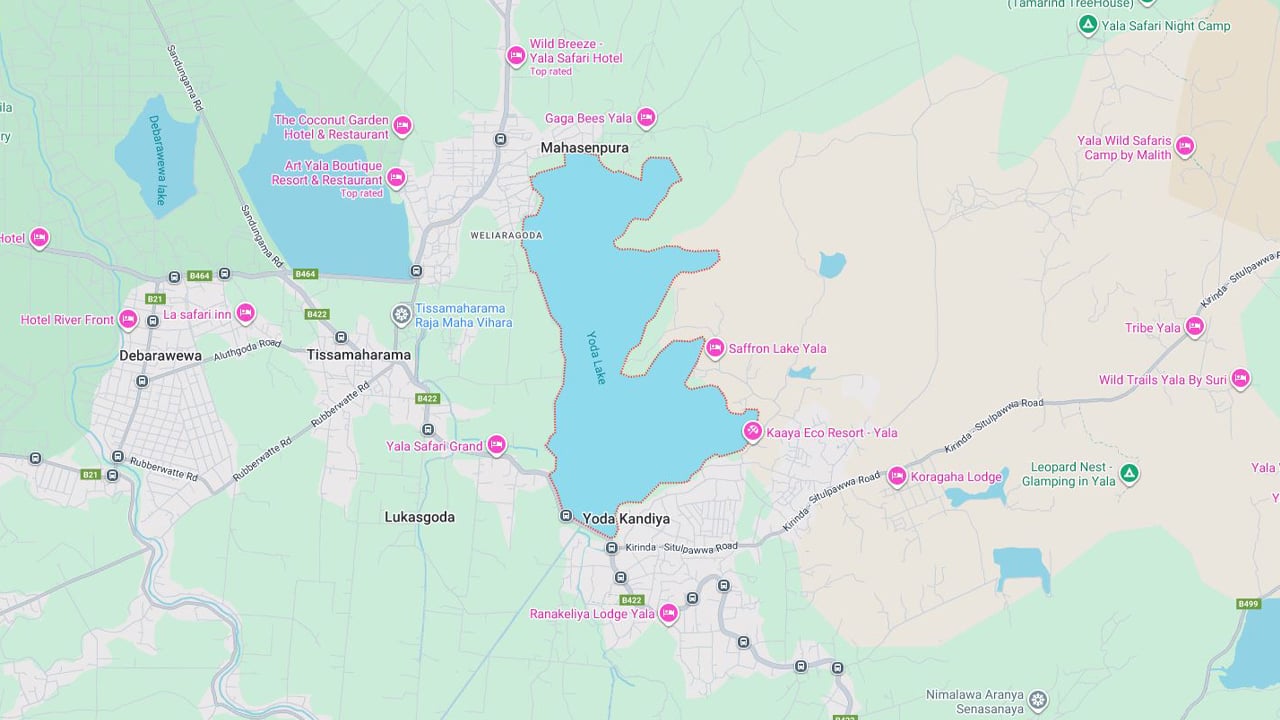
Standing quietly at the edge of Tissamaharama in Sri Lanka's Southern Province, Yoda Wewa is among the most enduring examples of ancient hydraulic engineering found anywhere in South Asia. Thought to have been commissioned during the reign of King Mahanaga in the 3rd century BCE, this vast earthen reservoir was not merely a feat of construction — it was a carefully conceived system designed to sustain an entire agrarian civilization in one of the island's driest regions.
What is the history of Yoda Wewa?
The name "Yoda Wewa" translates roughly as the "giant tank" or "great reservoir," a reference to its scale within the dry-zone landscape. Ancient Sri Lankan kings understood that controlling water meant controlling food supply, and the construction of large-scale irrigation works like this one was central to royal authority and statecraft. Yoda Wewa was part of a broader network of interconnected tanks, canals, and feeder streams that transformed arid scrubland into productive paddy country.
Its massive earthen embankments were engineered to withstand monsoon surges, while sophisticated spillway systems prevented destructive overflow. These design principles — developed more than two millennia ago — echo the kind of systems-level thinking that modern water engineers still recognize as remarkably sound. The reservoir's construction can be compared in ambition to other great dry-zone irrigation works at Polonnaruwa, where successive kingdoms built upon similar hydraulic traditions.
What role did Yoda Wewa play in religious life?
Water and spirituality have always been intertwined in Sri Lankan culture, and Yoda Wewa is no exception. The reservoir historically supported the surrounding Buddhist monastic community, including the sacred Tissamaharama Raja Maha Viharaya, one of the most revered temples in the south of the island. Water drawn from the wewa sustained daily monastic routines and ritual observances, embedding the reservoir deeply into the religious identity of the region.
Ancient kings who built or restored irrigation works were celebrated not only as administrators but as righteous rulers whose benevolence extended to both monks and farmers. This dual role — practical and spiritual — gave structures like Yoda Wewa a significance that went far beyond agriculture. Nearby, the Kiri Vehera Stupa stands as another reminder of how tightly religious monuments and water infrastructure were woven together in early Ruhuna civilization.
How was the ancient irrigation system engineered?
The technical sophistication of Yoda Wewa's design reflects knowledge accumulated across generations of builders and farmers. Key features of the system included:
- Earthen bunds: Broad, compacted embankments capable of impounding large volumes of water without mortar or masonry.
- Canal networks: Radiating channels that distributed water to distant fields, minimizing loss through evaporation or seepage.
- Sluice gates (biso kotuwa): Submerged outlet structures that allowed precise control of water release — a uniquely Sri Lankan invention that predates similar systems found elsewhere in Asia.
- Spillways: Overflow channels designed to safely carry excess water away from the bund during heavy rainfall.
Together, these elements allowed farmers to cultivate rice year-round rather than depending entirely on the northeast and southwest monsoons. Food security in the dry zone depended on exactly this kind of engineered reliability, and the paddy field traditions that survive in southern Sri Lanka today carry echoes of that ancient system.
What wildlife can be seen at Yoda Wewa today?
Yoda Wewa remains a functioning irrigation reservoir, which means it supports a living ecosystem as well as local agriculture. The shallow, nutrient-rich margins of the tank attract a wide variety of water birds throughout the year, with numbers peaking during the northern hemisphere winter when migratory species arrive from Central and East Asia.
Regular visitors to the waterway include painted storks, open-billed storks, various species of heron and egret, cormorants, and lesser whistling ducks. Raptors such as the white-bellied sea eagle occasionally patrol the open water. For wildlife photographers and birdwatching enthusiasts, early morning visits — before the heat builds and human activity increases — yield the most rewarding sightings.
The dry scrub and woodlands fringing the tank are also habitat for mugger crocodiles, which can often be seen basking on the bund edges or drifting near the shallows. Those interested in observing crocodiles in their natural habitat may also find crocodile watching experiences in this region worth exploring.
The proximity of Yoda Wewa to Udawalawe National Park means that a visit to the reservoir can fit naturally within a broader southern wildlife circuit, and elephants from the wider landscape are occasionally spotted drinking at the tank margins during the dry months.
When is the best time to visit Yoda Wewa?
The dry season — roughly from May to September — makes for the most comfortable visit, with lower humidity and clearer skies. Water levels in the tank drop during this period, concentrating wildlife along the remaining shoreline and making bird and crocodile sightings more reliable.
The northeast monsoon (November to January) brings significant rainfall to the Tissamaharama area and refills the reservoir. While this season can be wet, it also marks the peak of migratory bird activity, which draws serious ornithologists despite the rain. Avoid the heaviest rainfall weeks if you plan to walk along the bund.
How do I get to Yoda Wewa from Colombo or Galle?
Tissamaharama is approximately 250 km from Colombo by road, typically reached via the Southern Expressway (E01) to Mattala and then inland. Journey time by private vehicle is around four to five hours depending on traffic. From Galle, the drive is roughly two to two and a half hours via the coastal highway through Hambantota.
Yoda Wewa itself sits on the western edge of Tissamaharama town, easily accessible by tuk-tuk or on foot from the town centre. There is no dedicated entrance gate or admission fee — the reservoir bund is open to visitors and locals alike as part of the working landscape.
What else is worth seeing near Yoda Wewa?
Tissamaharama is a natural hub for exploring the ancient and natural heritage of southern Sri Lanka. Within a short distance of Yoda Wewa, visitors can explore:
- Tissamaharama Raja Maha Viharaya — one of the island's oldest Buddhist temples, with a large white dagoba visible from the reservoir bund.
- Tissa Wewa and Nuwara Wewa — two other ancient tanks that together with Yoda Wewa form a chain of reservoirs around the town.
- Udawalawe National Park — around 50 km to the northwest, renowned for its large resident elephant herds.
- Bundala National Park — a Ramsar-listed wetland to the south, internationally recognized for its migratory waterbird populations.
- The Elephant Transit Home at Udawalawe, where orphaned elephant calves are rehabilitated before release into the wild.
This cluster of sites makes the Tissamaharama region one of the most rewarding destinations in the south for travellers who want to combine cultural history with wildlife without crossing the island.
Nearby places
9 places within about 25 km, nearest first.
- Debarawewa Lakeunder 1 km
- Yatala Veheraunder 1 km
- Tissamaharama City2 km
- Tissamaharama Raja Maha Stupa2 km
- Weerawila Airport (WRZ)6 km
- Wirawila City6 km
- Weerawila City6 km
- Dambegoda Bodhisattva Statue7 km
- Pannegamuwa Lake10 km
Related reading
10 pages on closely related subjects.