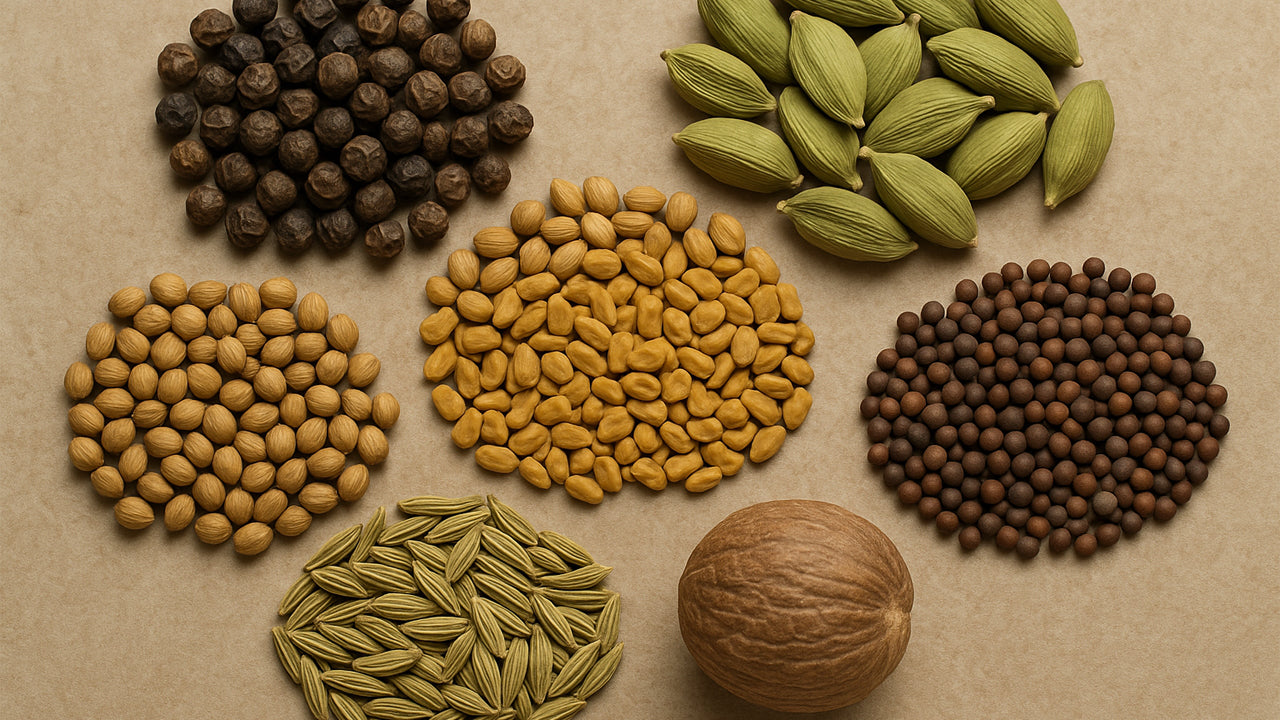
Long before the word "export" existed, Sri Lanka was moving spices across oceans. Greek and Roman merchants sailed to the island — known then as Taprobane — to trade for cinnamon, pepper and cardamom. Arab navigators made it a fixed waypoint on the route between the Red Sea and Southeast Asia. When the Portuguese arrived in the early sixteenth century, it was the spice trade, not gold, that made the island worth fighting over. That history is still alive today in the gardens, kitchens and markets of a country where spices are not a novelty — they are simply part of how food is made.
Why did Sri Lanka become the centre of the spice trade?
Geography played the decisive role. Sri Lanka sits at the southern tip of the Indian subcontinent, squarely across every historic sea lane that connected the Middle East, Europe and East Asia. Ancient trade-route charts show almost all traffic passing through or near the island.
Climate reinforced the advantage. Sri Lanka's compact landmass holds an unusual range of micro-climates — the cool, misty highlands of Kandy and Nuwara Eliya, the warm and humid lowland forests of the south-west, and the dry, sun-baked north and east. Each zone suits different crops. Cinnamon, for instance, grows best in the sandy coastal belt around Negombo and Kurunegala. Pepper and cloves thrive in the wet-zone highlands. Cardamom favours high-altitude shade. No other island of comparable size offers this variety under a single flag.
The result is that Sri Lanka became — and remains — one of the world's most important sources of high-quality, naturally grown spices. Ceylon True Cinnamon (Cinnamomum verum) is so distinct from the cassia variety sold elsewhere that it has its own botanical classification and is legally protected under geographic indication rules.
What spices are grown in Sri Lanka?
The list is longer than most visitors expect. Below are the spices most closely associated with the island, along with the part of the plant used and a note on where they are typically cultivated.
| Spice | Plant part used | Main growing regions |
|---|---|---|
| Cinnamon | Inner bark (quills) | Western and North-Western provinces |
| Black & White Pepper | Berries (dried) | Kandy, Matale, Kegalle |
| Cardamom | Seed pods | Knuckles Range, Uva highlands |
| Cloves | Dried flower buds | Southern and Sabaragamuwa provinces |
| Nutmeg & Mace | Seed and seed covering | Southern lowlands |
| Turmeric | Rhizome (dried, powdered) | Matale, Kurunegala |
| Ginger | Rhizome (fresh or dried) | Kandy district and hill country |
| Vanilla | Cured seed pods | Southern wet zone |
| Fenugreek | Seeds | Dry zone, home gardens island-wide |
| Goraka (Gamboge) | Dried fruit rind | Wet zone, Sabaragamuwa |
Goraka (Garcinia cambogia) is largely endemic to Sri Lanka and the Malabar coast and is essential in authentic Sri Lankan fish curries — its sour, smoky flavour cannot easily be replaced by tamarind or lime. Rampe (pandan leaf) and curry leaf (Murraya koenigii) technically fall into the aromatic herb category, but Sri Lankan cooks treat them as core seasoning rather than garnish.
How do Sri Lankan cooks use spices differently?
Sri Lankan cuisine layers spices in a sequence rather than blending them all at the start. A typical curry begins by tempering whole seeds — mustard, cumin, fenugreek — in hot oil or coconut oil. This process, known locally as thalana, releases fat-soluble flavour compounds that water-based cooking cannot unlock. Ground spices are added at a later stage, and raw green herbs last of all.
A few principles that experienced cooks apply:
- Heat unlocks fat-soluble aromatics. Frying whole spices in oil before adding other ingredients is the single most effective technique for building depth of flavour.
- Less can mean more. Removing an overpowering spice from a blend — or reducing its quantity — often sharpens the flavours of the spices that remain.
- Fresh beats dried, where available. Freshly ground cinnamon or pepper carries far more volatile oils than pre-ground powder that has been sitting in packaging for months.
- Combination limits matter. Most traditional Sri Lankan spice blends use between five and twelve spices. Blends much beyond twenty ingredients rarely improve the result and can create bitter, muddy flavour profiles.
- Storage determines quality. Whole spices held in airtight containers away from heat and light retain their potency significantly longer than ground spices. Grind only what you need.
Sri Lankan curry powder itself comes in two main varieties: raw curry powder (lightly toasted or untoasted) used for mild, coconut-milk-based curries, and roasted curry powder (deeply toasted) used for dark, intense meat and fish curries. Using the wrong type for the dish is a common and easily avoided mistake.
What is the historical significance of cinnamon in Sri Lanka?
Of all the island's spices, cinnamon carries the greatest historical weight. The Romans used it in religious rites and considered it worth many times its weight in silver. Medieval European apothecaries prescribed it for ailments ranging from digestive disorders to respiratory infections. Sri Lanka — as Ceylon — was the world's primary source of true cinnamon for centuries.
The Portuguese Crown seized control of the coastal cinnamon-growing regions in the early 1500s and maintained a monopoly until the Dutch East India Company (VOC) displaced them in the mid-seventeenth century. The British inherited the trade when they took Ceylon in 1796. The art of peeling cinnamon — practiced by a hereditary caste of specialists called chalias — was so closely guarded that the knowledge barely spread beyond the island for generations. Today Sri Lanka still produces Cinnamomum verum, which food scientists and chefs worldwide recognise as superior to cheaper cassia substitutes in both flavour complexity and low-coumarin content.
Where can you see spice cultivation in Sri Lanka?
The Matale district, roughly 25 km north of Kandy, is the most accessible spice-growing region for visitors on a standard itinerary. Spice gardens here grow pepper vines, cardamom, cinnamon, nutmeg and cloves within a short walk of each other — giving a concentrated sense of the island's agricultural diversity. Knowledgeable guides demonstrate harvesting and processing techniques and explain the traditional medicinal uses of each plant, many of which overlap with Ayurvedic practice.
For a more immersive experience, a guided cooking session using locally sourced spices translates botanical knowledge directly into practical kitchen skills. Lakpura organises structured visits to working spice gardens in Matale that include a hands-on cooking component — a practical way to bring Sri Lankan techniques home.
What health properties are associated with Sri Lankan spices?
Traditional Ayurvedic medicine, practiced in Sri Lanka for over two thousand years, uses spices as one of its primary therapeutic tools. Modern food science has confirmed biological activity in several of the island's key spices, though the clinical evidence varies in strength.
- Cinnamon — studied for its potential role in supporting healthy blood sugar metabolism; contains cinnamaldehyde and various polyphenols with antioxidant properties.
- Turmeric — curcumin, its active compound, is one of the most researched natural anti-inflammatory agents, though bioavailability improves significantly when consumed with black pepper.
- Black pepper — piperine, which gives pepper its heat, is documented to enhance the absorption of other nutrients and bioactive compounds taken alongside it.
- Ginger — widely used in Sri Lankan home remedies for nausea, digestion and mild respiratory complaints; supported by a reasonable body of clinical evidence for nausea relief.
- Cloves — among the highest antioxidant values of any spice by dry weight; traditionally used in Sri Lankan and Ayurvedic practice for oral health and as an analgesic.
- Fenugreek — seeds contain soluble fibre and compounds linked to cholesterol management and appetite regulation in Ayurvedic dietary guidance.
These properties are reasons to cook generously with spices — not to replace medical advice with kitchen remedies. The traditional Sri Lankan diet, rich in spices across every meal, is considered by nutritionists to be one of the more naturally anti-inflammatory dietary patterns in Asia.
How should you buy and store Sri Lankan spices?
When buying spices to take home, whole spices travel better than powders and hold their flavour far longer. Cinnamon quills, whole peppercorns and dried cloves bought from a reputable source will retain potency for a year or more in an airtight container. Ground powders are convenient but begin losing volatile compounds within weeks of grinding.
Look for spices that carry origin labelling — "Ceylon Cinnamon" or "Sri Lanka" on the packaging is a meaningful quality signal, not just marketing. Vacuum-sealed or nitrogen-flushed packaging extends shelf life. Avoid spices sold in clear plastic bags exposed to shop lighting, which degrades colour and flavour compounds.
Related reading
4 pages on closely related subjects.