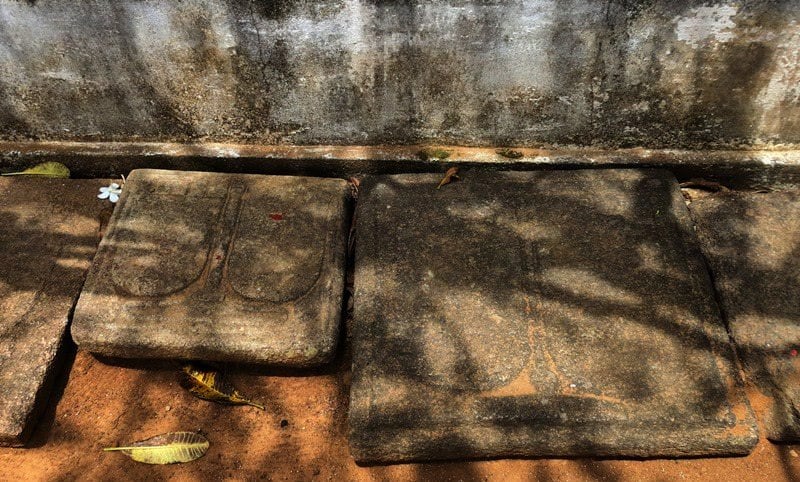


On the northeastern edge of Anuradhapura, about 1.4 kilometres from the Jaffna Junction along the Anuradhapura–Rambewa road, a largely forgotten monastery quietly endures the encroachment of scrub and tall grass. Officially gazetted by the Department of Archaeology as the Pubbarama Archaeological Reserve, the site is more commonly known as Puliyankulama — or, in older records, Puliyankulam — and it rewards the curious visitor with some of the most architecturally distinctive monastic remains in the ancient city's outer ring.
What makes Puliyankulama different from other Anuradhapura ruins?
Most visitors to Anuradhapura focus on the well-maintained sacred precinct at the city's heart. Puliyankulama belongs to a rarer category: the pabbatha vihara, or mountain monastery, a form of Buddhist monastic complex that archaeologists believe was deliberately integrated with a natural rock formation. Rather than occupying flat ground, a pabbatha vihara is arranged as a series of rectangular courtyards set at different levels, with water features surrounding each tier.
The defining element of this layout is a large rectangular sacred quadrangle at the uppermost level. Within it, four principal shrines are arranged in a precise canonical order: a stupa (relic mound), a bodhighara (shrine enclosing a bodhi tree), a patimaghara (image house), and a prasada that scholars identify as the uposathaghara — the chapter house where monks gathered to recite the monastic code. This fourfold arrangement is characteristic of Sri Lanka's classical monastic tradition and can also be observed, in more complete form, at Mahasena's Palace and Jetavana in the inner city.
What do the inscriptions at Puliyankulama reveal?
An inscription recovered from the shrine complex provides the monastery's ancient identity with unusual precision. It names the establishment as Uda-Kitagbopavu — expanded in full as Udaya-Kittaggabodhi-Pabbata — and records that the vihara was dedicated to monks affiliated with Puvaram-vehera, identified by scholars as Pubbārama. This is a significant detail: it ties Puliyankulama into the broader network of Anuradhapura's monastic fraternities rather than treating it as an isolated foundation. The name Pubbārama itself suggests a connection to one of the older monasteries patronised during the height of the Anuradhapura Kingdom.
Epigraphic evidence of this kind is rare at peripheral sites, and the inscription has helped archaeologists place the monastery within the religious and administrative landscape of early medieval Sri Lanka.
What is the current condition of the site?
Candid honesty is warranted here. Puliyankulama is not maintained to the standard of Anuradhapura's flagship attractions. Tall grass and dense scrub cover much of the precinct, and the structural remains require a careful eye to read. The Department of Archaeology has placed a nameplate at the site, but active conservation work has been limited. This is partly a consequence of the monastery's low profile with general tourists, which in turn reduces the pressure and funding needed to prioritise it.
Despite this, the site is accessible and safe to walk around. For travellers with an interest in archaeology or early Buddhist monastic architecture, the absence of crowds is itself an appeal. Visiting in the dry season — broadly from May through September in the North Central Province — keeps the undergrowth lower and visibility of the stonework considerably better.
When is the best time to visit Puliyankulama?
The North Central Province, where Anuradhapura is located, receives its main rainfall from the northeast monsoon between October and January. During this period the site can become overgrown and access paths muddy. The drier months from around February through to September offer more comfortable conditions for exploring the open-air ruins. Early morning visits — before 9 a.m. — are also advisable, both to avoid the heat of the day and to see the stonework in the low-angle light that defines the textures of old masonry.
How do I get to Puliyankulama from central Anuradhapura?
The monastery is approximately 1.4 kilometres from the Jaffna Junction, taking the Anuradhapura–Rambewa road heading north. From the New Bus Stand or from the main Anuradhapura railway station, a tuk-tuk ride of around ten minutes is the most practical option. Because the site is not on standard guided-tour itineraries, it is worth confirming the location with your driver in advance — the Department of Archaeology nameplate is the most visible landmark. There is no formal car park, but the road shoulder near the site is adequate for a vehicle to wait.
Is Puliyankulama worth visiting alongside the main Anuradhapura sacred area?
Puliyankulama is not a substitute for the UNESCO World Heritage sites at the core of Anuradhapura — the Ruwanwelisaya, Jetavana Stupa, and Sri Maha Bodhi — but it makes a thoughtful complement for any visitor spending more than a single day in the city. The pabbatha vihara form is underrepresented in the standard tourist circuit, and seeing a partially cleared example helps contextualise the architectural ambition of Anuradhapura's monastic patrons beyond the monuments that have received sustained restoration funding.
Travellers interested in the Sacred City of Anuradhapura as a whole will find that peripheral sites like Puliyankulama add a layer of scholarly depth to the more famous landmarks.
Practical visitor information
| Detail | Information |
|---|---|
| Official designation | Pubbarama Archaeological Reserve |
| Distance from Jaffna Junction | Approximately 1.4 km along Anuradhapura–Rambewa road |
| District | Anuradhapura, North Central Province |
| Managed by | Department of Archaeology, Sri Lanka |
| Best visiting season | February to September (drier months) |
| Entry fee | No dedicated ticket; covered under general Anuradhapura heritage zone access |
| Nearest transport hub | Anuradhapura railway station or New Bus Stand |
Nearby places
11 places within about 25 km, nearest first.
- Nuwara Wewaunder 1 km
- Jetavana Monastery1 km
- Rajagirilena1 km
- Jetavanaramaya Stupa2 km
- Atamasthana2 km
- Sri Angulimala Maha Stupa2 km
- Sandahiru Stupa2 km
- Thuparamaya Stupa2 km
- Saliyapura3 km
- Saliyapura Railway Station4 km
- Yan Oya8 km