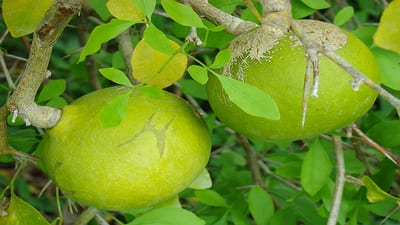
Pouteria campechiana, commonly known as canistel or egg fruit, is a tropical fruit tree native to Central America that has been naturalised across South and Southeast Asia, including Sri Lanka. On the island, it occupies a modest but meaningful place in both home gardens and the wider catalogue of Ayurvedic medicinal plants — a living link between traditional healing systems and everyday horticulture.
What is Pouteria campechiana?
Pouteria campechiana belongs to the family Sapotaceae, a large family of tropical trees that also includes the sapodilla. The tree grows to a moderate height, typically between six and twelve metres, with dense, glossy foliage and a spreading canopy that offers welcome shade in the lowland tropics. Its fruit is perhaps its most distinctive feature: an oval to pear-shaped drupe with a smooth, thin skin that turns from green to deep yellow-orange when fully ripe.
Inside, the flesh is dense, dry, and richly coloured — somewhere between egg yolk and sweet potato — which gives rise to the common English name "egg fruit." The texture has been compared to a hard-boiled egg yolk, and the flavour is mildly sweet with caramel-like undertones. One or a few large, glossy brown seeds occupy the centre of the fruit.
How is Pouteria campechiana used in Ayurvedic medicine in Sri Lanka?
Sri Lanka maintains one of the oldest living traditions of Ayurveda in Asia, and its official catalogue of medicinal plants includes Pouteria campechiana as a recognised entry. Various parts of the plant — primarily the leaves, bark, and seeds — have been attributed with therapeutic properties within traditional practice.
- Bark and leaf extracts have historically been used in preparations intended to manage fever and support skin health.
- Seed oil, extracted from the large kernels, is applied topically in some traditional formulations and has been investigated for its emollient qualities.
- The fruit itself is nutritionally dense, providing carbohydrates, beta-carotene, niacin, and ascorbic acid, making it a valued supplementary food in rural communities.
It is worth noting that while traditional use is well documented, the clinical evidence base for specific therapeutic claims remains limited. Anyone seeking treatment for a medical condition should consult a qualified practitioner of Ayurveda or conventional medicine rather than self-administering plant preparations.
Pouteria campechiana sits alongside other documented Sri Lankan medicinal species such as Acacia chundra and Pongamia pinnata, both of which appear in the national Ayurvedic plant catalogue and share a similar profile of traditional multi-part usage.
Where does Pouteria campechiana grow in Sri Lanka?
The tree thrives in Sri Lanka's lowland wet zone and intermediate zone, where rainfall is relatively high and temperatures remain warm year-round. It is most commonly found in home gardens and small-scale cultivation plots rather than in large commercial orchards. The species tolerates a range of soil types but performs best in well-drained, fertile loam.
Elevations below around 700 metres above sea level suit it well. You are more likely to encounter the tree in the Southern and Western provinces than in the dry north, although it can be grown in irrigated settings almost anywhere on the island. In areas such as the Sinharaja Forest Reserve buffer zone, fruit trees including canistel are common in the smallholder gardens that fringe the protected forest.
What nutritional value does canistel (egg fruit) offer?
For all its modest culinary profile outside the tropics, canistel is nutritionally significant. The ripe fruit is a concentrated source of energy from natural sugars and starch, and provides meaningful amounts of vitamins and minerals that are valuable in diets where diverse fresh produce is not always available.
- Beta-carotene (pro-vitamin A): supports eye health and immune function
- Niacin (vitamin B3): important for metabolic processes
- Vitamin C (ascorbic acid): an antioxidant supporting tissue repair
- Iron and calcium: in modest but useful quantities
The dry, starchy texture makes canistel an unusual eating experience for those unfamiliar with it. In Sri Lankan homes it is sometimes eaten fresh when fully ripe, blended into smoothies, or incorporated into simple sweet preparations. It does not preserve well once ripe, which partly explains why it has not become a major commercial crop despite its nutritional qualities.
How does Pouteria campechiana fit into Sri Lanka's broader botanical heritage?
Sri Lanka's botanical heritage is extraordinarily rich relative to its land area. The island hosts a high proportion of endemic plant species, and centuries of trade, migration, and cross-cultural exchange have introduced hundreds of useful plants from across Asia, Africa, and the Americas. Pouteria campechiana is among those introductions — brought to Asia from the New World, adapted to local conditions, and eventually absorbed into the Ayurvedic tradition.
This process of botanical adoption mirrors the story of other now-common Sri Lankan plants. Syzygium aromaticum (cloves), for instance, was once an exclusive spice of the Maluku Islands before becoming established in Sri Lankan gardens and trade. The canistel's journey from Central America to South Asian homesteads is a quieter version of the same pattern.
The tree's inclusion in the national Ayurvedic catalogue reflects a formal acknowledgement of traditional knowledge that has accumulated over generations. Sri Lanka's Department of Ayurveda maintains records of such plants as part of ongoing efforts to document and regulate the use of natural medicines across the country.
Is Pouteria campechiana cultivated commercially in Sri Lanka?
Commercial cultivation of canistel in Sri Lanka remains limited. The tree has never attracted the same investment as high-value export crops such as Ceylon black pepper or Ceylon tea, and its domestic market is niche. Most trees grow in mixed home gardens where they are valued for shade, fruit for family consumption, and occasionally for traditional medicinal use.
There is growing academic and horticultural interest in underutilised tropical fruit species, and canistel is sometimes discussed in that context — both for its nutritional density and for its potential as a climate-resilient crop in warming lowland zones. Whether that interest translates into broader cultivation in Sri Lanka remains to be seen.
What is the Sinhala name for Pouteria campechiana?
In Sri Lanka, Pouteria campechiana is known locally as Laulu (ලෝලූ) in Sinhala, though regional variations in common names exist. The tree is not as widely recognised by a single consistent vernacular name as more established fruit species, which reflects its status as a relatively recent introduction to the island's agricultural landscape.