Rising from a granite outcrop in Sri Lanka's North Western Province, the Yapahuwa Palace Complex is one of the island's most evocative medieval sites. Built in the late 13th century as both a royal residence and a military stronghold, the fortress served as Sri Lanka's capital for a brief but historically charged period. Today it rewards visitors with remarkable carved stonework, panoramic views across paddy fields and forest, and a layered history that stretches from ancient monks to the Sacred Tooth Relic of the Buddha.
What is the history of the Yapahuwa Palace Complex?
Yapahuwa was constructed around 1273 CE during the reign of King Bhuvanekabahu I, who sought a defensible capital following decades of instability and South Indian invasions. The site — a sheer-sided granite inselberg rising roughly 90 metres from the surrounding plain — was chosen precisely for its natural fortifications. Deep moats and thick concentric walls reinforced the rock's natural defences, though most of these earthworks have since been levelled or bridged.
The kingdom's legitimacy was inseparable from the Sacred Tooth Relic of the Buddha, the island's most venerated object. When the court relocated from Polonnaruwa, the Relic came with it, lending Yapahuwa both religious authority and political weight. The complex flourished briefly, but around 1288 CE a South Indian army captured the site and removed the Relic to the Pandya kingdom. With the Relic gone, Yapahuwa's importance collapsed rapidly, and the site was gradually reclaimed by forest.
What can you see at the Yapahuwa Palace Complex?
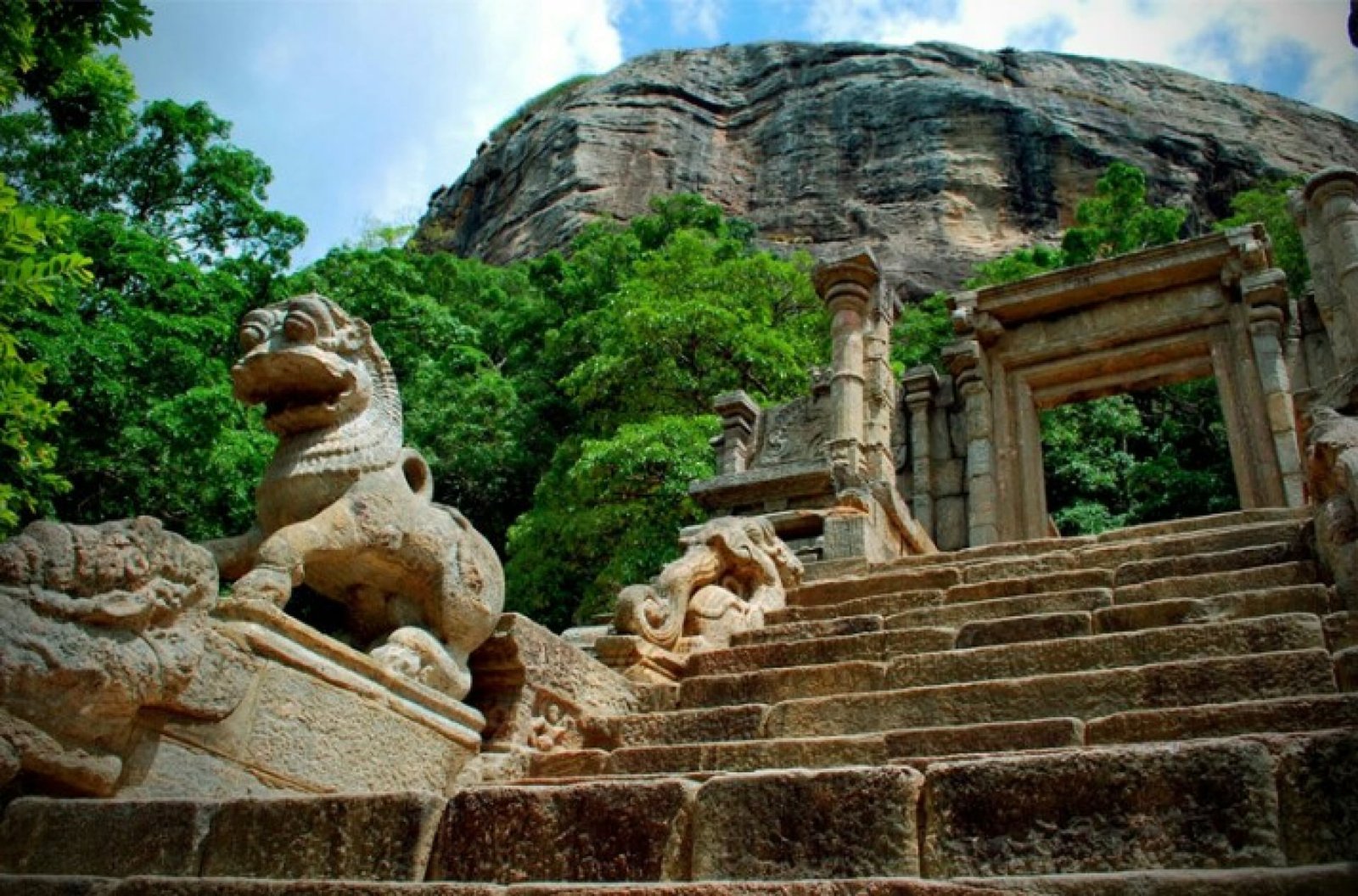
The centrepiece of the site is a ceremonial stone staircase of extraordinary quality — one of the finest examples of medieval Sri Lankan decorative carving. Steep and narrow, it climbs the rock face in several flights, its balustrades and pilasters covered in intricate relief sculpture.
- The ornamental staircase: The most photographed feature of the complex. Bands of scroll work, figures, and foliage frame the ascent in a style that blends indigenous Sinhalese craft with influences absorbed from South and East Asia.
- The Chinese-influenced stone lions: Midway up the staircase, two large stone lions guard the approach. Their stylised grimace and proportions reflect a strong Chinese artistic influence, unusual in a Sri Lankan context and a subject of ongoing scholarly interest.
- The entrance archway (torana): The elaborately carved decorative arch that frames the upper staircase landing is considered among the finest examples of medieval Sinhalese stone craft surviving on the island.
- The summit ruins: Climbing to the very top of the granite outcrop reveals the remains of the site's earliest inhabitants — Buddhist monks who preceded the palace. A small stupa, a Bo-tree enclosure, and a rock cave shelter still stand here, weathered but recognisable.
- The panorama: From the summit, the view extends across an expansive green landscape of paddy fields, jungle, and distant blue ridgelines. It is a genuinely wide prospect that conveys why this rock was chosen as a place of both spiritual retreat and strategic command.
How does Yapahuwa compare to other ancient Sri Lankan capitals?
Sri Lanka's medieval history is marked by a succession of capitals, each shifting in response to invasion, dynastic politics, or the movement of the Sacred Tooth Relic. Yapahuwa occupies a short but significant chapter in that sequence. Unlike the sprawling tank-and-dagoba cities of Anuradhapura or Polonnaruwa, Yapahuwa is compact and largely vertical — a rock fortress rather than a planned urban centre. Its strength lay in topography rather than civic infrastructure.
The sculptural programme at Yapahuwa is, however, widely considered superior to many contemporaneous sites. The stone carving on the staircase and torana represents a late flowering of Sinhalese decorative art before the political centre of gravity shifted south and west toward Gampola and eventually Kandy.
What is the significance of the Sacred Tooth Relic to this site?
In Sri Lankan Buddhist tradition, the ruler who held the Sacred Tooth Relic held the mandate to govern the island. This made the Relic not only a devotional object but a political instrument of the highest order. Its presence at Yapahuwa drew pilgrims, legitimised the court, and attracted economic activity. Its removal by the Pandya army in the late 13th century effectively ended Yapahuwa's role as a capital, as subsequent rulers redirected their efforts to recovering the Relic and re-establishing authority elsewhere. The Esala Perahera Festival, still held annually in Kandy, is the modern expression of that same centuries-old tradition of venerating the Relic.
When is the best time to visit Yapahuwa?
The site is accessible year-round, but the most comfortable visiting conditions fall between December and April, when the North Western Province experiences its dry season. Morning visits are preferable — the rock face gets warm by mid-morning, and the staircase climb is steep enough to be tiring in full afternoon heat. The site is generally uncrowded on weekday mornings, which allows unhurried time with the sculpture.
During or just after the monsoon (typically May to August in this region), the surrounding paddy fields are vivid green and the views from the summit are particularly clear, though the stone steps can be slippery when wet.
How do I get to Yapahuwa from Colombo or Kurunegala?
Yapahuwa lies roughly 11 kilometres from Maho junction, which sits on the main Colombo–Anuradhapura road and rail line. From Colombo, the drive takes around three hours under normal traffic conditions. From Kurunegala town, the journey is approximately 50 kilometres northward along the A10 road. Maho is also a rail junction, so visitors travelling by train can alight at Maho and arrange a short tuk-tuk or taxi connection to the site. A private driver is the most convenient option for those combining Yapahuwa with other nearby heritage sites such as Ridi Vihara or Arankele.
What practical information should I know before visiting?
| Detail | Information |
|---|---|
| Location | Near Maho, Kurunegala District, North Western Province |
| Opening hours | Typically dawn to dusk daily (confirm locally before visiting) |
| Entry fee | Government-administered; fees apply for foreign visitors (check current Central Cultural Fund rates) |
| Footwear | Remove shoes before entering sacred precincts; the stone steps are uneven |
| Fitness level | Moderate — the staircase is steep; the summit scramble is rougher terrain |
| Time required | Around 2–3 hours to explore comfortably |
What else can I visit near Yapahuwa?
The Kurunegala district and the broader North Western Province contain several sites worth combining into a single journey. Ridi Vihara, a cave temple complex with ancient paintings and gilded Buddha images, is within comfortable driving distance. Arankele, a forest hermitage with ancient meditating monks' paths (addhayoga) cut into the jungle, suits those interested in early Buddhist monasticism. Visitors continuing north can reach Anuradhapura, the island's oldest capital, within roughly 90 minutes. Those routing south can connect to Kandy in under two hours.
Nearby places
9 places within about 25 km, nearest first.
Related reading
6 pages on closely related subjects.