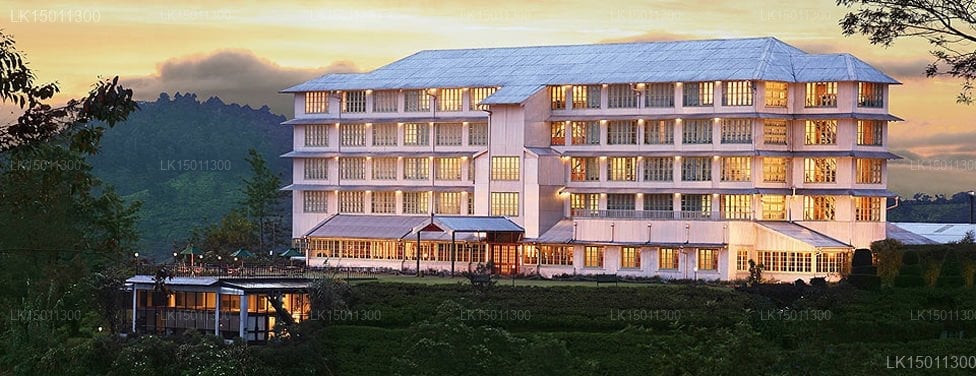
Set among the rolling tea-covered hillsides of the Talawakelle-Nanu Oya corridor, Maha Eliya Estate — more widely known by its Calsay division — sits at an elevation of around 1,341 metres above sea level. The estate forms part of one of Sri Lanka's most productive high-grown tea belts, where cool temperatures, frequent mist, and well-drained soils combine to produce leaf with a distinct brightness and brisk character. A visit here offers more than scenic views; it reveals how a working estate operates from field to cup.
What is the history of Maha Eliya Estate and the Holyrood factory?
The Holyrood factory at the heart of the estate was established in 1922, making it one of the older processing facilities still in active operation in the hill-country. Over its century of production, the factory has refined its methods considerably while retaining the orthodox processing techniques that define western high-grown Ceylon Tea. That commitment to quality has earned the Holyrood factory a rare distinction: it is one of only two factories in Sri Lanka to hold HACCP (Hazard Analysis Critical Control Points) certification, an internationally recognised food-safety accreditation that sets rigorous standards for hygiene and process control throughout manufacturing.
The estate itself spans approximately 331 hectares and achieves an annual yield that typically exceeds 1,500 kilograms of made tea per hectare — a figure that reflects both the fertility of the land and the disciplined management of the cultivation cycle.
What makes western high-grown tea from this region different?
Ceylon tea is broadly classified by elevation and geography. Teas grown above roughly 1,200 metres are designated "high-grown," and those from the western slopes of the central highlands — which include the Talawakelle and Nanu Oya areas — carry a regional character shaped by the southwest monsoon. The heavy rainfall this side of the mountains receives promotes vigorous growth, and the sharp diurnal temperature swings slow the leaf down during cooler nights, allowing flavour compounds to concentrate. The result is a cup that tends to be bright in colour with a lively, sometimes slightly floral edge.
The Holyrood factory processes orthodox black tea, meaning the leaf is rolled rather than CTC-cut, preserving structure and delivering a more nuanced liquor than commodity-grade teas. Grades produced here are well regarded among specialist buyers at the Colombo Tea Auction. For a broader understanding of how elevation and terroir shape Sri Lanka's tea varieties, the Ceylon Green Tea page provides useful context on processing methods across the island's estates.
Where is Maha Eliya Estate located, and how do I get there?
The estate lies in the Talawakelle-Nanu Oya area of the Nuwara Eliya district, in Sri Lanka's Central Province. The nearest town of scale is Nuwara Eliya, roughly 20–25 kilometres to the east along the A7 highway. Colombo is approximately 160–170 kilometres away by road, making the estate a feasible day trip from Kandy (around 80 kilometres) or a natural stop on a hill-country touring itinerary.
The most atmospheric way to approach this part of the country is by the scenic railway that threads between Nanu Oya station and Kandy, passing through tunnels, waterfalls, and terraced tea slopes. From Nanu Oya, the estate is accessible by private vehicle. Independent travellers should note that working estates generally require advance arrangement before visiting; entry is not simply walk-in, as operational safety and factory hygiene standards apply.
What can visitors experience at Maha Eliya Estate?
Arranged visits to working estates in this part of Sri Lanka typically include a guided walk through the tea fields, an explanation of plucking cycles and leaf quality standards, a tour of the factory floor to observe withering, rolling, fermentation, and drying, and a tasting session that highlights how elevation and processing affect the cup. At estates with HACCP certification such as Holyrood, the factory tour itself is particularly instructive — the standards required for certification mean the facility is unusually clean and well-organised by industry norms.
Beyond the factory, the surrounding landscape offers its own rewards. The estate sits adjacent to some of the best hiking terrain in the Talawakelle area, with views extending across ridgelines draped in tea. The nearby Horton Plains National Park is within half an hour's drive and presents a compelling contrast — montane grassland, dense cloud forest, and the World's End cliff-edge viewpoint.
When is the best time to visit the Talawakelle-Nanu Oya tea country?
The hill country sits at the intersection of two monsoon systems, so conditions shift depending on the season. January through April tends to bring the clearest weather on the western slopes, and this is widely considered the optimum window for visiting estates around Talawakelle. The mornings are cool and often crisp, with mist lifting off the tea bushes in the early hours — a characteristic scene of the region.
The southwest monsoon arrives around May and brings persistent rain to this side of the hills through to August or September, which can make factory visits muddier but also intensifies the green of the landscape. The inter-monsoon months of October and November bring unpredictable showers. Year-round, visitors should pack layers: temperatures at 1,300 metres rarely exceed 25°C and can drop sharply after sunset.
What else is worth seeing near Maha Eliya Estate?
The Talawakelle-Nanu Oya corridor sits at the centre of a cluster of notable sites. Nuwara Eliya town, known locally as "Little England" for its colonial-era architecture, is worth a half-day. The Bluefield Tea Gardens nearby offer another perspective on high-grown tea production. To the south, the roads wind down toward Ella, where Ella has developed into a lively base for hikes and rail journeys. For those travelling with enough time, the Sinharaja rainforest is accessible from the southern foothills, representing the island's lowland counterpart to the highland ecology visible around the estate.
| Detail | Information |
|---|---|
| Factory name | Holyrood Factory |
| Factory established | 1922 |
| Elevation | Approximately 1,341 m above sea level |
| Estate area | Approximately 331 hectares |
| Tea type | Western high-grown orthodox black tea |
| Certification | HACCP (one of two factories in Sri Lanka) |
| Annual yield | Typically over 1,500 kg of made tea per hectare |
| Nearest town | Nuwara Eliya (~20–25 km) |
| Nearest railway station | Nanu Oya |
Nearby places
10 places within about 25 km, nearest first.
- Queensberry Estateunder 1 km
- Watawala Railway Stationunder 1 km
- Watawala City2 km
- Mlesna Tea Castle St Claire2 km
- Dessford Estate2 km
- Watawala Ella2 km
- St Clairs Falls3 km
- Talawakelle City3 km
- Holyrood Estate3 km
- Ihalawatawala railway station4 km
Related reading
1 pages on closely related subjects.