
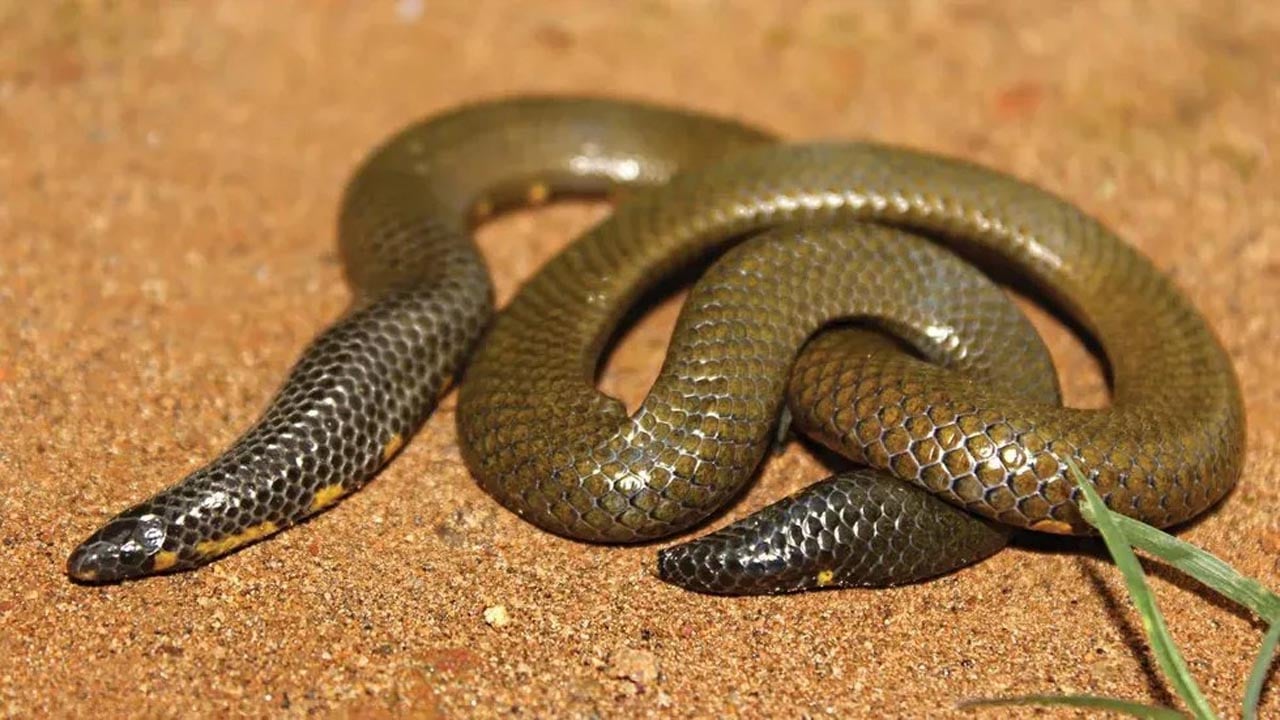
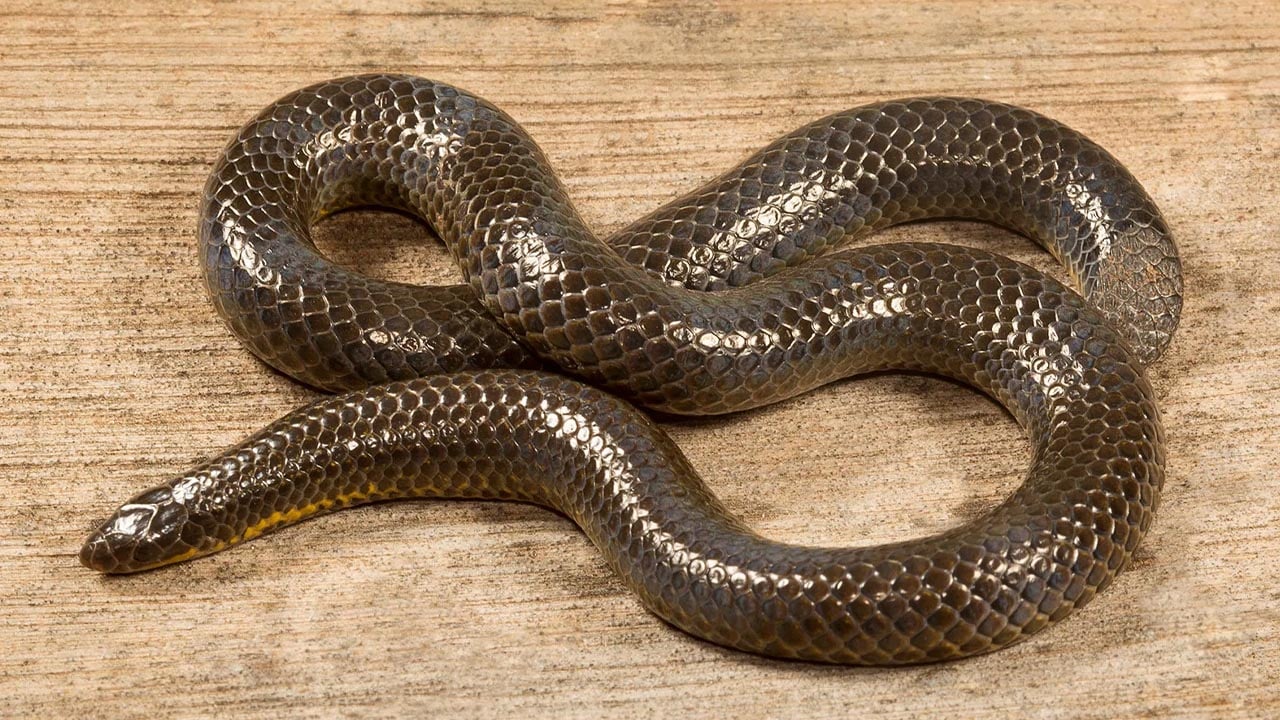
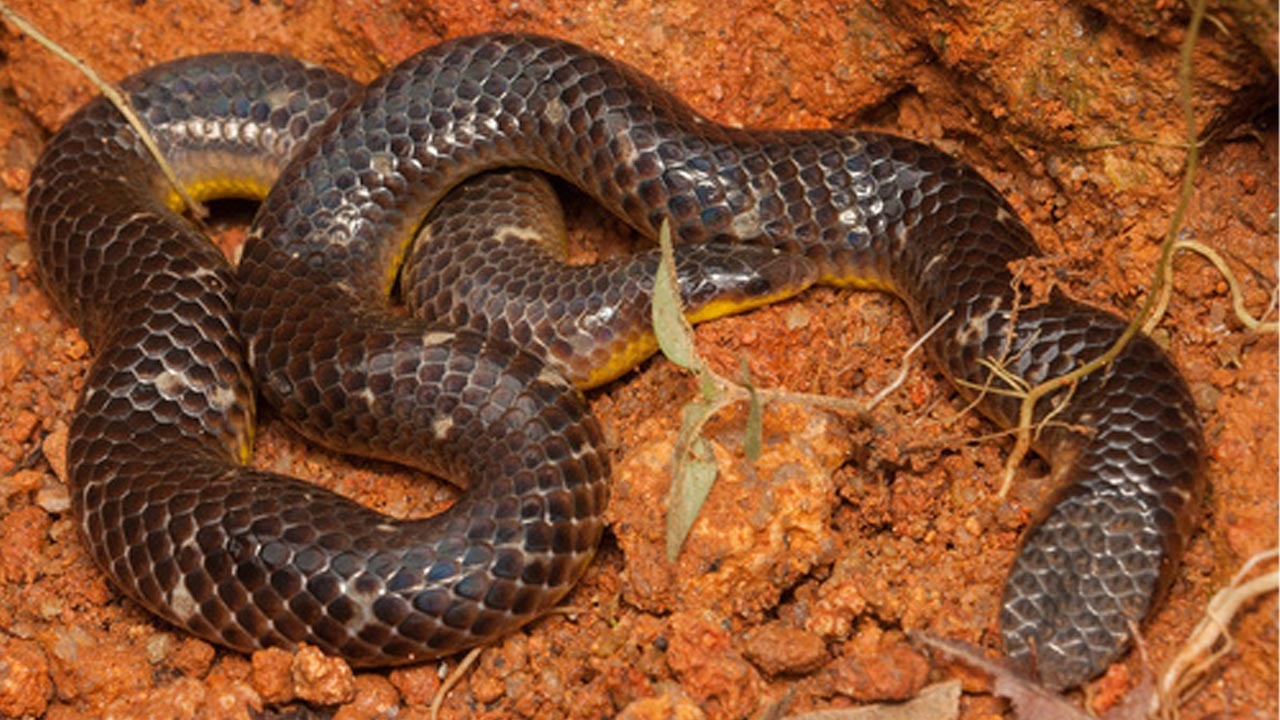
The Large Shieldtail (Uropeltis macrolepis) is one of Sri Lanka's more intriguing endemic reptiles — a secretive, non-venomous burrowing snake that spends most of its life beneath the forest floor. Belonging to the ancient family Uropeltidae, it is rarely seen by casual visitors and even by dedicated herpetologists, which makes any encounter a genuine field achievement.
What does the Large Shieldtail look like?
Adults typically measure between 40 and 60 cm in length, placing Uropeltis macrolepis among the larger representatives of its genus. The body is cylindrical and smooth, covered in glossy scales that range from brown to reddish-brown, sometimes with faint darker patterning along the flanks and a pale cream underside. The head is small, flattened, and barely distinct from the neck — an adaptation that reduces resistance when pushing through compacted soil.
The defining feature is the tail itself. Thickened, flattened, and shield-shaped, it functions both as a brace for digging and as a deterrent to predators approaching from behind. When threatened underground, the snake presents this reinforced tail rather than its vulnerable head — a behavioural strategy that gives the entire Uropeltidae family its common name.
Where in Sri Lanka can the Large Shieldtail be found?
This species is entirely endemic to Sri Lanka, recorded primarily in the central highlands and the southwestern wet zone. It favours humid tropical forests where soils remain loose and moist — conditions found in rainforest interiors, shaded plantations, and the edges of cloud forest. The Sinharaja Forest Reserve, a UNESCO World Heritage Site in the Southern Western Ghats, represents the kind of closed-canopy, high-rainfall habitat that supports this species, along with the montane forests approaching the Horton Plains area.
Because the snake rarely surfaces, elevation and soil moisture matter more than any specific locality. Reports cluster between roughly 300 m and 1,500 m above sea level, with the greatest density of sightings in areas where earthworm biomass is high — reflecting the snake's dietary preferences.
How does the Large Shieldtail behave and what does it eat?
The Large Shieldtail is fossorial by nature, meaning it is built for a life underground. It surfaces only occasionally — often after heavy rain softens the soil or disturbs its tunnels — and is most commonly encountered by farmers or forest workers turning earth rather than by active searchers. Its cylindrical build, smooth scales, and recessed head all reduce friction as it moves through soil.
Diet consists almost entirely of soft-bodied invertebrates encountered during burrowing: earthworms are the primary prey, supplemented by ant and termite larvae. This feeding habit makes shieldtails useful contributors to soil health in forest ecosystems, regulating invertebrate populations in the leaf litter and upper soil layers.
Reproduction follows an ovoviviparous pattern — females retain developing eggs internally and give birth to live young that are fully formed at delivery. Litter sizes in the Uropeltis genus are generally small, which means populations recover slowly from habitat disturbance.
Is the Large Shieldtail venomous or dangerous?
No. Uropeltis macrolepis is completely non-venomous and poses no threat to humans. The species has no heat pits, no venom glands, and no aggressive display behaviour. Its instinctive response to disturbance is to hide its head beneath a coil of its body while presenting the blunt, armoured tail. Handling is not recommended — not for safety reasons but to avoid stressing a rare species — but there is no venom risk.
What threats does the Large Shieldtail face?
The species is not currently listed as Critically Endangered, but its restricted range and highly specialised habitat requirements make it inherently vulnerable. Deforestation for agriculture — including rubber, tea, and cinnamon cultivation — reduces available forest cover, and soil compaction from machinery degrades the loose, moist substrate the snake depends on. Because it is rarely seen and scientifically under-surveyed, population trends are difficult to establish with confidence.
Sri Lanka's wet zone forests have already been reduced to a fraction of their original extent, and remaining fragments are under sustained pressure from smallholder expansion and infrastructure development. Protected areas such as Horton Plains National Park provide partial refuge, but much of the species' range falls on unprotected private or estate land.
How can I see a Large Shieldtail in the wild?
Reliable sightings require patience and an element of luck. The most practical approach is to join a guided night walk or early-morning survey in appropriate wet-zone habitat shortly after rain. Research stations and community naturalist groups operating within Sinharaja and the Knuckles Range occasionally record the species. Turning logs and leaf litter is discouraged in protected areas and should always be done minimally and with replacement if permitted by local rules.
Travel during the inter-monsoon periods — April to May and October to November — when rain is frequent but conditions are warm, tends to produce the most invertebrate activity and the highest chance of shieldtails approaching the surface.
How does the Large Shieldtail fit into Sri Lanka's broader reptile diversity?
Sri Lanka hosts an exceptional density of endemic reptiles relative to its land area — a consequence of the island's geographic isolation and the climatic diversity compressed between sea level and peaks above 2,500 m. The Uropeltidae family is represented across Sri Lanka and the southern tip of India, but several species, including Uropeltis macrolepis, are restricted entirely to the Sri Lankan wet zone.
For naturalists, the Large Shieldtail belongs to the same itinerary as endemic geckos, agamid lizards, and the island's remarkable freshwater fish fauna — species that rarely appear in mainstream wildlife tourism but reward specialist visitors with genuinely unusual observations.
| Attribute | Detail |
|---|---|
| Scientific name | Uropeltis macrolepis |
| Family | Uropeltidae |
| Length | Typically 40–60 cm |
| Venom | Non-venomous |
| Diet | Earthworms, ant and termite larvae |
| Reproduction | Ovoviviparous (live-bearing) |
| Range | Central highlands and southwestern wet zone, Sri Lanka |
| Habitat | Humid tropical forest, loose moist soil |
| Activity | Subterranean, occasionally surface after rain |