
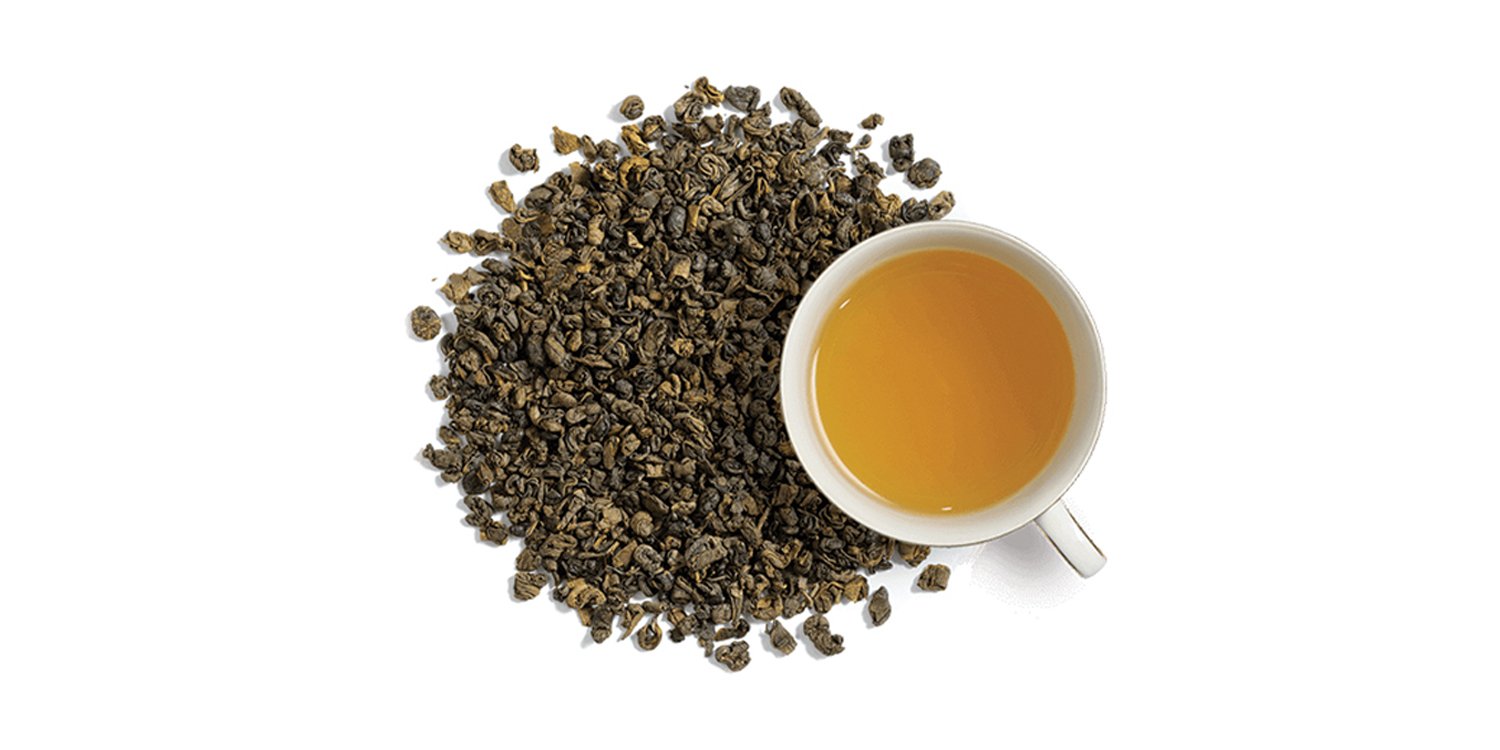
Gunpowder is one of the oldest and most recognisable styles of green tea in the world. Its name comes not from any fiery quality but from its appearance: each leaf is hand-rolled or machine-rolled into a tight, greyish-green pellet that closely resembles a grain of black powder. The rolling technique is deliberate and functional — it slows oxidation, locks in volatile aromatic compounds, and extends the tea's shelf life considerably compared with flat-leaf green teas.
Where does gunpowder tea come from?
Gunpowder tea originated in Zhejiang Province, China, where it has been produced since at least the Tang Dynasty (618–907 AD). The style is most closely associated with the area around Pingshui, which lends its name to one of the most respected regional varieties — Pingshui Gunpowder. From China, the style spread along historic trade routes, eventually reaching North Africa, the Middle East, and Central Asia, where it became a staple ingredient in the cultures of several tea-drinking nations.
Today, gunpowder green tea is also produced in Taiwan and, to a lesser extent, in other Asian tea-growing regions. Sri Lanka, renowned for its orthodox black teas and high-grown Ceylon greens, produces and retails gunpowder-style green teas through several of its established tea houses.
How is gunpowder tea made?
After harvesting, the leaves are withered briefly to reduce moisture, then steamed or pan-fired to halt oxidation — the same fundamental step that keeps all green teas green. What distinguishes gunpowder from other green teas is what happens next: the softened leaves are rolled, either by hand or by machine, into compact spherical pellets. Tighter pellets generally indicate higher quality and a longer shelf life.
- Steamed-then-rolled leaves tend to produce a greener, more vegetal cup.
- Pan-fired-then-rolled leaves, the more traditional Chinese method, yield the slightly smoky, toasty notes the style is famous for.
- The pellet size is loosely graded — finer, more uniform pellets generally command a higher price.
What does gunpowder tea taste like?
Gunpowder has a bolder, more assertive flavour profile than most other green teas. A well-brewed cup delivers a full-bodied infusion with earthy, slightly smoky undertones and a clean, moderately astringent finish. There is typically a hint of bitterness, which is a desirable characteristic when the tea is properly steeped — it signals the presence of catechins and other polyphenols. Lighter, younger-harvest gunpowder teas can show a subtle sweetness alongside the earthiness.
Because of this robustness, gunpowder stands up well to additions that would overwhelm a more delicate green tea. It also holds its character even after the pellets have been stored for several months, provided they are kept away from moisture, heat, and strong odours.
How do you brew gunpowder tea correctly?
The main risk with gunpowder — as with all green teas — is over-heating the water. Boiling water scorches the leaves, accentuating bitterness and masking the tea's more nuanced flavours.
| Parameter | Recommended range |
|---|---|
| Water temperature | 75 °C – 85 °C |
| Leaf quantity | 1 teaspoon (around 2–3 g) per 200 ml |
| Steeping time | 1–3 minutes |
| Re-steeps | 2–3 times (increasing steep time slightly each round) |
Watch the pellets as they steep — they gradually unfurl into full leaves, which is part of the pleasure of brewing this style. Using a glass teapot or cup lets you observe the process directly.
What is gunpowder tea used for beyond plain brewing?
Gunpowder's resilience makes it an ideal base for blended and flavoured preparations. Its most famous application is Moroccan mint tea (atay), in which gunpowder is brewed with generous quantities of fresh spearmint and sweetened with sugar. The tea is poured from a height to create a frothy top, and the ritual of serving it is considered an act of hospitality across the Maghreb region and beyond.
Gunpowder is also commonly used as a base for jasmine tea blends, and it appears in several traditional Chinese medicinal tea formulations. In some preparations it is combined with other green or oolong teas to add body and depth to an otherwise light blend.
How does gunpowder tea compare to other green teas?
Compared with Japanese green teas such as sencha or gyokuro, gunpowder is less vegetal and umami-forward, and more earthy and smoky. Compared with Chinese dragonwell (longjing), it is fuller-bodied and less sweet. It sits closer to a roasted oolong in character than many other green teas, which partly explains its broad appeal across cultures that do not typically favour lighter, grassy teas.
- Caffeine content: moderate, broadly similar to other green teas (typically lower than black tea).
- Antioxidant content: high in catechins, including EGCG, in common with other unoxidised green teas.
- Shelf life: longer than most green teas when stored correctly, owing to the compact pellet form.
How should gunpowder tea be stored?
Store gunpowder in an airtight container away from direct light, heat, and strong-smelling foods. A tin or opaque ceramic jar is preferable to clear glass. Kept in these conditions, good-quality gunpowder can retain its character for up to a year after opening — considerably longer than most flat-leaf green teas.

