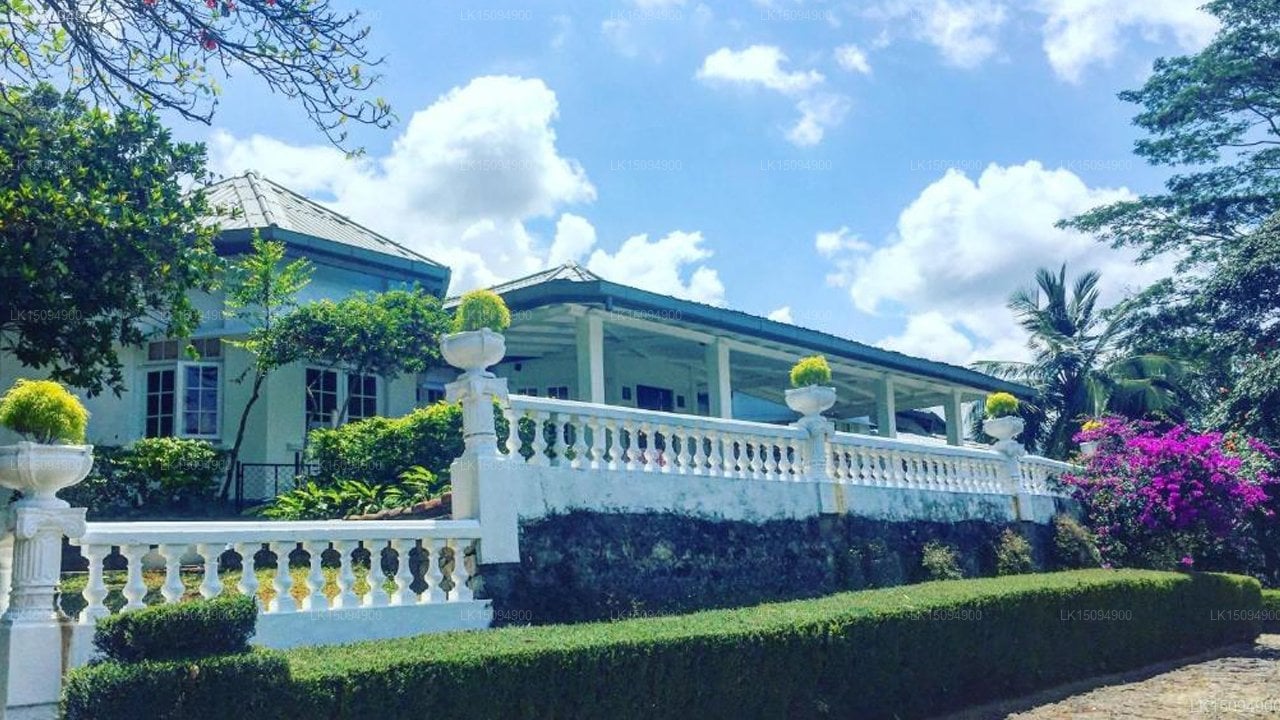
Gadaladeniya sits at around 545 metres above sea level in the Kandy District, roughly 95 km from Colombo by road. Most visitors pass through on the way to or from Kandy City, yet the town itself rewards a short detour — chiefly for a medieval rock temple that has stood here since the fourteenth century and a landscape of rolling paddy fields backed by the central highlands.
What is Gadaladeniya best known for?
The town's defining landmark is the Gadaladeniya Raja Maha Viharaya, a Buddhist temple carved partly into a granite outcrop and constructed in 1344 CE during the reign of King Bhuvanekabahu IV. The main shrine room follows a South Indian Dravidian style — unusual for the Kandyan highlands — with a stone mandapam (porch) of intricately carved pillars. A separate image house behind it adopts a more distinctly Lankan architectural idiom, its roof pitched with hand-cut stone slabs.
Gadaladeniya is one of three celebrated temples in the Kandy area built during the same reign; the others are Lankatilaka and Embekke Devale. Together they form an informal heritage circuit that most culture-focused itineraries cover in a single half-day outing from Kandy.
What can I see at the Gadaladeniya Temple?
The approach path climbs past a small pond and a Bo tree of considerable age before reaching the rock face. Carvings on the outer walls depict elephants, lotus motifs, and guardian figures. Inside, a large seated Buddha image dominates the shrine room, flanked by attendant bodhisattva figures. A Hindu shrine within the complex reflects the syncretic religious character common to many Kandyan-era temples.
A stone inscription near the entrance, dated to the fourteenth century, records the temple's founding and the artisans responsible — one of the more legible medieval epigraphs surviving in the region. The World Heritage context is relevant here: the Sacred City of Kandy, which includes the Temple of the Tooth Relic, lies only a short drive away, and many scholars regard the Gadaladeniya–Lankatilaka–Embekke cluster as an extension of Kandy's outstanding universal value.
When is the best time to visit Gadaladeniya?
The Kandy District receives two monsoon influences, so there is rarely a completely dry month. That said, the period from January through April tends to offer the most settled weather for sightseeing, with lower humidity and good visibility across the hills. July and August bring the Kandy Esala Perahera — one of Asia's most elaborate procession festivals — which draws large crowds to the entire district; booking transport well in advance is advisable during this period.
The temple itself is generally accessible year-round, though heavy rain can make the stone steps slippery. Morning visits are quieter and cooler; afternoon light tends to illuminate the carved interiors more warmly.
How do I get to Gadaladeniya from Colombo?
The most straightforward option is a private transfer along the Colombo–Kandy expressway (E01) and then the A1 highway toward Peradeniya, branching off toward Gadaladeniya on a secondary road. Journey times vary with traffic but typically fall between two and a half and three hours. Lakpura arranges intercity transfers on this route in air-conditioned vehicles with experienced chauffeur-guides who can narrate the landscape along the way.
Visitors arriving at Bandaranaike International Airport can also arrange a direct airport-to-Gadaladeniya run; fares are quoted per route at the time of booking. The nearest rail station is Peradeniya Junction, about 8 km from the temple; from there a tuk-tuk or taxi completes the journey.
| Detail | Information |
|---|---|
| Road distance from Colombo | Approximately 95 km |
| Elevation | About 545 m above sea level |
| Nearest city | Kandy (around 15 km) |
| Key landmark | Gadaladeniya Raja Maha Viharaya (built 1344 CE) |
| Architectural style | Dravidian stone mandapam with Kandyan roof elements |
| Combined day-trip options | Lankatilaka Temple, Embekke Devale, Peradeniya Botanical Garden |
What else is near Gadaladeniya?
The Royal Botanic Gardens at Peradeniya, one of the finest botanical collections in Asia, lie roughly 8 km to the east. The gardens cover over 147 acres and include an avenue of royal palms, an orchid house, and a collection of ayurvedic medicinal plants that illustrates Sri Lanka's long tradition of herbal medicine.
Kandy City, with the Temple of the Tooth Relic at its centre, is the obvious base for exploring this area. Day-trippers can combine Gadaladeniya with Lankatilaka and Embekke in a morning, then spend the afternoon in Kandy before the evening puja ceremony at the Tooth Temple. The market town of Dambulla and the plain of ancient Polonnaruwa lie further north for those extending their itinerary into the Cultural Triangle.
Is Gadaladeniya suitable for a day trip from Kandy?
Yes — the temple is compact enough to explore thoroughly in under an hour, making it an easy addition to a Kandy-based itinerary rather than a standalone destination. The scenic drive through tea-fringed hills and small villages adds considerable charm to the outing. Comfortable walking shoes are recommended for the stone paths leading to the temple; modest dress (covered shoulders and knees) is required as an act of religious respect.
For travellers interested in a more immersive experience of highland village life, local guides can arrange walking routes through the surrounding farmland, where cinnamon, pepper, and arecanut are still grown in smallholder plots much as they were in medieval times.
Nearby places
9 places within about 25 km, nearest first.