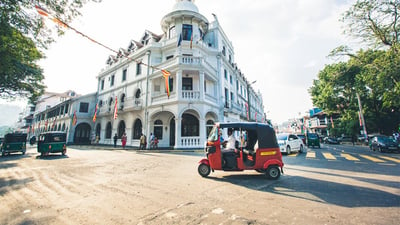
Perched on the edge of the Kadugannawa Pass, just a few metres before the road crests the ridge on the Colombo-to-Kandy route, Kadugannawa Ambalama is one of Sri Lanka's most quietly significant historic structures. Easy to miss if you are not looking for it — it sits on the left as traffic climbs toward Kandy — this small wayside pavilion has stood for more than two centuries, watching an unbroken stream of merchants, horsemen, pilgrims, and now motorists pass through one of the island's most dramatic mountain gateways.
What is an Ambalama, and why does Kadugannawa have one?
An ambalama is a traditional Sri Lankan rest shelter, historically built at intervals along busy trade and pilgrimage routes to give travellers a shaded place to stop, drink water, and recover from the road. The concept predates the colonial period, rooted in the Buddhist merit of providing hospitality to strangers. Kadugannawa Pass sits at roughly 500 metres above sea level on the old highland route connecting the coastal lowlands with the Kandyan kingdom, making it a natural and necessary rest point for anyone making the steep ascent on foot or horseback.
This particular ambalama was constructed during the early decades of British colonial rule in Ceylon — most likely in the first quarter of the 19th century — placing it in the same era as the construction of the Colombo–Kandy road itself. Travellers carrying spices, cloth, and highland produce would have rested here before the final push into Kandy, or gathered their strength for the descent toward Colombo and the coast.
What architectural style does the Kadugannawa Ambalama represent?
The structure is a clear example of Kandyan-era vernacular architecture, characterised by a low-pitched roof with wide overhanging eaves designed to provide maximum shade, heavy timber columns, and open sides that allow air to circulate freely. Unlike the grand temples and audience halls of the Kandyan kingdom, an ambalama was always a functional, unpretentious building — its sophistication lies in its proportions and in the quality of its joinery rather than in decorative elaboration.
That restraint is precisely what makes structures like this archaeologically valuable. They represent everyday colonial and pre-colonial building practice rather than the ceremonial architecture that more typically survives. The Kadugannawa Ambalama retains enough original fabric to be studied as a physical document of how ordinary infrastructure was built in early 19th-century Ceylon. Visitors interested in Kandyan heritage will find natural connections with the broader cultural landscape that surrounds Kandy, the ancient hill capital the ambalama once served.
What is the conservation history of the Ambalama?
The structure was renovated by Sri Lanka's Ministry of Tourism, working under the technical guidance of the Department of Archaeology. The project prioritised restoring the building's structural integrity and its authentic character rather than undertaking a wholesale reconstruction. Following that intervention, the Kadugannawa Ambalama was formally recognised as a national heritage item — a designation that places it under legal protection and acknowledges its cultural and historical importance.
Recognition as a national heritage site also means the building cannot be altered or demolished without government approval, which provides a degree of long-term security unusual for this category of minor historic monument. Many ambalama across Sri Lanka have disappeared quietly as roads were widened and surrounding land was developed; the Kadugannawa example survives partly because its location on a well-travelled highway kept it visible and partly because of that formal protection.
Where exactly is the Kadugannawa Ambalama, and how do I find it?
The ambalama stands on the A1 Colombo–Kandy highway, very close to the Kadugannawa Pass. When travelling from Colombo, watch for it on the left-hand side of the road a short distance before the pass itself. The town of Kadugannawa sits roughly 12 kilometres west of Kandy city, making this an easy stop for anyone travelling the route by private car or hired vehicle.
Because the A1 carries heavy traffic, stopping requires care. The safest approach is to plan a brief pull-over in advance rather than stopping impulsively. Drivers familiar with the road will know the spot; if you are travelling with a Lakpura driver-guide, mention your interest before the journey so the stop can be scheduled without interrupting traffic flow.
What else can I see near Kadugannawa?
The Kadugannawa Pass area rewards slow travel. The pass itself offers panoramic views across the Kandy valley, and the hillsides along the descent toward Kandy are lined with Ceylon tea smallholdings and patches of tropical forest. Several colonial-era engineering works survive in the vicinity, including sections of the old Colombo–Kandy road that predate the current highway alignment.
- Kadugannawa Railway Tunnel: One of the oldest railway tunnels in Sri Lanka, bored through the ridge as part of the original Colombo–Kandy line.
- Alugama Clock Tower: A colonial landmark visible on the approach to Kadugannawa from the lowland side.
- Kandy city: The cultural heart of the central highlands, approximately 12 kilometres east, with the Temple of the Tooth Relic and the Esala Perahera Festival as its best-known draws.
- Peradeniya Botanical Gardens: Sri Lanka's national botanical gardens, a short distance toward Kandy on the same highway.
Is the Kadugannawa Ambalama worth a dedicated visit?
The ambalama is not a destination in itself in the way that a major temple or national park would be. It is best understood as a meaningful pause within a longer journey — a moment to step off the road, stand inside a structure that served the same function for generations of travellers before you, and think about the human geography of the Kandy route before the age of the motor car. That kind of contextual, unhurried encounter with a historic place often leaves a more lasting impression than a rushed walk through a crowded monument.
For travellers with a genuine interest in Sri Lanka's colonial architecture, vernacular building traditions, or the history of the Kandyan kingdom, the stop repays the few minutes it requires. It pairs naturally with a visit to the Kandy Tourist Information Center, where staff can provide additional context on the broader heritage of the region.
What is the significance of the Kadugannawa Pass in Sri Lankan history?
The pass was strategically critical to the Kandyan kingdom precisely because it was one of the few practical routes through the central highlands from the western coast. Controlling the pass meant controlling access to Kandy, and the difficulty of the ascent — particularly for armies moving with heavy equipment — was one of the natural defences that helped the Kandyan kings resist European colonial powers for longer than the lowland kingdoms. The British eventually built a proper road through the pass in the early 19th century, and the opening of that road fundamentally changed the relationship between the highland capital and the coast, accelerating the integration of Kandy into the colonial economy. The ambalama dates from precisely that transitional moment.
Nearby places
11 places within about 25 km, nearest first.
- Elamaldeniyaunder 1 km
- Balana2 km
- Balana Fort2 km
- Kadugannawa2 km
- Kadugannawa View Point2 km
- Kadugannawa Rock Tunnel2 km
- Lankathilaka Viharaya3 km
- Kadugannawa Railway Station3 km
- Gadaladeniya City3 km
- Giraagama City5 km
- Hingula City6 km
Related reading
3 pages on closely related subjects.