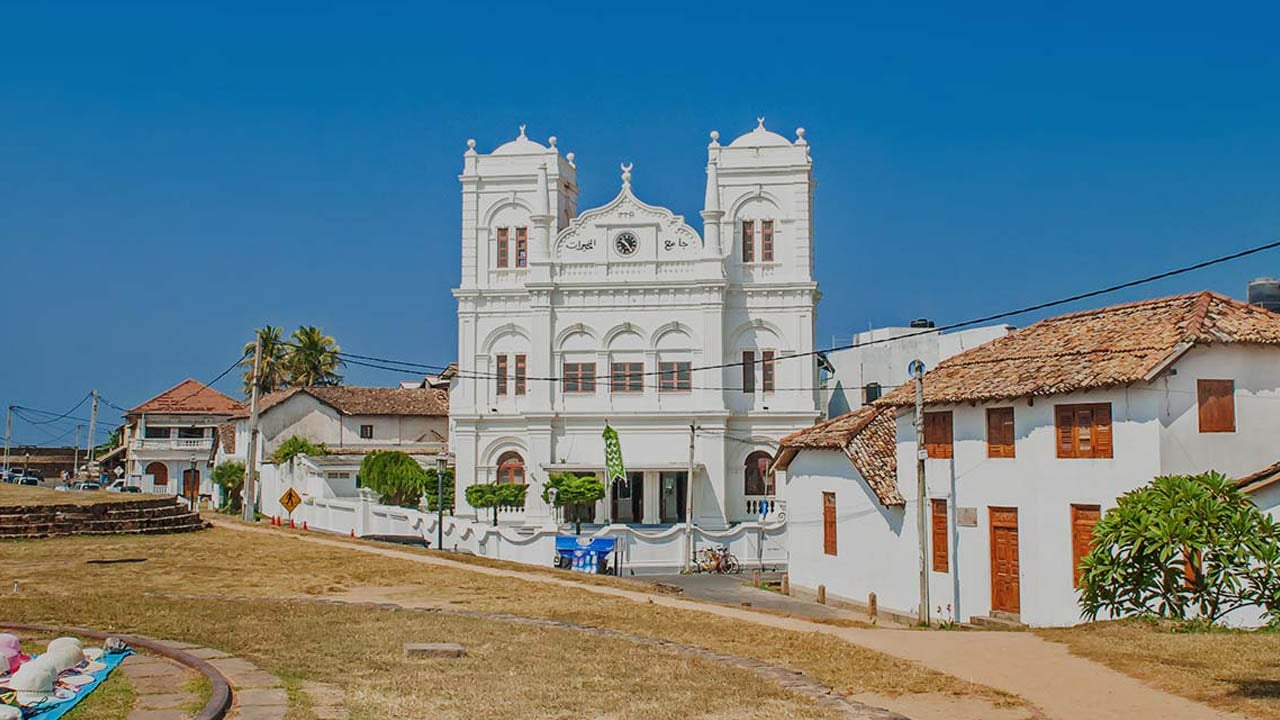


Meeran Masjid is the largest and most historically significant mosque within the walls of Galle Fort. Standing in a neighborhood that has sustained a Muslim community for centuries, the mosque is a quiet but important landmark inside one of South Asia's best-preserved colonial fortifications. Visitors who take the time to step inside find an interior that contrasts vividly with the fort's austere Dutch stonework — colourful hand-laid floor tiles, intricately worked stained glass, and a prayer hall whose proportions feel far larger than the narrow lane outside might suggest.
How old is Meeran Masjid?
The mosque is believed to be around 300 years old, placing its origins in the late 17th or early 18th century — a period when Arab and Malay traders were a significant presence along Sri Lanka's southern coast. The current structure was substantially refurbished approximately 120 years ago, which accounts for much of the ornamental tilework and stained glass visible today. The name Meeran is a title of honour used in South Asian Islamic tradition, while Masjid is simply the Arabic word for mosque.
What makes Meeran Masjid worth visiting?
The main prayer hall is the architectural highlight. The floor is covered in patterned ceramic tiles that draw the eye down a long, airy nave, while stained glass filters the tropical light into warm colour across whitewashed walls. The craftsmanship reflects the Indo-Islamic decorative tradition that arrived with traders from the Arabian Peninsula and the Malabar Coast, then evolved through local artisans over generations.
Galle Fort itself is a rich destination for a half-day city tour, and Meeran Masjid sits alongside Dutch Reformed churches, a Buddhist temple, and a Hindu kovil within a few hundred metres — a density of living religious sites found almost nowhere else in Sri Lanka.
What is the Muslim community's connection to Galle Fort?
Galle has one of the highest concentrations of Sri Lankan Muslims — known locally as Sri Lanka Moors — in the southern province, and the Fort neighbourhood has been a Muslim residential area for several centuries. The community traces its ancestry largely to Arab and Persian traders who settled along the coast during the pre-colonial period, long before the Portuguese arrived in the early 16th century. Meeran Masjid remains an active place of worship central to this community's daily religious life, not merely a heritage attraction.
Can women visit Meeran Masjid?
Women are welcome to visit and pray at Meeran Masjid. A dedicated women's prayer room was added relatively recently, providing a separate space within the mosque complex. It is worth noting that the women's section is located apart from the main hall, so female visitors do not see the principal interior from the same vantage point as men. Nevertheless, the mosque is by no means an exclusively male space — women attend regularly, particularly during Ramadan, when congregational Tarawih prayers in the evenings draw large numbers of worshippers of all ages.
The common assumption that mosques are solely for men is a misconception. While Friday Jumu'ah prayer carries a specific obligation for Muslim men, women participate in mosque life throughout the week and especially during significant religious periods. If you are a non-Muslim visitor, it is courteous to dress modestly (shoulders and knees covered), remove footwear at the entrance, and observe any quiet or prayer periods respectfully.
How do I get to Meeran Masjid inside Galle Fort?
The mosque is situated on Leyn Baan Street within the Fort — one of the quieter residential lanes running parallel to the ramparts. The fort's main gate from Galle town is the most straightforward entry point on foot. From there, the mosque is a short walk through the fort's grid of streets. Galle itself is roughly two hours by road from Colombo along the Southern Expressway, or reachable by train along the scenic coastal line. The fort is compact enough that most visitors explore it on foot once inside.
What else can I see near Meeran Masjid?
The fort packs an unusual variety of heritage into a small area. The Dutch Reformed Church (Groote Kerk), the Galle Fort Museum, the old lighthouse, and the rampart walks are all within easy walking distance. Madu Ganga, the island-dotted estuary north of Galle, makes a natural half-day extension for those interested in the region's natural landscape. The southern coast's turtle hatcheries at Kosgoda and Koggala are also within reach for visitors spending a night or two in the area.
| Detail | Information |
|---|---|
| Location | Leyn Baan Street, Galle Fort, Southern Province |
| Estimated age | Around 300 years (refurbished approximately 120 years ago) |
| Admission | Free (non-Muslim visitors welcome outside prayer times) |
| Dress code | Modest dress required; head covering advisable for women |
| Active prayer times | Five daily prayers; busiest on Fridays at midday |
Tips for respectful visits
- Remove shoes before entering the mosque premises.
- Avoid visiting during the five daily prayer times if you are there purely as a sightseer — the prayers typically last 10–20 minutes and you can wait just outside.
- Women should bring a scarf or shawl to cover their hair; some mosques provide these at the entrance but it is best to come prepared.
- Photography inside active prayer halls is generally not welcomed during prayers — ask first and be guided by what worshippers indicate.
- Speak quietly and move slowly through the space; this is a working house of worship, not a museum.
Nearby places
16 places within about 25 km, nearest first.
- All Saints' Church Galle Fortunder 1 km
- Old Dutch Hospital Galle Fortunder 1 km
- Galle Beachunder 1 km
- Barbarin Lighthouseunder 1 km
- Church Streetunder 1 km
- Galle Clock Towerunder 1 km
- Galle Dutch Fortunder 1 km
- Galle Fort Entranceunder 1 km
- Galle International Cricket Stadiumunder 1 km
- Galle Portunder 1 km
- National Maritime Museum Galleunder 1 km
- St Joseph's Chapelunder 1 km
- The Old Dutch Government Houseunder 1 km
- Zwart Bastion (Black Fort)under 1 km
- Neptune Bastionunder 1 km
- Shipwreck Divingunder 1 km